


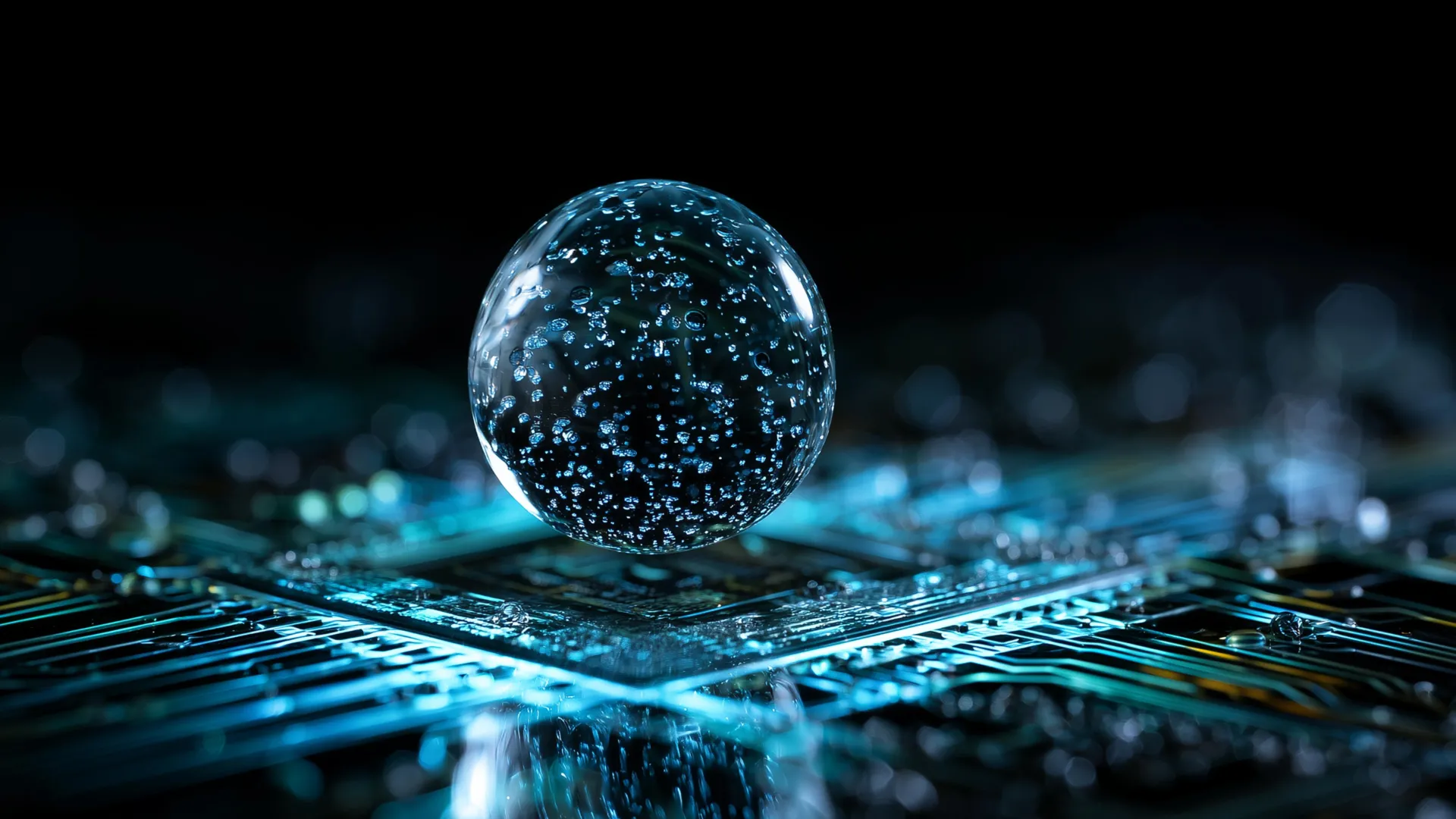
Researchers at Tokyo Metropolitan University have developed a new way to control ink drying by adding ultrafine bubbles to ink droplets instead of chemical additives. The researchers found that by simply changing the number of air bubbles within each droplet, they could dramatically change the pattern that remains when the liquid evaporates. This approach may be particularly valuable for manufacturing small electronic devices where residual additives can interfere with the performance of printed materials.
Inkjet printing is no longer just used for documents and images. This has become an essential manufacturing technique for advanced technologies such as microelectronics and MEMS (microelectromechanical systems), where fine coatings and complex circuit patterns need to be deposited with very high precision.
The big challenge is controlling what happens after each droplet hits the surface. When a liquid dries, suspended particles can collect in an uneven pattern. One of the most well-known examples is the “coffee ring” effect. In this effect, most of the solid material collects around the outer edge of the droplet, similar to the stain left by a dry coffee drop.
Manufacturers often add chemicals that change the surface tension of the liquid to create a smoother, more uniform coating. However, these additives can remain after drying and change the behavior of the print, which is undesirable for many advanced applications.
Control dryness with ultra-fine bubbles
To get around this problem, the research team led by Professor Arata Kaneko took a different approach. Rather than modifying the ink with surfactants or chemically altering the particles, they dispersed nanoscale, ultra-fine bubbles throughout the liquid.
For the experiment, the researchers suspended silica nanoparticles in water and passed the mixture through an ultra-fine bubble generator. They then deposited 1 nanoliter droplets onto a silicon substrate using an inkjet nozzle and allowed them to dry.
The results showed that the bubbles gave the researchers significant control over the final particle pattern. The foam-free droplets produced a noticeable coffee ring effect. Introducing a moderate number of bubbles created a more uniform coating, but further increasing the bubble concentration instead caused the particles to cluster closer to the center of the droplet. The bubbles did not change the charge-containing nanoparticles themselves. Instead, they changed the surface tension of the liquid and the way the liquid spreads across the surface.
Cleaner printing for advanced electronics
One of the biggest advantages of this technique is that as the droplets dry, the bubbles completely disappear, leaving no residue behind. Therefore, this method is particularly useful when the original properties of the nanoparticles need to remain unchanged.
For example, graphene and molybdenum dioxide nanoparticles are often used in gas sensors because their conductivity changes when they absorb gas. The sensitivity of these sensors is highly dependent on the shape of the printed deposit. Conductive nanoparticles used in electronic circuits also perform best when their surfaces are kept as clean and pure as possible.
Because the ultrafine bubbles disappear after drying, the researchers believe this method could provide a cleaner and more precise way to fabricate next-generation microdevices without the drawbacks of traditional ink additives.
This research was supported by JSPS KAKENHI grant numbers JP22H01377 and JP25K01136, and the JKA Promotion Fund under grant number 2024M-394.
