


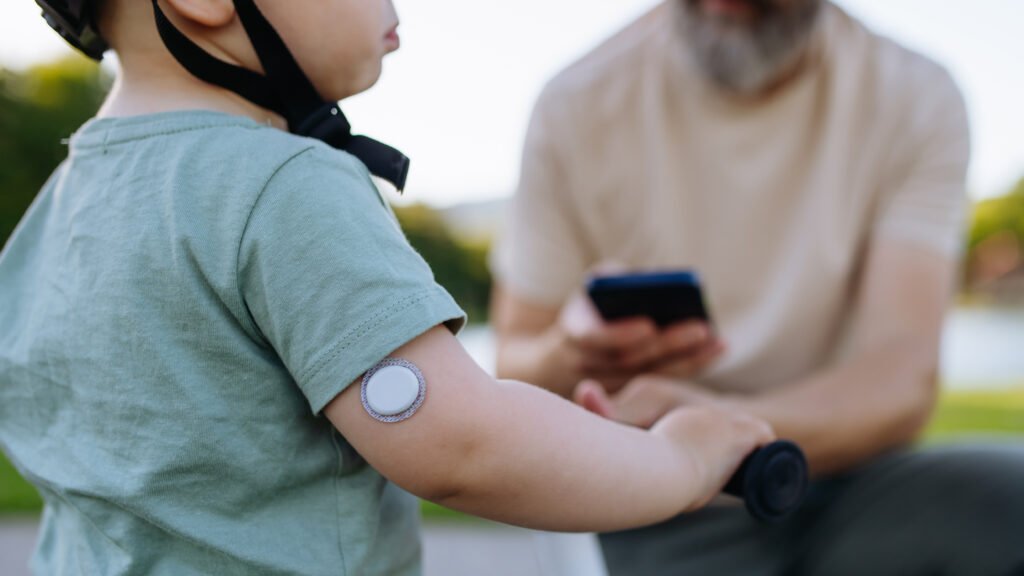
You Get a CGM, You Get a CGM, Everyone Gets a CGM?For the first time in the United States, children ages 2 and older can now receive continuous blood glucose monitoring without a doctor’s prescription.
Is that a good thing? The Food and Drug Administration thinks so.
“By providing real-time blood sugar data, these devices can help pediatric patients and their caregivers become more aware of their blood sugar, track patterns of response to diet and exercise, and make informed adjustments to support healthier long-term outcomes and quality of life,” the agency wrote last month when it granted marketing permission for Dexcom’s Stelo.
However, experts have mixed views on how the use of CGM in stores affects children. Some clinicians argue that collecting more data on children at high risk for diabetes could inform clinical interventions. Some worry that the onslaught of information will create a culture that places too much emphasis on data, leading to unnecessary panic and restrictive eating behaviors.
“Many of the health trends we see in our culture today are directed at our families,” said Wendy Schafer, a pediatrician who specializes in eating disorder prevention. “It’s really premature at this point to consider[CGM]as part of the clinical standard of care, much less as part of an over-the-counter drug. We don’t have enough information, let alone enough guidance, to really help families understand what this tool offers and how to use it without harming their child.”

Could new childhood obesity guidelines encourage eating disorders?
A CGM is a wearable device that uses a needle inserted into the skin and a small sensor placed under the skin to sample blood sugar levels around the clock and record the values every 15 minutes. They are touted as a way to combat chronic diseases that are starting early in the United States. It is estimated that one in three adolescents has prediabetes or type 2 diabetes, and one in five children is obese. Without meaningful intervention, children are more likely to carry these chronic diseases into adulthood, putting them at risk for progression to diabetes, metabolic syndrome, and other health problems.
CGMs are also a popular topic for MAHA advocates, with Secretary of Health Robert F. Kennedy Jr. advocating for Americans to use CGMs and other medical technology wearables to collect their own health data. Expanding in-store sales to children opens up a huge new market of potential customers for Dexcom. These customers may also include “health-conscious” parents who use CGM themselves and are starting to consider extending their health obsession to their children.
In support of this decision, the FDA’s premarket notification points to clinical trials involving participants 2 years of age and older. This study is related to one study in children and adolescents with type 1 diabetes who used Dexcom G7 prescription CGM but not Stelo. Other CGM companies may follow suit and seek approval for commercially available pediatric devices.
Possibility of blood sugar level monitoring
The American Academy of Pediatrics told STAT it has not yet reached a position on the use of commercial CGM in children and adolescents. But some clinicians shared some temporary excitement.
Kristen Nadeau, a pediatric endocrinologist at Children’s Hospital Colorado, sees children with obesity, prediabetes, and diabetes and regularly prescribes CGM. She thought Stelo could be a more affordable option. “This has the potential to increase access for underserved populations,” Nadeau said. The biggest barrier to using CGM for her patients is accessibility. High out-of-pocket costs and lack of insurance coverage for children not receiving insulin therapy particularly limit high-risk patients with diabetes who may benefit from CGM before insulin is required.
Dexcom said these devices will expand “access to glucose insights for millions of families as young-onset type 2 diabetes continues to rise,” especially for patients who don’t have access to prescription options. Prescription CGM is specifically indicated for use in diabetic patients requiring insulin therapy. However, Stelo is not only approved for use in diabetic patients who are not taking insulin, it is also widely approved for people who want to understand how their lifestyle affects their blood sugar.
Stelo costs $99 per month for two sensors for 15 days, an applicator and adhesive patch to keep the device in place. Stelo’s companion app is free. As over-the-counter CGMs become more available and affordable, Julie Wilson, a clinical dietitian and certified diabetes care and education specialist at Rady Children’s Health in San Diego, believes the devices may have a greater impact on blood sugar levels than traditional education by medical professionals.
“It’s going to give them a little bit more knowledge, it’s going to give them a little more ability to understand what’s going on. … I think it’s going to cause a change in diet,” she said. Wilson, who has type 1 diabetes and uses a CGM herself, said that among her patients, those who benefit most from using over-the-counter CGMs are those who are obese, prediabetic, and have type 2 diabetes who are not using insulin, and who typically do not have insurance coverage for prescription devices.
Pediatric blood glucose data are limited
A potential downside to increased access to CGMs is that “healthy” children without diabetes, elevated blood sugar levels, or obesity will also have access to these devices, but experts are unsure how this will affect them. “There’s a bit of a ‘missing the cart,'” Professor Nadeau said, noting there was not enough data on the range of “normal” blood sugar levels in children without diabetes.
Nadeau and researchers across the country are collaborating on the DISCOVERY trial, a study of blood sugar levels across adolescence in children with high body mass index, family history, or other risk factors for diabetes. She hopes this study will help fill gaps in knowledge about the range of blood sugar levels at which children are at high risk for diabetes during key growth and development years. The trial will enroll approximately 3,600 children between the ages of 8 and 15 in the longitudinal study, excluding younger and older children and those not at high risk for diabetes.
Insufficient data on “normal” blood glucose levels in children without diabetes can make interpretation of CGM data difficult, especially when clinicians are not involved. In one study that evaluated a range of blood sugar levels across multiple age groups, participants, including children, reported experiencing both hypoglycemic and hyperglycemic episodes during the trial, even though they maintained normal blood sugar levels for the majority of the trial. Blood sugar levels fluctuate throughout the day in response to eating, sleep, and activity. Significant fluctuations in CGM values can cause parents to overreact.


STAT Plus: Continuous blood sugar monitoring for the masses is here. Are you ready?
“I’m worried that my kids will be told, ‘The last time I ate a cupcake, my blood sugar went up too high, so I’m not allowed to eat a cupcake again,'” Wilson said. She said if diets are too restrictive, it can cause friction between parents and children, leading to children sneaking food or developing an unhealthy relationship with food. Wilson points out that families need help learning how to interpret CGM values. Factors such as language barriers and family culture can also complicate how parents and children work with data.
The Stelo website and phone apps used with your device currently contain information that is relevant only to adult users. Dexcom did not respond to questions about its plans to add information specifically for pediatric users and their families.
Laura Barros Jackson, RD, a registered dietitian in the Pediatric Weight Management and Obesity Clinic at King’s Daughters Children’s Hospital in Norfolk, Virginia, worries that using CGMs can lead children and families to focus on food intake based on blood sugar response and away from a diverse, balanced diet. “Many nutritious foods contain carbohydrates. Growing brains and bodies need carbohydrates to grow,” she said.
Risk of eating disorders in children and teens
Another potential risk is that CGM use may lead to excessive dietary control and eating disorders, as eating disorders in children and adolescents are on the rise worldwide.
An FDA news release states that patients with a history of eating disorders should consult their health care provider before using Stelo. But experts say eating disorders are under-recognized in the United States. Producing large amounts of data for children and families to make health decisions could be counterproductive, multiple experts told STAT.
“Certainly if you pay too much attention to fluctuations that may be normal, or use them as a way to get feedback about dietary restrictions or certain types of foods, that can lead to disrupted eating patterns,” Nadeau says.
Schafer said many people are focused on getting as much information as possible about their bodies, but are concerned about how that information is handled. “This fosters orthorexia (an obsession with healthy eating),” Schafer said. Parental orthorexia can affect how children are fed, and parental dietary management plays a role in the development of a child’s future mental health and fight against orthorexia, Schafer said. Considering all these risks, she suggests discussing your child and family’s goals with your health care provider to determine if CGM is the right tool for you.
She challenged the assumption that all children at high risk for diabetes would benefit from access to CGM. “If we continue to look at diabetes and obesity as the big bad wolf and don’t understand what’s going on with each child, we’re putting them at serious risk of harm,” Schafer said.
“When ‘health’ boils down to numbers, it’s normal to want to react and modify individual numbers,” Schafer says. “That means parents are more number-conscious than their children.”
