


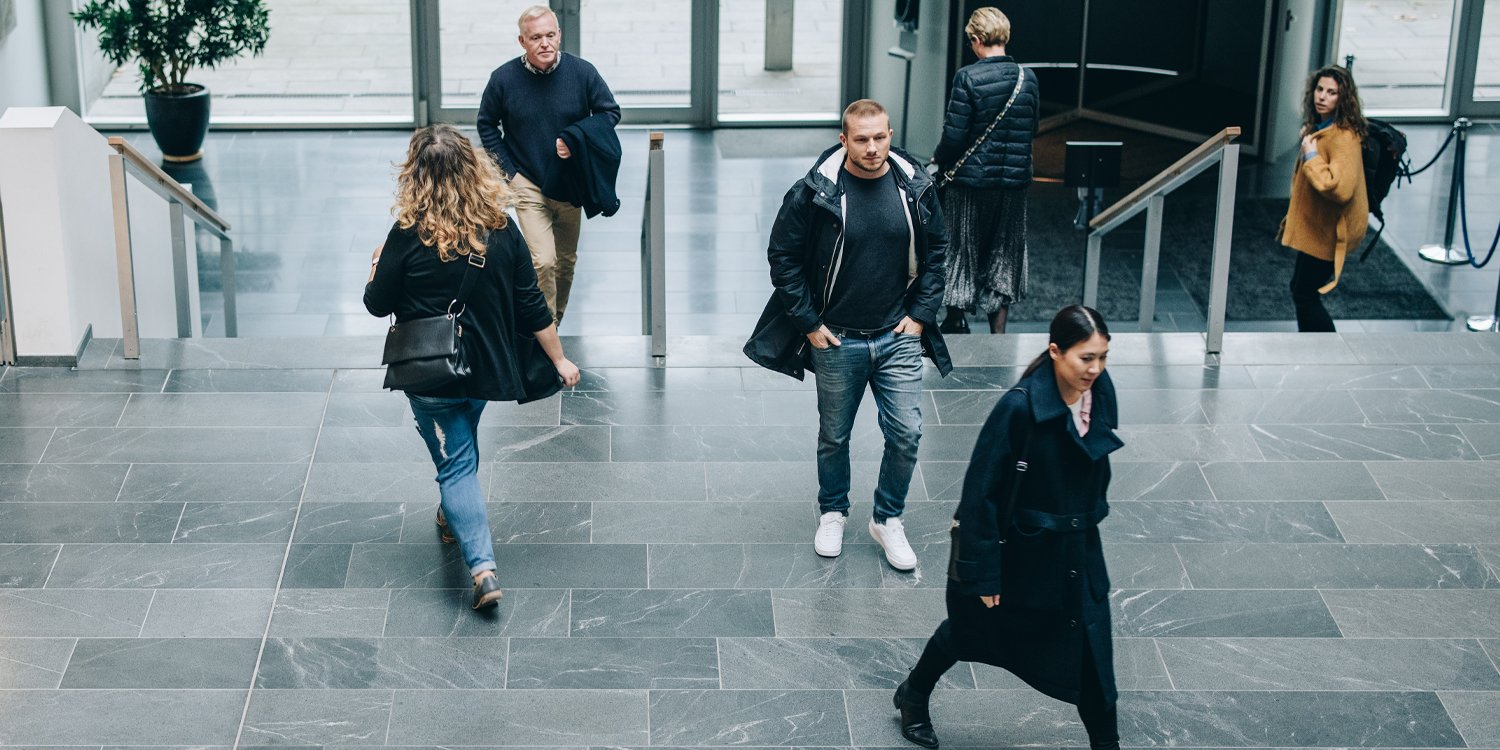
When humans walk freely in open or enclosed spaces, they naturally tend to turn in a counterclockwise direction. This individual bias provides evidence that essential individual tendencies shape the way large crowds organize spontaneously. These findings published in the journal nature communicationsproposes a new way to understand human movement.
In studying pedestrian dynamics, scientists observe how large groups move together in shared spaces. In crowded places, people often spontaneously form opposing lanes or take turns like zippers when passing through narrow doorways. These patterns are known as emergent behavior. Emergent behavior occurs when simple actions taken by individuals combine to form complex, coordinated group patterns without a central leader.
Until now, experts believed that these collective crowding patterns resulted primarily from social interactions and environmental boundaries. For example, if people move to the right to avoid a collision, the entire group may end up rotating in a certain direction near a wall. Other theories suggest that learned social habits, such as driving on a particular side of the road, determine how crowds move.
To test these hypotheses, an international research team designed an experiment to determine whether the counterclockwise rotation seen in crowds is a social phenomenon or a built-in personal bias. The research team was led by Iñaki Echeverría Huarte, a researcher at the Department of Physics and Applied Mathematics at the Faculty of Science of the University of Navarra in Pamplona, Spain. Researchers from Waseda University, the University of Tokyo, Shanghai Polytechnic University, and Carlos III University of Madrid participated in this project.
Echeverría Huarte said the project was a collaborative effort born out of years of patient experimentation. In fact, the initial discovery was completely by chance. “It was a complete coincidence,” he told SciPost. “During the COVID-19 pandemic, we were experimenting with social distancing and trying to understand how many people could safely share a room. While analyzing the footage, we happened to notice that people continued to walk counterclockwise.”
That unexpected observation became the starting point for everything that followed. To formally study this behavior, the authors conducted an initial experiment at the University of Navarra. They recruited 50 adult participants and placed them in a confined circular area with a radius of 5 meters. Participants were instructed to walk randomly several times at intervals of approximately 40 seconds. A camera placed 10 meters above the area recorded their exact trajectory at 15 frames per second.
Before the walking test, the researchers tested whether each person turned left or right toward a wall. These people were then mixed into groups of varying sizes and combinations. To track rotation, the scientists calculated a mathematical score of collective motion and measured whether a group preferred one direction.
Results showed persistent counterclockwise rotation across all groups. This occurred regardless of the overall group density or the proportion of people who preferred to turn right. “If you ask a group of people to roam freely, with no rules or instructions, they are very likely to go counterclockwise,” Echeverría Huarte says. He called this a playful little fact about human behavior that most people never realize.
To see if walls cause this rotation, the authors moved their next experiment to open space. They observed 107 teenagers aged 13 to 14 walking freely across a 50 x 60 meter schoolyard. The drone recorded the students from 40 meters above the ground, capturing video at 30 frames per second. The researchers used a custom computer program to track every student’s walking speed and location.
Despite having no physical boundaries to guide their movements, the teenagers consistently rotated in a counterclockwise direction as a group. The mathematical distribution of their walking paths matched the results in the enclosed arena. This suggests that interactions with walls and fences are not the main source of rotational bias.
Next, the researchers traveled to Japan to test the collision avoidance theory. In Spain, pedestrians usually move to the right to avoid hitting oncoming people. In Japan, pedestrians generally walk on the left, and the researchers confirmed this through a preliminary photo study. If stepping aside caused group rotation, Japanese participants should have rotated clockwise.
The team recruited 39 adults and asked them to walk randomly through a circular enclosure with a radius of 4 meters. Participants wore colored hats to help tracking software map their precise coordinates. Surprisingly, the Japanese group also showed consistent counterclockwise rotation. This finding disproves the idea that local conflict avoidance maneuvers drive group movement patterns.
Echeverria Huarte said the results repeatedly surprised the research team. “The biggest surprise happened in Japan, where road traffic and voluntary pedestrian lanes were moving in the opposite direction to Spain, so we were confident that the rotation would be reversed in Japan,” Echeverría Huarte said. “When my colleague Claudio Feliciani sent me the first video from Tokyo, my immediate reaction was, ‘Oh my god, it’s counterclockwise again!’ Its robustness across cultures is what makes this product so impressive.”
The researchers also wanted to investigate whether learned adult rules influenced this behavior. They analyzed existing video data of preschoolers running around freely during musical activities in a Japanese nursery school. Children under the age of six have not yet fully absorbed adult social rules, so their behavior is more instinctive.
Tracking data showed that children showed very stable and pronounced counterclockwise movements. In fact, the children moved in a cohesive whirlpool pattern, in perfect agreement with each other. This suggests that a counterclockwise walking bias exists long before humans learn the complex social rules of traffic and pedestrian flow.
To confirm that implicit social expectations are not at work in adults, scientists surveyed 168 Spanish university students. They showed the students a picture of a circular arena and asked them which direction they would personally walk. The researchers also measured what behavior experts call experiential and normative expectations, asking students in what direction they expected others to walk.
The survey results showed no consensus regarding counterclockwise social norms. In fact, almost 40% of respondents expected people to walk clockwise, which directly contradicted physical experiments. Because actual body movements did not match expectations, the researchers concluded that conscious social rules were not responsible for the behavior.
Finally, the researchers attempted to completely isolate the behavior by testing 209 adults walking alone. Each person walked freely within an empty hexagonal enclosure for 60 seconds, and a camera followed each person’s path. The researchers assessed each participant through a physical exam to determine their dominant hand, dominant foot, and dominant eye. To test the visual effects, 49 of the participants were asked to walk with the patch over their right eye.
Even when walking completely alone, participants showed a strong mathematical preference for counterclockwise movement. Scientists found no statistical differences based on a person’s handedness, dominant foot, or dominant eye. Wearing an eyepatch did not change the deviation in gait. These single-person experiments provide evidence that counterclockwise preference is an innate individual characteristic rather than a byproduct of crowd dynamics.
“The deeper one is scientific. For physicists, this reshapes the way we think about complex systems,” Echeverría Huarte said. “We usually think of the patterns we see in a crowd as emerging from interactions among its members, but the group rotation here comes not from the group at all, but from biases that each person already holds individually. This suggests that some group patterns may have hidden individual origins that we have overlooked.”
As with all research, there are limitations that should be considered. Sample sizes for individuals with certain characteristics, such as being left-footed or left-handed, were relatively small. Therefore, the current data do not allow us to completely exclude minor biological effects on walking direction. Additionally, all participants were healthy children, teens, and young adults.
“We can say with confidence that this bias is individual and very strong, but we still cannot explain its origins,” Echeverría Huarte said. “Our best interpretation points to subtle body asymmetries at the level of the sensorimotor system, which remains to be resolved.” The sensorimotor system refers to the parts of the brain, nerves, and muscles that work together to process sensory information and control movement. Echeverria Huarte also warned against overselling modest practical applications at this stage.
We should avoid assuming that this counterclockwise bias determines behavior in all real-world scenarios. In highly structured environments, explicit goals and dense crowding can override this subtle natural tendency. People traveling through crowded stations with visible signs and stationary obstacles may not exhibit the same looping behavior seen in such an empty test site.
“The biggest unanswered question is the root of why these personal biases exist in the first place,” Echeverría Huarte said. “We are currently conducting virtual reality experiments to precisely separate locomotion from other cognitive components and test whether there are asymmetries in the way we sense, integrate, and execute movement. Finding the root cause is the next big step.”
As the research team continues to investigate the biological roots of human walking patterns, they are reflecting on the unexpected nature of their initial findings. “Sometimes the most interesting discoveries are not what you were looking for,” says Echeverría Huarte.
The study, “Individual motion bias drives counterclockwise movement in pedestrian crowds,” was authored by Iñaki Echeverría Huarte, Claudio Feliciani, Zigan Shi, Katsuhiro Nishinari, Ángel Sánchez, Ángel Garcimartín, and Iker Zurigel.
