


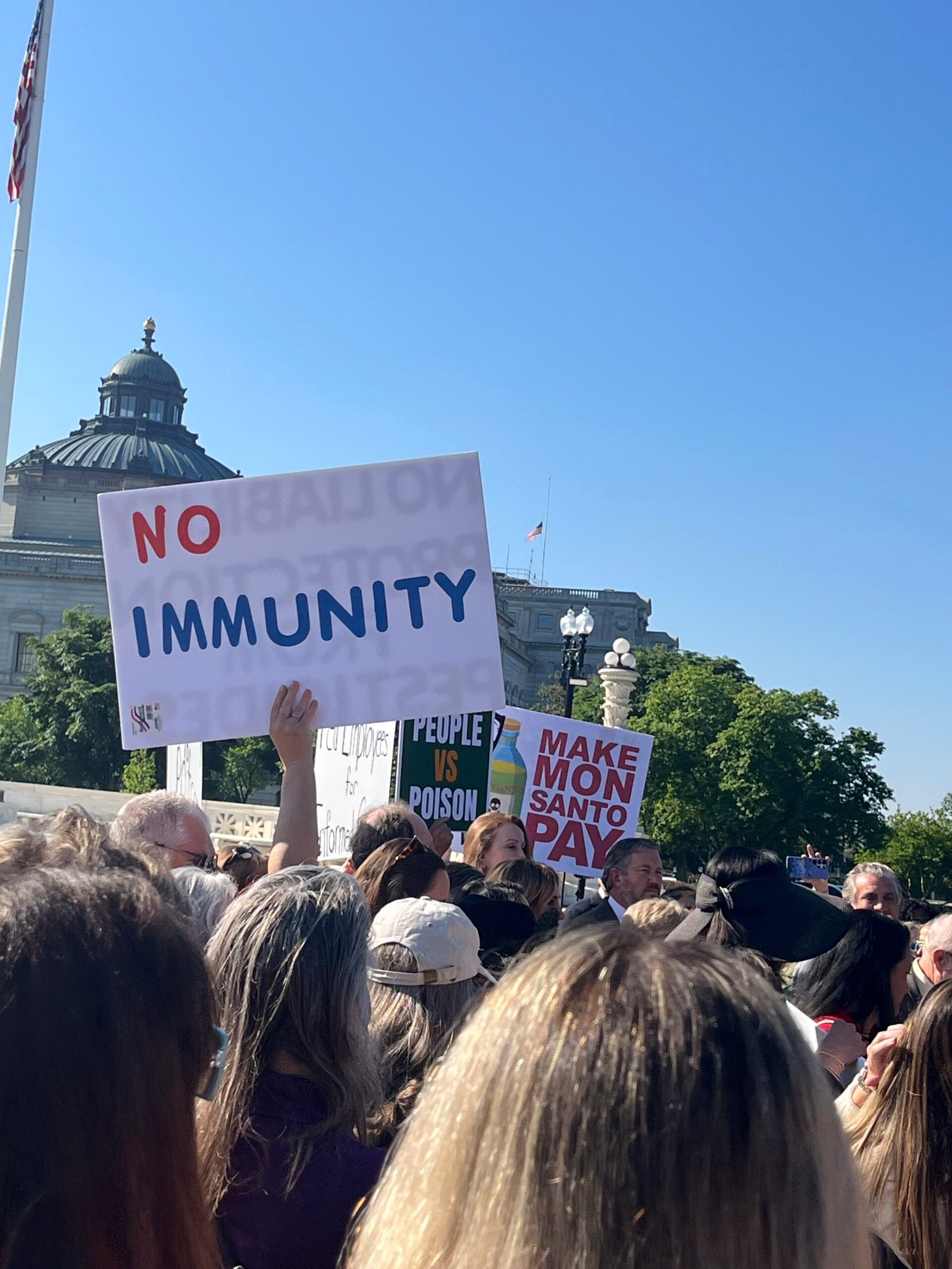
A day after a landmark U.S. Supreme Court decision stripped consumers of a key tool to sue pesticide companies, legal experts said the ruling is a blow to those who blame their injuries from pesticide exposure, but it’s not a final blow.
While Bayer and other pesticide manufacturers celebrated the Monsanto v. Darnell decision, plaintiffs’ lawyers, state and federal lawmakers, and public health advocates vowed to continue fighting for corporate accountability for dangerous products.
However, lawsuits alleging that Bayer’s glyphosate-based herbicides, such as Roundup, cause cancer can and will continue, many lawyers said, as well as lawsuits alleging that Syngenta’s paraquat herbicide causes Parkinson’s disease.
At the same time, lawmakers from both parties said they would introduce measures to reverse the impact of the Supreme Court’s decision. Consumer advocates and watchdog groups also said they would increase pressure on regulators to be more diligent in overseeing pesticide products.
“The war is not over yet,” said George Kimbrel, legal director and co-executive director of the Center for Food Safety, which is suing the EPA over pesticide evaluations. He said the court’s decision was “a galvanizing call for continued action.”
common topics
In the court’s 7-2 decision, a majority of the justices found that federal law protects pesticide companies from lawsuits accusing them of failing to warn of alleged risks associated with their products when the Environmental Protection Agency (EPA) does not require such warnings.
Allegations of failure to warn are a common thread in lawsuits brought against Bayer and Syngenta, which have cost Bayer more than $11 billion in settlements and jury awards to date, and Syngenta well over $100 million to date.
Bayer, which sought the Supreme Court’s ruling as a way to end litigation it inherited in its 2018 acquisition of Monsanto, said the ruling should result in the dismissal of the current failure to warn lawsuit and avoid future litigation.
But several leading lawyers and analysts said the ruling was narrow and left the door open to several other types of lawsuits that have already been filed.
“There is no question that claims of failure to warn based on EPA-approved labels are over, but the court’s decision was limited to those claims,” said lead plaintiff attorney Brent Wisner, who helped win the first Roundup case against Monsanto.
“Litigation against pesticide manufacturers is going to be much more difficult, but if they claim this is the silver bullet that will end all litigation, they’re just blowing the air,” Wisner said.
Robin Greenwald, another prominent mass tort plaintiffs’ attorney who has been involved in Roundup litigation since its inception more than a decade ago, agreed.
“There’s no reason not to pursue these lawsuits,” Greenwald said. “Monsanto’s actions go much deeper than their actions against the label. They mislead the public in a variety of ways. I certainly don’t think this is the end of the Roundup case.”
Gibbs Henderson, another plaintiff’s attorney working on pesticide cases, said the case will continue “unabated.”
“The language of the judgment makes clear that its scope is limited to cases of failure to warn,” Henderson said. Other types of claims would continue to provide “a powerful mechanism to hold Monsanto accountable,” he said.
However, many plaintiffs’ lawyers acknowledge that some paid mass tort lawyers are reluctant to take cases to trial because they are restricted from making failure to warn claims, which are a key factor in a jury’s decision in a plaintiff’s favor. Several plaintiff companies have spent the past few months instructing their customers to agree to settlements with Bayer ahead of the Supreme Court’s ruling, fearing a ruling in their favor.
“Narrow range”
In addition to claims of failure to warn, typical lawsuits brought against Monsanto also allege “negligence,” alleging that Monsanto had a duty to ensure that users would not be unreasonably and dangerously affected by exposure to its glyphosate herbicides.
The lawsuit also includes product liability claims for “design defects,” with the plaintiffs alleging that the formulation of the company’s herbicides was defective because they were more dangerous than consumers expected and posed a “substantial risk of cancer.”
Another allegation common to thousands of lawsuits is “breach of implied warranty.” The plaintiffs allege that the company falsely represented that its herbicides were safe and misled users about the risks of exposure.
Juries presented with all the allegations have awarded significant punitive damages in some Roundup trials, with jury awards in the hundreds of millions of dollars in multiple cases, with some totaling more than $1 billion.
Bayer and Syngenta are pursuing a settlement of all outstanding claims, and the companies are currently offering plaintiffs a lump sum settlement. Bayer faces a July 9 hearing on its proposed $7.25 billion class action settlement. Syngenta has similarly tried to offer settlements to plaintiffs, but many have refused.
It is in the interests of both parties if the plaintiff determines that a settlement is more advantageous than limiting the claim and going to trial. However, it remains to be seen whether the Supreme Court’s ruling will act as a lever to increase participation in the settlement.
“An important aspect of the SCOTUS decision is its narrow scope, so I don’t think we’ll see a large settlement in the Roundup case,” said Carl Tobias, a William William professor at the University of Richmond School of Law. “This decision applies only to caveat-deficiency cases. This opinion does not apply to the thousands of pending cases or to future cases proceeding for other reasons.”
“These other theories of recovery mean that many mass tort lawyers will continue to pursue thousands of these cases and take a significant number to trial,” Tobias said.
Will Congress act?
Critics of the Supreme Court’s decision noted that it was based entirely on an interpretation of specific language within FIFRA that deals with labeling powers reserved to the EPA, and did not address the significance of the science linking pesticides such as glyphosate and paraquat to health hazards.
Lawsuits against companies over product safety have helped uncover a history of cheating and hidden product dangers with pesticides and other chemicals, and some lawmakers said Congressional action is needed to ensure they continue.
Democratic Sen. Cory Booker said Thursday that the Supreme Court has a history of “unjust” decisions and that it will take “the power of the people” to overturn the Monsanto case.
“I will lead an amendment to take away this preemptive power and give it back to the people. We need to come together on both sides of the aisle now to undo what the Supreme Court has done,” Booker said.
Similarly, Republican U.S. Rep. Anna Paulina Luna said she would introduce legislation that would strip liability protections from pesticide companies.
“These companies knowingly knowing that their products cause cancer and other health problems are deliberately omitting information on their labels,” she wrote in a post on social media platform X, adding, “It’s time they are held accountable. Enough is enough.”
Featured image of protesters in front of the U.S. Supreme Court on April 27, 2026, taken by Carrie Gillum.
-
Carrie Gillum is editor-in-chief of The New Lede and a veteran investigative journalist with more than 30 years of experience covering U.S. news, including 17 years (1998-2015) as a senior correspondent for Reuters International. She is the author of Whitewashing: A Story of Herbicides, Cancer, and the Corruption of Science, which exposed the agricultural corruption of the Monsanto corporation. The book won the coveted Rachel Carson Book Award from the Association of Environmental Journalists in 2018. Her second book, the narrative law thriller The Monsanto Documents, was released on March 2, 2021.
She also contributed chapters to a textbook on environmental journalism and a book on pesticide use in Africa.
Mr. Gillum testified about his research as an invited expert before the European Parliament in 2017 and was a featured speaker at the World Democracy Forum in Strasbourg, France in 2019. He has also been a keynote speaker and panel speaker at events and universities in North America, Australia, the Netherlands, Brussels, and France.
Gillam is a regular contributor to the Guardian. Her work has also appeared in The New York Times, Huffington Post, Time, and other outlets.
In 2022, Gillum helped launch The New Lede as a journalism initiative of the Environmental Working Group.
Gillum is a member of the Association of Environmental Journalists.
