


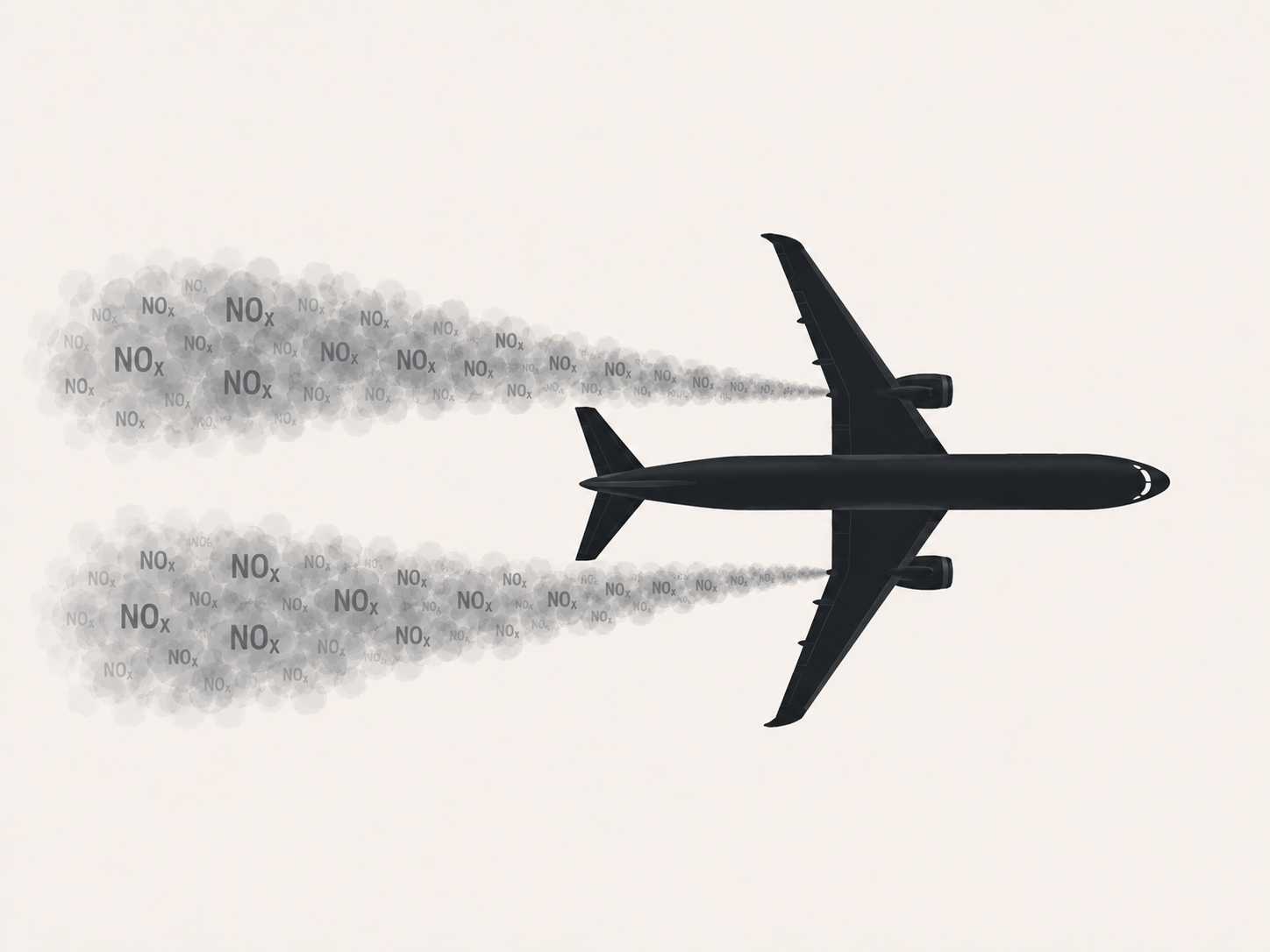
A global modeling study has warned that increased aircraft NOx emissions could sharply increase the health burden on the aviation industry, despite the industry’s focus on carbon-neutral flight.
Research: Impact of increasing aircraft emissions on global air quality and human health. Image credit: ChatGPT / OpenAI
Researchers quantified the current and future global health impacts of aviation-related air pollution by modeling aircraft emissions under multiple scenarios and estimating the impact on mortality.
This research was published as a “paper” in a journal Communication Earth and Environment The authors are Flávio DA Quadros, Rick Nelen, Mirjam Snellen, and Irene C. Dedoussi, researchers at Delft University of Technology and the University of Cambridge.
Aviation emissions: trends, impacts, and assessment challenges
Aircraft emissions contribute to climate change, nitrogen deposition, and poor air quality, primarily by increasing concentrations of fine particulate matter (PM2.5) and ozone. These pollutants are associated with significant public health impacts, with annual deaths estimated to range from hundreds to tens of thousands of people.
In recent decades, global jet fuel consumption has increased by 3-4% annually, increasing pressure on the environment. The aviation industry has set ambitious targets for carbon neutrality by 2050, but achieving these targets is highly dependent on sustainable aviation fuels, and nitrogen oxide (NOx) emissions remain substantially unreduced. Given that NOx is a major contributor to global aviation-related air quality impacts, these impacts are likely to worsen unless stronger mitigation measures are implemented.
Aircraft operations are typically divided into landing and takeoff (LTO) and non-LTO phases. The majority of emissions are emitted in the upper troposphere and lower stratosphere, where they spread across intercontinental distances through the formation of secondary pollutants. The resulting air quality and health impacts are highly diverse and are influenced by background pollution, weather patterns, air traffic fluctuations, population density, interactions with other emissions, and climate factors. This complexity poses a major challenge in assessing the true impact of aviation.
A number of studies have assessed the impact of aviation on air quality at local, regional, and global levels, but results vary widely due to differences in atmospheric modeling, chemical processes, and microphysical assumptions. Estimates of health effects also vary depending on the pollutant tested, the mortality endpoint chosen, and the concentration-response relationship used.
Assessing the global impact of aircraft exhaust on air quality and human health
The current study quantified the contribution of fixed-wing commercial aircraft to ground-based air pollution by comparing atmospheric simulations with and without aviation emissions. We also estimated the extent to which total flight impacts could be specifically attributed to NOx by differentiating the impact of emissions from the LTO cycle and excluding non-NOx aircraft emissions in a separate simulation.
Aircraft emissions were expressed as a three-dimensional field of monthly averages of pollutants including NOx, carbon monoxide (CO), hydrocarbons, and non-volatile particulate matter. While 2019 emissions are based on detailed inventory and engine-specific data, 2040 projections cover “low,” “baseline,” and “high” scenarios to account for uncertainties in traffic growth, vehicle turnover, and technology advancements. Contributions from business jets and piston aircraft were excluded due to limited data.
The 2040 scenario incorporates traffic growth, fleet turnover, retirement rates, fuel efficiency improvements, operational improvements, engine pressure ratio assumptions, and NOx reduction targets derived from ICAO analysis. This study does not take into account the potential mitigation effects of expanded biofuel use or aircraft that are not powered by hydrocarbon fuels, including aircraft powered by electricity or hydrogen.
Emissions were calculated by region, aircraft type, and operational factors, and atmospheric impacts were assessed using the GEOS-Chem model across different weather and emissions scenarios. Population exposure and health effects were estimated globally, and mortality was attributed to changes in PM2.5, ozone, and NO2 concentrations across age groups and regions. Uncertainty in these estimates was addressed using established concentration response functions, confidence intervals, and scenario analysis.
Aircraft emissions have a significant impact on global health
In 2019, emissions from all aircraft flights increased ground-based PM2.5 and ozone levels, with PM2.5 impacts being greatest in densely populated areas and ozone impacts being more spatially widespread. Low-altitude emissions increased NO2 levels near the airport, but decreased them in other areas. This is because high altitude NOx promotes ozone formation, and NO2 decreases further away from the source.
Most of aviation’s air quality impacts occurred in the Northern Hemisphere, where most fuel is burned and most people are concentrated. Although aviation’s contribution to global pollution was modest, regionally aircraft accounted for more than 2% of PM2.5 in regions of Europe and North America.
Air quality impacts from aviation varied, with ozone increasing fairly evenly, but PM2.5 increases were greatest in densely populated regions such as Asia, affecting more than 1.5 billion people. Although there was a general decrease in NO2 worldwide, there was a significant increase in areas near airports, particularly in North America where LTO emissions are high.
In 2019, excess deaths due to aircraft emissions were 33,900 (95% confidence interval: 23,500 to 45,600) due to PM2.5 and 24,600 due to ozone ( 15,500 to 34,200) and 6,700 (4,100 to 9,400) due to NO2, with Asia bearing the greatest burden. Although non-LTO emissions account for the majority of global PM2.5 and ozone mortality, LTO emissions were more important near airports and for NO2-related impacts. Wide-body and narrow-body aircraft were the leading cause of aviation-related fatalities. The choice of concentration-response function also significantly influences these health status estimates.
Aircraft emissions are expected to continue to impact air quality, with global changes in PM2.5 and ozone generally following trends in NOx emissions, but with reduced sensitivity in higher emissions scenarios. Depending on socio-economic conditions, aircraft-induced average concentration changes can be 4% lower or 13% higher for PM2.5 and 9% lower or 3% higher for ozone compared to the SSP2-4.5 baseline. NO2 is projected to continue decreasing overall, but with regional variations.
As aircraft NOx emissions increase, population exposure is expected to increase, but sensitivities vary by pollutant and scenario. In the baseline scenario, by 2040 there will be 68,000 excess deaths from aviation emissions (47,100 to 91,900) from PM2.5 and 50,000 from ozone. The number could reach 4,100 (34,100 to 75,100), more than double the 2019 level due to rising emissions, population growth, and baseline mortality rates. In the scenario with high aircraft emissions, the death toll would be even higher, with 83,800 deaths from PM2.5 and 66,300 deaths from ozone. Socioeconomic and non-aviation emission trends may further increase or decrease these health impacts.
Weather conditions also determine future impacts. Using 2040 climate model meteorology rather than 2019 reanalysis meteorology significantly reduced aircraft-induced PM2.5 exposure in some simulations and had a much smaller impact on ozone exposure. However, within the framework of the 2040 climate model, switching non-aircraft emissions had a larger impact than switching only the weather scenario. Therefore, both emission trends and meteorological assumptions need to be considered when estimating health impacts.
conclusion
Aircraft emissions have measurable and modeled impacts on air quality and public health, with the greatest impacts seen in densely populated areas and near major airports. As aviation activity and the world’s population increase, these health risks are projected to increase unless effective mitigation strategies are implemented, particularly those that reduce aviation NOx emissions while also addressing localized particle pollution near airports.
However, the authors note that the exact magnitude of the burden remains uncertain, as absolute mortality estimates depend on the concentration-response function used.
Click here to download your PDF copy.
Reference magazines:
- Quadros, F. D., Nehlen, R., Snellen, M., and DeDousi, I. C. (2026). Impact of increasing aircraft emissions on global air quality and human health. Communication Earth and Environment. Doi: 10.1038/s43247-026-03732-4, https://www.nature.com/articles/s43247-026-03732-4
