


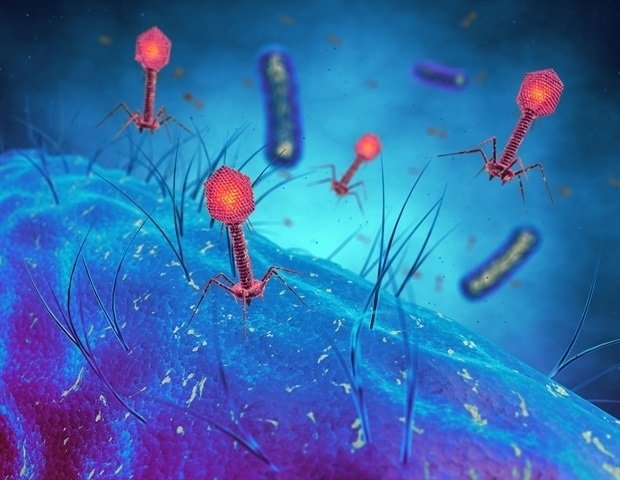
An interdisciplinary team of Rice University researchers has uncovered a previously unknown relationship between bacteriophages (viruses that infect bacteria) and their bacterial hosts, providing a powerful new tool for the next generation of microbiome engineering.
Published in nature communicationsthe study utilized an RNA-based barcoding system developed by Rice that allows scientists to identify which bacteria receive genetic material from bacteriophages (also called phages) in complex microbial environments. This approach allowed the researchers to uncover a previously undescribed group of bacterial hosts for the well-studied bacteriophage P1 and examine how subtle changes in viral structure affect the microorganisms that the phage can target.
“Phages are ubiquitous and play a huge role in shaping microbial communities and transferring genes between bacteria,” said corresponding author Lauren Stadler, associate professor of civil and environmental engineering.
However, identifying which phages interact with which hosts in real-world microbial communities has been a long-standing challenge. This study provides a scalable method to directly observe these interactions. ”
Lauren Stadler, Associate Professor of Civil and Environmental Engineering, Rice University
Phages are the most abundant biological entities on Earth, outnumbering all other life forms. They affect the microbial ecosystem by killing bacteria, changing their metabolism, and transferring genes between organisms. Scientists are increasingly interested in using phages as an alternative to antibiotics and as a tool for manipulating the microbiome, but traditional techniques for understanding which bacteria phages infect often require culturing bacteria in the lab, which is labor-intensive, or are unable to distinguish between viruses that simply attach to cells and successfully transfer DNA.
To overcome these limitations, the Rice team, which also included Associate Professor of Biological Sciences James Chappell and Stewart Memorial Professor of Biological Sciences Jonathan Silberg, adapted a synthetic biology platform known as RNA-addressed modification. Originally developed to track gene transfer through bacterial binding, the system uses engineered ribozymes (RNA strands that can catalyze specific biochemical reactions) to insert a unique “barcode” into the bacteria’s 16S ribosomal RNA after receiving DNA from a phage. Researchers can then identify the recipient organism through targeted RNA sequencing.
“Rather than trying to isolate every interaction individually, we allowed the phages to leave behind molecular signatures within the cells they arrived at,” Stadler said. “This provides a sensitive and high-throughput method to directly map host range within microbial communities.”
The researchers incorporated a barcoding system into bacteriophage P1, a virus known to transfer DNA between enterobacteria (microorganisms primarily found in the intestinal tracts of humans and animals), and thought it might be contributing to the spread of antibiotic resistance genes. The researchers then tested the approach on microbial communities grown in the lab and on wastewater collected from treatment plants in the Houston area.
Further surprising discoveries were made in wastewater experiments. Among the organisms that received genetic material from P1 were members of the order Aeromonadales, including Aeromonas hydrophila, a common wastewater bacterium that had not previously been identified as a P1 host.
“Discovering entirely new host groups from complex environmental samples demonstrates the power of this approach,” Stadler said. “It’s likely that important phage-host relationships have remained hidden because we lacked the tools to easily and painlessly observe them.”
The researchers also used this technique to investigate how different viral tail fibers, the protein structures that phages use to recognize and attach to bacteria, affect host range. By engineering phage-derived particles using alternative tail fibers and applying an RNA barcoding system, the researchers showed that each tail fiber targets a different set of microorganisms within the wastewater community.
“These experiments allowed us to see how relatively small genetic changes in a phage can dramatically change which bacteria it interacts with,” Stadler said. “That information is invaluable for engineering phages with specific functions, whether the goal is to introduce a beneficial gene or selectively eliminate harmful bacteria.”
In the future, this method could accelerate efforts to develop engineered phages for medical, environmental remediation, and industrial biotechnology. Because this approach relies on common molecular biology techniques such as amplicon sequencing rather than labor-intensive culture methods, it may also enable large-scale studies of viral ecology across diverse microbiomes.
The study was also authored by Zachary LaTurner, a postdoctoral fellow in Stadler’s lab and now a postdoctoral fellow at the Institute for Innovative Genomics at the University of California, Berkeley, and Rice graduate students Matthew Dysart, Samuel Schwartz, and Elizabeth Zeng. The research brought together scientists from Rice University’s departments of civil and environmental engineering, biological sciences, bioengineering, chemical and biomolecular engineering, and the systems, synthetic and physical biology graduate program.
sauce:
Reference magazines:
LaTurner, Z.W.; others. (2026) Trans-order detection of bacteriophage transduction in microbial communities using RNA barcoding. nature communications. DOI: 10.1038/s41467-026-70995-y. https://www.nature.com/articles/s41467-026-70995-y.
