



In the five months since jet fuel began leaking into Piscataway Creek from Joint Base Andrews, no agency has tested the water or sediment about 20 miles downstream, where the creek empties into the Potomac River and shoreline communities and where anglers flock to fish and boat along its banks.
The leak was discovered on Dec. 11 at Joint Base Andrews in Prince George’s County. Of the estimated 32,000 gallons that spilled into the headwaters of the creek, only 10,000 gallons were recovered, with the remaining 22,000 gallons spilling into the environment. Environmental leaders and activists have criticized the base for waiting more than three months to notify state regulators.
From its source, the stream flows 30.6 miles before slipping into the Potomac River at Fort Washington Park. This public access point along the adjacent Piscataway Park shoreline is known for attracting anglers from throughout the Washington area. The surrounding park is managed by the National Park Service.
The base said it has no plans to conduct sampling at Fort Washington Park. “We’re not doing water sampling in those specific locations,” Matt Everb said., Director of Media Operations at Joint Base Andrew; Comment by email. “However, we have completed multiple joint water sampling events with the Maryland Department of the Environment both on-site and immediately outside the facility,” Everb said, adding that sampling was conducted at Piscataway Creek on April 13, April 20, and May 18, and that the extent of contamination has decreased over time.
When asked if testing would be extended to the tidal estuaries, the rationale was clear. “The station does not intend to conduct assessments at the tidal mouth of the creek,” Ebarb said, adding that testing within and immediately surrounding the facility has already yielded relevant data. “We have fully coordinated our sampling plan with MDE.”
The National Park Service, which manages the land around the riverfront, had not communicated with Maryland regulators about the issue, even though its parent agency, the U.S. Department of the Interior, was notified of the leak in March. MDE has been conducting sampling near the base, but expanded its monitoring area downstream at the request of residents during the agency’s site visit on May 9.
“The U.S. Department of the Interior was one of the organizations that received initial notification of the incident from the National Preparedness Center on March 23,” said MDE spokesperson Jay Apperson. “The National Park Service has not contacted us. If the National Park Service or anyone else with concerns contacts us, we will work with them.”
The Home Office and NPS did not respond to multiple requests for comment from Inside Climate News.
Native communities along Piscataway Creek and other organizations that manage their shorelines are sensing institutional inertia regarding downstream sampling and are beginning to take steps to take action on their own.
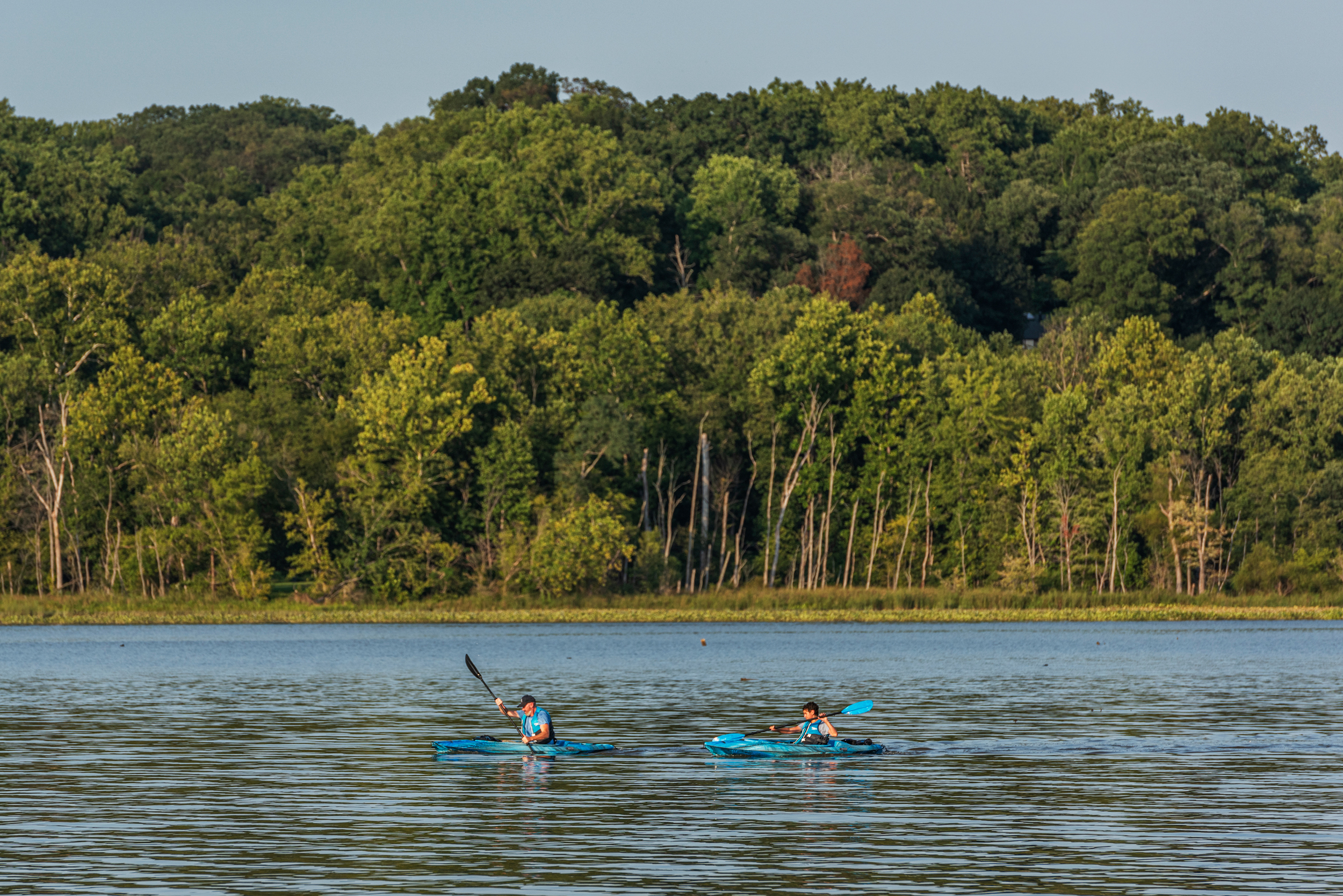 Kayakers on Piscataway Creek in Acook, Maryland. Credit: Craig Hudson/The Washington Post via Getty Images
The Acokeek Foundation, which manages Piscataway Park under a long-standing contract with NPS, is partnering with the Potomac Riverkeeper Network to begin independent water quality monitoring at the park near areas where pollutants are likely to enter.
“Once operational, trained volunteers will collect weekly water samples that will be analyzed through the Potomac River Keeper’s Community Science Program and the Sea Dog Floating Laboratory at National Harbor,” said Angela Burns, executive director of the foundation and member of the Piscataway community.
In an emailed comment, Burns said the initiative aims to fill a gap: “Our goal is to provide residents, anglers, visitors, and park officials with consistent and accessible information about local water quality conditions.”
MDE said the upstream focus reflects standard practice. “It makes sense to first take samples closest to the source of contamination, and then work further downstream to determine the extent of contamination if necessary,” Uperson says.
This story is funded by readers like you.
Our nonprofit newsroom provides free advertising for our award-winning climate coverage. We rely on donations from readers like you to continue our work. Donate now to support our work.
donate now
The agency expected to begin downstream sampling within about two weeks after the May 9 community meeting. Results will be announced in 10 to 14 days and posted on the Joint Base Andrews release page on the website.
For Burns, the testing gap is the latest episode in a long pattern of neglect.
“The need to consider cumulative impacts began more than 400 years ago,” she said. “Environmental issues in the Piscataway homeland cannot be isolated as isolated events.”
She traced the decline from beaver populations in the fur trade in the 1600s to deforestation for plantation agriculture, coastline modification, industrialization, overfishing, stormwater runoff, wastewater failure, and PFAS pollution to current jet fuel emissions, calling them “all chapters in a much longer story of cumulative ecological change.”
For Indigenous communities, “waterways are not just an environmental resource, they are part of an interconnected cultural landscape,” she said.
Piscataway Park is one of the few public fishing access points along the Potomac River. Burns said the foundation posted advisory notices at public fishing piers and visitor centers.
But she made it clear that the ultimate responsibility does not rest with organizations like hers. Burns said that while foundations can bridge long-standing relationships with residents and tribal communities, “the responsibility for environmental monitoring, enforcement, remediation and publicity ultimately rests with the agencies and organizations charged with those duties.”
About this story
As you may have noticed, this article, like all news we publish, is free to read. That’s because Inside Climate News is a 501c3 nonprofit organization. We don’t charge subscription fees, keep our news behind paywalls, or fill our website with ads. We provide climate and environmental news free to you and anyone who wants it.
That’s not all. We also share our news for free with dozens of other news organizations across the country. Many of them cannot afford to do their own environmental journalism. We’ve established bureaus across the country to report on local news, partner with local newsrooms and co-publish stories to ensure this important work is shared as widely as possible.
The two of us started ICN in 2007. Six years later, we won the Pulitzer Prize for national reporting and now run the nation’s oldest and largest dedicated climate newsroom. We tell the story in its entirety. We hold polluters accountable. We expose environmental injustice. We debunk misinformation. We explore solutions and inspire action.
Donations from readers like you fund all aspects of our work. If you haven’t already, will you support our ongoing work, our coverage of the biggest crises facing our planet, and help us reach more readers in more places?
Please make a tax-deductible donation. Any of those things make a difference.
thank you,

Aman Azhar
washington dc reporter
Aman Azhar is a Washington, DC-based journalist who covers environmental justice for Inside Climate News, focusing on the Baltimore-Maryland area. He has previously worked as a broadcast journalist and multimedia producer for the BBC World Service, VOA News and other international news organizations, reporting from London, Islamabad, the United Arab Emirates and New York. He holds a postgraduate degree in media anthropology from the School of Oriental and African Studies (SOAS), University of London, a master’s degree in political science from the University of the Punjab, and is the recipient of a Chevening Scholarship from the UK Government and an Academic Scholarship for Postgraduate Studies from the Australian Government.
