

Close Menu

    Subscribe to Updates

    Get the latest creative news from FooBar about art, design and business.

    What's Hot

    Most people who discontinue GLP-1 drugs like Ozempic eventually relapse

    June 16, 2026

    New study investigates possible cross-species spread of chronic wasting disease

    June 16, 2026

    Tirzepatide is more effective than semaglutide in actual weight loss

    June 16, 2026
    Facebook X (Twitter) Instagram
    Facebook X (Twitter) Instagram
    Health Magazine
    • Home
    • Environmental Health
    • Health Technology
    • Medical Research
    • Mental Health
    • Nutrition Science
    • Pharma
    • Public Health
    • Discover
      • Daily Health Tips
      • Financial Health & Stability
      • Holistic Health & Wellness
      • Mental Health
      • Nutrition & Dietary Trends
      • Professional & Personal Growth
    • Our Mission
    Health Magazine
    Home » News » Scientists have discovered a way to explain flocks of birds that ‘defies’ Newton’s third law
    Nutrition Science

    Scientists have discovered a way to explain flocks of birds that ‘defies’ Newton’s third law

    healthadminBy healthadminJune 16, 2026No Comments4 Mins Read
    Scientists have discovered a way to explain flocks of birds that ‘defies’ Newton’s third law
    Share
    Facebook Twitter Reddit Telegram Pinterest Email


    Birds can see much of the world around them, but when flying in flocks they only pay attention to the birds next to them or in front of them. They do not coordinate their movements with the birds behind them. This behavior appears to contradict Newton’s third law. This is the famous principle of action and reaction, often summarized as, “For every action, there is an equal and opposite reaction.”

    This principle is easy to see in everyday life. When we run, our feet push against the ground and the ground pushes back with the same force. The same idea explains how cars move, how people row boats, and why balloons fly forward when the air leaves their openings. For more than 300 years, Newton’s third law has been one of the cornerstones of classical physics.

    “Whatever we usually teach students in theoretical mechanics is ultimately based on the principle of action and reaction,” explains research group leader Marin Bukov.

    Bird flocks are not the only systems that seem to deviate from this rule. Groups of bacteria, people, and even groups of cells in living tissue behave similarly. In these systems, individual components respond to only part of their environment, rather than all of their surroundings. As a result, the interaction is unidirectional and there is no balance between action and reaction.

    Physicists call these non-interactions. Traditional theories were designed considering interactions where action and reaction are equal. Because of this limitation, scientists have struggled to accurately simulate irreversible systems. Better simulations are important for understanding biological processes, crowd behavior, and animal collective movements.

    Researchers in Dresden, in collaboration with physicist Roderich Messner, have developed a solution to this long-standing problem. Messner is Principal Investigator of the Würzburg-Dresden Cluster of Excellence ctd.qmat (Complexity, Topology and Dynamics of Quantum Materials) and Director of the Max Planck Institute for the Physics of Complex Systems in Dresden.

    A new way to model irreversible systems

    “The research team has developed and proven a theory that applies much of what we teach students to non-reciprocal systems. These systems for which Newton’s third law does not apply can finally be accurately described and accurately simulated using established techniques. This is exactly the kind of tool that has been lacking in recent years,” says Bukov.

    The researchers achieved this by extending the traditional action-reaction framework. Their approach allows irreversible systems to be studied using many of the same tools already used in regular reversible systems. The key is the introduction of additional artificial variables.

    Physicists typically describe natural systems using mathematical variables that correspond to real-world characteristics, such as the position and speed of a bird, the position of a fish in a school, or the position of a car in traffic.

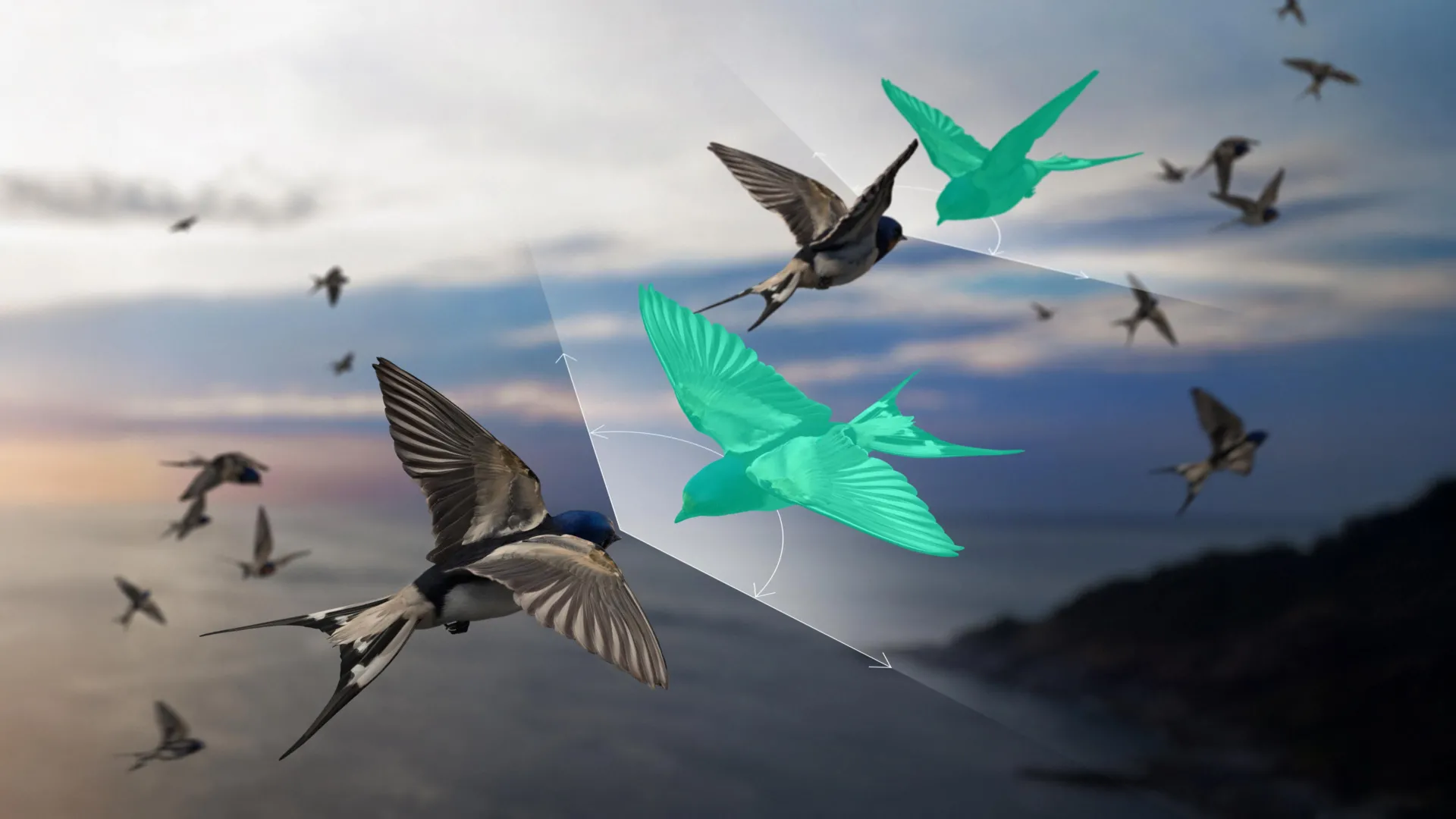
    “The trick behind the new theory is to construct partners for each component of the system, imaginary partners that do not exist in nature. The original non-interactions are replaced by interactions through these auxiliary degrees of freedom,” explains Bukov’s colleague, biophysicist Ricard Alert.

    imaginary bird incident

    What would this idea look like in practice?

    “To accurately simulate bird movement, we use established methods to describe a dynamic system, a ‘flock of birds’, as if it were a reciprocal system, which in fact it is not. An elegant solution is to artificially place imaginary birds in front of each real bird, side by side in exactly opposite directions,” Alert says.

    These imaginary partners do not represent real birds. Instead, they are mathematical tools that allow researchers to convert one-way interactions into a form that can be analyzed using existing methods.

    New possibilities for physics research

    The use of auxiliary degrees of freedom is not a new concept in physics. What’s new is how they can be applied to systems with non-interactions.

    This approach allows scientists to generate more accurate simulations of complex systems while leveraging the established framework of many-body physics. Equally important, it provides a deeper understanding of the underlying physics. This kind of understanding often lays the foundation for future discoveries.

    “In Würzburg and Dresden, we study quantum materials in which particles interact under certain conditions in ways that give rise to new phenomena such as magnetism and lossless current transport. The interesting question now is whether these exceptions to Newton’s laws lead to completely new forms of collective quantum behavior. We still know very little about this, and that is precisely what makes this research so interesting,” says Messner.

    The team’s findings were published in the journal natural physics.


    Source link

    Visited 3 times, 3 visit(s) today
    Share. Facebook Twitter Pinterest LinkedIn Telegram Reddit Email
    Previous ArticleUncovr wins $7 million for AI surgical documentation infrastructure
    Next Article US infant mortality rate falls to record low
    healthadmin

    Related Posts

    Most people who discontinue GLP-1 drugs like Ozempic eventually relapse

    June 16, 2026

    New study investigates possible cross-species spread of chronic wasting disease

    June 16, 2026

    Scientists have discovered the hidden weakness of eternal chemicals

    June 16, 2026

    Semaglutide (Ozempic) is associated with fewer bone fractures despite greater weight loss

    June 16, 2026

    Your brain wasn’t designed for news this bad

    June 16, 2026

    Alien messages may be reaching Earth without us even noticing.

    June 16, 2026
    Add A Comment
    Leave A Reply Cancel Reply

    Categories

    • Daily Health Tips
    • Discover
    • Environmental Health
    • Exercise & Fitness
    • Featured
    • Featured Videos
    • Financial Health & Stability
    • Fitness
    • Fitness Updates
    • Health
    • Health Technology
    • Healthy Aging
    • Healthy Living
    • Holistic Healing
    • Holistic Health & Wellness
    • Medical Research
    • Medical Research & Insights
    • Mental Health
    • Mental Wellness
    • Natural Remedies
    • New Workouts
    • Nutrition
    • Nutrition & Dietary Trends
    • Nutrition & Superfoods
    • Nutrition Science
    • Pharma
    • Preventive Healthcare
    • Professional & Personal Growth
    • Public Health
    • Public Health & Awareness
    • Selected
    • Sleep & Recovery
    • Top Programs
    • Weight Management
    • Workouts
    Popular Posts
    • 1773313737_bacteria_-_Sebastian_Kaulitzki_46826fb7971649bfaca04a9b4cef3309-620x480.jpgHow Sino Biological ProPure™ redefines ultra-low… March 12, 2026
    • pexels-david-bartus-442116The food industry needs to act now to cut greenhouse… January 2, 2022
    • 1773729862_TagImage-3347-458389964760995353448-620x480.jpgDespite safety concerns, parents underestimate the… March 17, 2026
    • 1774403998_image_28620e4b6b0047f7ab9154b41d739db1-620x480.jpgGait pattern helps distinguish between Lewy body… March 24, 2026
    • 1773209206_futuristic_techno_design_on_background_of_supercomputer_data_center_-_Image_-_Timofeev_Vladimir_M1_4.jpegMulti-agent AI systems outperform single models… March 11, 2026
    • the-pros-and-cons-of-paleo-dietsThe Pros and Cons of Paleo Diets: What Science Really Says April 16, 2025

    Demo
    Stay In Touch
    • Facebook
    • Twitter
    • Pinterest
    • Instagram
    • YouTube
    • Vimeo
    Don't Miss

    Most people who discontinue GLP-1 drugs like Ozempic eventually relapse

    By healthadminJune 16, 2026

    People taking GLP-1 drugs for type 2 diabetes (liraglutide, semaglutide, or tirzepatide) may be more…

    New study investigates possible cross-species spread of chronic wasting disease

    June 16, 2026

    Tirzepatide is more effective than semaglutide in actual weight loss

    June 16, 2026

    Study finds branding of cannabis products attracts young people

    June 16, 2026

    Subscribe to Updates

    Get the latest creative news from SmartMag about art & design.

    HealthxMagazine
    HealthxMagazine

    At HealthX Magazine, we are dedicated to empowering entrepreneurs, doctors, chiropractors, healthcare professionals, personal trainers, executives, thought leaders, and anyone striving for optimal health.

    Our Picks

    Study finds branding of cannabis products attracts young people

    June 16, 2026

    US infant mortality rate falls to record low

    June 16, 2026

    Scientists have discovered a way to explain flocks of birds that ‘defies’ Newton’s third law

    June 16, 2026
    New Comments
      Facebook X (Twitter) Instagram Pinterest
      • Home
      • Privacy Policy
      • Our Mission
      © 2026 ThemeSphere. Designed by ThemeSphere.

      Type above and press Enter to search. Press Esc to cancel.