


Katherine Levy remembers a childhood deeply rooted in Lake Tahoe’s natural offerings. He water skied in the summer and worked as a ski instructor in the surrounding snowy mountains in the winter.
After years away from the area, Levy recently returned to live a retired life along the north shore of the lake. But she doesn’t like what she finds when she returns home. The U.S. government plans to spray multiple types of herbicides, including the cancer-linked herbicide glyphosate, on National Forest property adjacent to the community’s treasured lake.
“I was horrified to find out what was going on,” Levy said.
Levy is one of many Lake Tahoe area residents and officials fighting to block or modify a U.S. Forest Service project aimed at restoring areas damaged by the 2021 Kaldor Fire.
Wildfires have burned more than 200,000 acres in and around the Lake Tahoe Basin. The Forest Service manages more than 156,000 acres of National Forest land within its watershed.
A town hall meeting was held on June 11 to strategize how to fight the Forest Service’s plan, and residents are calling for action on various social media platforms, including posts on Facebook groups such as Lake Tahoe Locals and Keep Tahoe Blue.
 From a Facebook post on May 26th.
The brewing battle is just one of similar battles over the use of forestry pesticides playing out across the United States, but the Lake Tahoe issue has drawn the attention of leaders of the Make America Healthy Again (MAHA) movement, which is lobbying the U.S. Environmental Protection Agency to ban or severely limit the use of glyphosate.
“Tahoe area residents are shocked that the U.S. Forest Service is considering spraying glyphosate on their precious old-growth forest and are rapidly organizing to oppose it,” said Kelly Ryerson, leader of MAHA, which is helping organize the opposition.
Glyphosate was introduced by the former Monsanto Company in the 1970s. Chemical-based brands such as Roundup have long been popular with farmers as well as homeowners and commercial landscapers. But in 2015, cancer experts at the World Health Organization classified the pesticide as probably carcinogenic to humans. Chemicals also Associated with harm to animalsAnd federal regulators have found that it can. have a negative impact Over 90% of endangered species.
worried about water
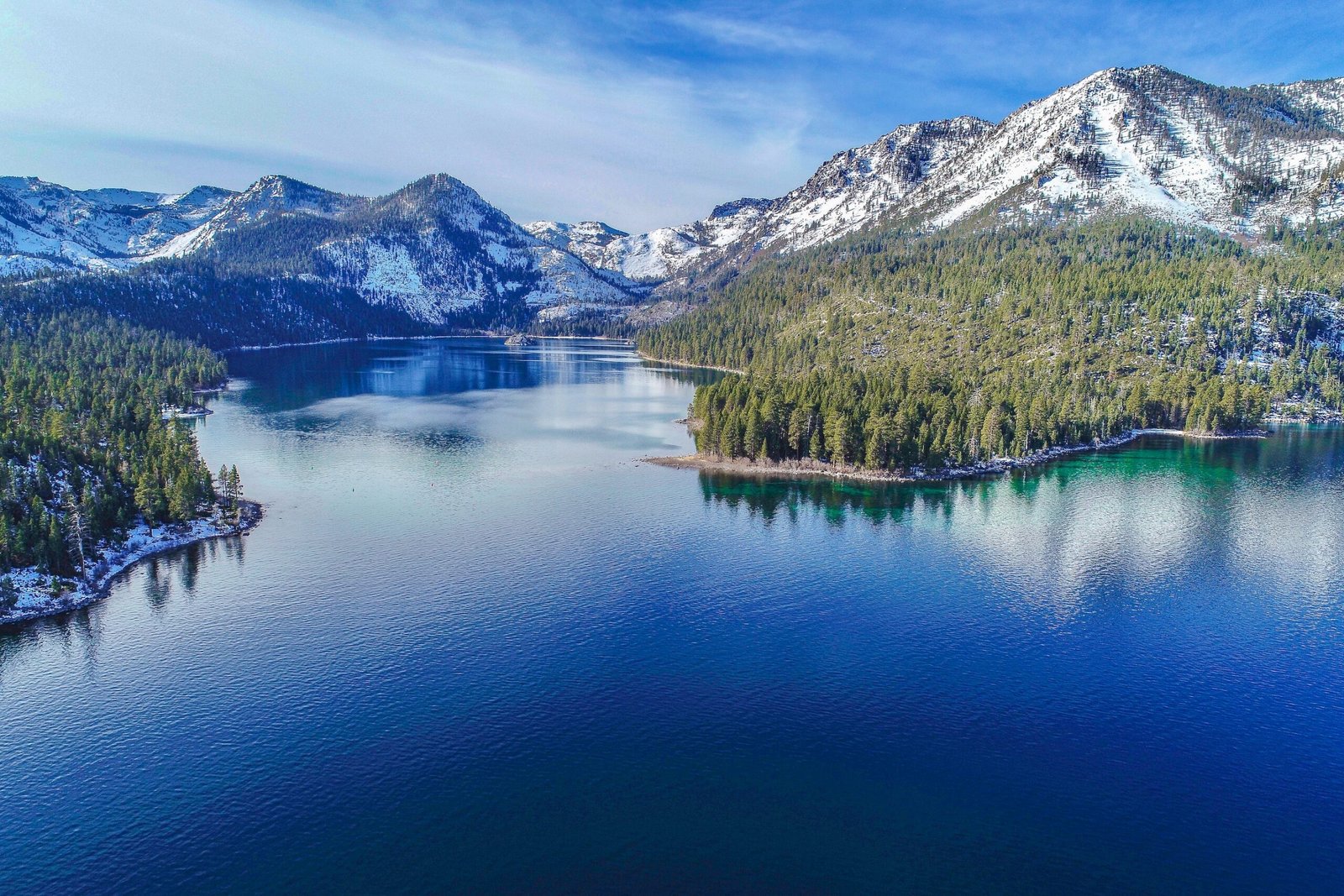
Known as the largest alpine lake in North America, Lake Tahoe is extremely pristine and has long been a popular tourist destination. It is located in the Sierra Nevada Mountains, straddling the California-Nevada border. The region’s inhabitants are spread over 12 towns and two mountain villages.
“It’s a big concern for all of us.” – South Lake Tahoe Mayor Cody Bass
About 75% of the lake’s watershed is within national forest land, and some of the areas proposed for spraying are in the mountains above the lake, where snowmelt flows into tributaries that lead directly to Lake Tahoe.
“This is of great concern to all of us,” South Lake Tahoe Mayor Kody Bass said. “I didn’t know glyphosate was still being used in forests. It was kind of shocking knowing what we know about glyphosate and still using it on public lands.”
 Aerial photo of Lake Tahoe by Brandon Berry of the Tahoe Environmental Research Center at the University of California, Davis.
Mr. Bass, who is also a local business owner, serves on the 15-member Board of Directors of the Tahoe Regional Planning Authority (TRPA). TRPA strongly recommends the use of synthetic herbicides in the area, and Bass is now asking the board to ban the chemicals.
TRPA sent a letter to the Forest Service’s Lake Tahoe Basin Management Division on May 27, requesting a meeting with Forest Service officials. The letter notes that TRPA and water quality officials want to minimize herbicide use “to the extent possible.”
Planning for the Forest Service’s large-scale restoration project has been in the works for more than a year, but the community only recently became aware of an article in the Mother Jones news organization that said up to 75,000 acres affected by the Kaldor Fire were targeted for glyphosate spraying. Mother Jones reports that the plan also includes areas near Lake Tahoe Ski Area.
A follow-up article in the magazine revealed in late May that spraying had already begun at one of the ski and snowboard resorts in the El Dorado National Forest south of Lake Tahoe.
Herbicide spraying on public forest land in Lake Tahoe is not unusual. From 2017 to 2020, 938,732 pounds of pesticide products were applied to a cumulative 1,467,944 acres of federal forest land across the United States, according to federal data obtained by the Center for Biological Diversity. (CBD).
“People think this is just a one-time thing, but it’s actually everywhere,” said Lori Ann Byrd, director of the CBD’s environmental health program. “We expect to see more and more spraying projects like this. There are always excuses that just don’t make sense when weighed against the potential harm and risk.”
“Emergency” permission
The Forest Service’s plan calls for the use of glyphosate and other herbicides to remove shrubs, bushes and other vegetation before planting new trees, and to control vegetation that could inhibit tree growth after planting, according to the Forest Service.
In March, Forest Service officials said work to restore 11,700 acres of land within the Lake Tahoe watershed was justified.Emergency” permission. The project estimates that between 2,400 and 3,600 acres of land “may be treated with herbicides to support reforestation.”
To minimize damage to ‘non-target’ native plants, the herbicide will be applied from a backpack sprayer rather than from the air, and the Forest Service said it will work to reduce the risk of the pesticide entering streams and other water bodies.
 Photo taken by Jenny Lundin on May 3, 2026 in El Dorado National Forest.
“Forest restoration involves targeted actions to accelerate the recovery of forest landscapes after fire, strengthen resilience to wildfire, insects, and disease, and support wildlife species that depend on healthy forest habitats…” the Forest Service said in its 2025 proposal outlining the plan. “Proposed forest restoration treatments include forest thinning and fuel reduction, afforestation activities (site preparation, planting, competitive stocking), herbicide treatments, and prescribed fire.”
Although the Forest Service has listed glyphosate and four other herbicides in its plan for ongoing remediation efforts, most of the local anger is against glyphosate and concerns about the risks to human and environmental health.
When asked about local opposition, Robert Lawrence of the Forest Service said:The project’s National Environmental Policy Act (NEPA) planners acknowledged the community’s concerns.
He pointed to information on the Forest Service’s website that says each herbicide used is properly registered with regulatory agencies, biologically tested and determined to be “the best tool for achieving forest health or restoration.” The agency’s website also states that the Forest Service conducts “rigorous, multidisciplinary assessments of each chemical and its potential impacts.”
However, these guarantees do not allay residents’ concerns.
“People come here from all over the world because of its purity and natural beauty,” said Hannah Teter, who lives in the South Lake Tahoe area near areas affected by the Kaldor Fire and works for a local wakesurf charter company. “The idea of spraying thousands of gallons of herbicide across the Tahoe Basin to determine which species will regenerate after a natural wildfire is deeply disturbing.”
She lives next door and is worried about her brother, who is currently battling cancer. The use of glyphosate poses serious concerns to local residents, especially those who are already immunocompromised and vulnerable, Teter said.
Featured image of Lake Tahoe by Brandon Berry of the Tahoe Environmental Research Center at the University of California, Davis.
-

Carrie Gillum is editor-in-chief of The New Lede and a veteran investigative journalist with more than 30 years of experience covering U.S. news, including 17 years (1998-2015) as a senior correspondent for Reuters International. She is the author of Whitewashing: A Story of Herbicides, Cancer, and the Corruption of Science, which exposed the agricultural corruption of the Monsanto corporation. The book won the coveted Rachel Carson Book Award from the Association of Environmental Journalists in 2018. Her second book, the narrative law thriller The Monsanto Documents, was released on March 2, 2021.
She also contributed chapters to a textbook on environmental journalism and a book on pesticide use in Africa.
Mr. Gillum testified about his research as an invited expert before the European Parliament in 2017 and was a featured speaker at the World Democracy Forum in Strasbourg, France in 2019. He has also been a keynote speaker and panel speaker at events and universities in North America, Australia, the Netherlands, Brussels, and France.
Gillam is a regular contributor to the Guardian. Her work has also appeared in The New York Times, Huffington Post, Time, and other outlets.
In 2022, Gillum helped launch The New Lede as a journalism initiative of the Environmental Working Group.
Gillum is a member of the Association of Environmental Journalists.
