


Researchers have identified large-scale geological features hidden beneath the East Antarctic Ice Sheet, revealing previously unrecognized connections between some of the continent’s largest buried landforms.
The newly identified structure consists of a network of huge basins hidden beneath the ice, more than 3 kilometers (almost 2 miles) thick in some places.
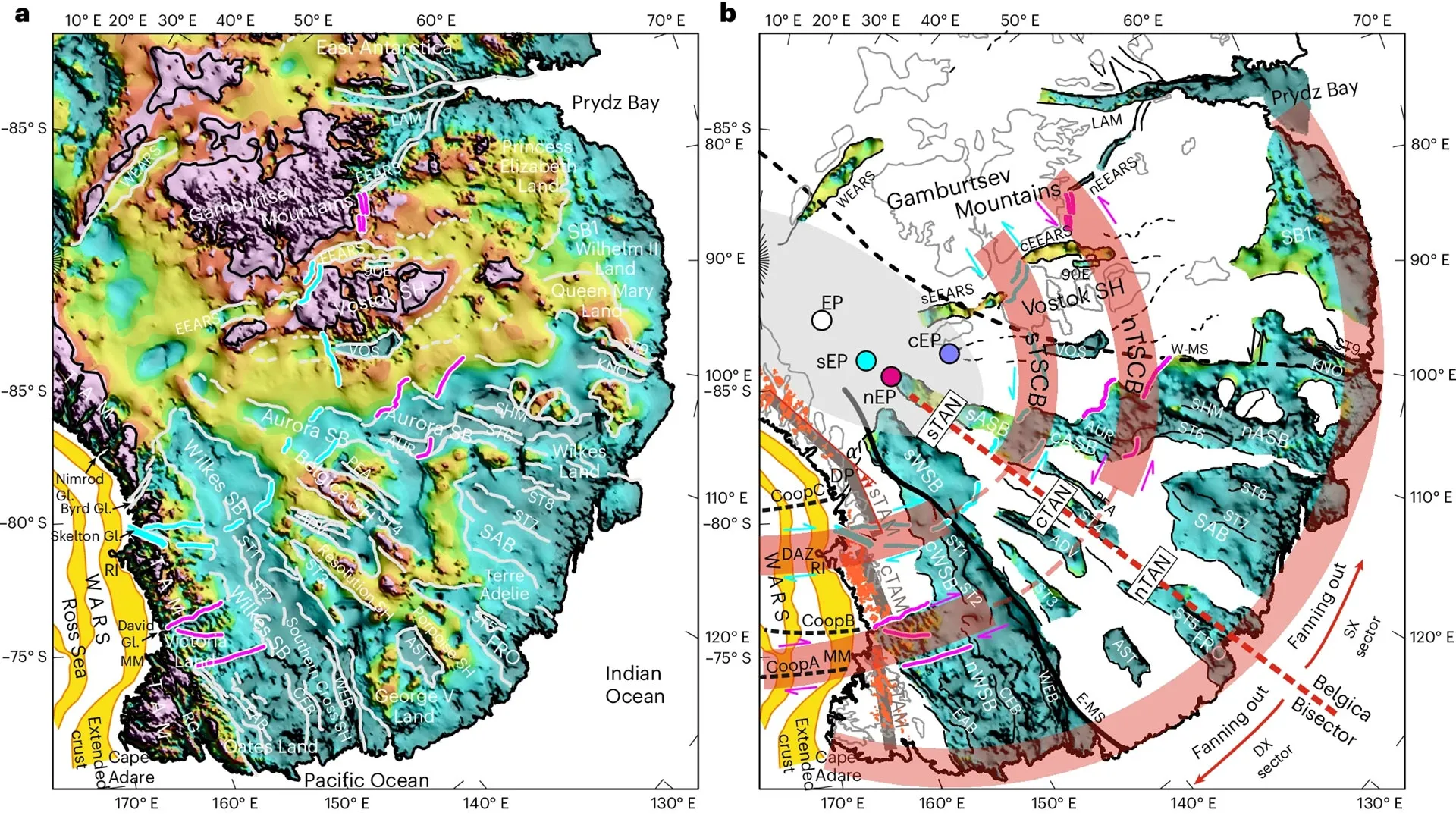
Together, these basins form a continent-wide fan pattern, which researchers have named the East Antarctic Fan Basin Province.
The state includes several well-known subglacial landforms, including the Wilkes Basin and the Aurora Basin, basins that include Lake Vostok, the largest known subglacial lake on Earth.
Scientists have studied many of these basins individually for years, but this is the first time they have been recognized as part of a single, interconnected geological structure.
Evidence of ancient crustal expansion and contraction
The researchers say the structure was likely formed through a process known as dispersive rotational extension.
This occurs when the continent’s crust gradually stretches outward from a central point. Researchers liken this pattern to a hand in which the base of the thumb remains fixed but the fingers are spread apart. The spaces between the fingers resemble triangular basins that form as the Earth’s crust expands.
The East Antarctic Fan Basin may be one of the largest examples of rotational extension ever identified within the continental crust.
Scientists believe this structure developed through multiple tectonic movements associated with the formation and evolution of the ancient Gondwana supercontinent. It may also be associated with the subsequent separation of Antarctica and Australia, and may even have played a role in the separation of the continents.
The discovery raised several new questions, including when the structure formed and what geodynamic processes were involved in its formation.
Impact on the Antarctic ice sheet
The significance of this discovery extends beyond reconstructing Antarctica’s geological past.
The shape of the bedrock beneath the ice continues to influence how ice moves across the continent today. This hidden landform can help locate subglacial basins and lakes, which can influence the stability of regions of the Antarctic ice sheet that are particularly susceptible to climate change.
Mapping Antarctica’s hidden landscapes
To investigate the newly recognized structure, the researchers combined multiple data sources, including subglacial topography, geological observations, gravity measurements, magnetic data, seismic information, and models of the Earth’s crust and lithosphere.
Their analysis shows that this landform is the result of deep tectonic processes operating within the Antarctic lithosphere.
Dr Guy Paxman from the Department of Geography was a member of the international research team.
He led calculations to estimate what the landscape of East Antarctica would look like if the entire ice sheet were removed – land bounced up to a kilometer upwards.
This reconstructed “bounced topography” allowed researchers to examine both the elevation and orientation of newly identified geological structures.
The research was led by Dr. Egidio Armadillo from the University of Genoa and supported by the Italian National Antarctic Research Program.
