

Close Menu

    Subscribe to Updates

    Get the latest creative news from FooBar about art, design and business.

    What's Hot

    Standing ovation for RevMed, warning for Akeso

    May 31, 2026

    Rape myths are subtly ingrained in family conversations about safety

    May 31, 2026

    Irregular brain maturation in childhood predicts emotional habits in early adolescence

    May 31, 2026
    Facebook X (Twitter) Instagram
    Facebook X (Twitter) Instagram
    Health Magazine
    • Home
    • Environmental Health
    • Health Technology
    • Medical Research
    • Mental Health
    • Nutrition Science
    • Pharma
    • Public Health
    • Discover
      • Daily Health Tips
      • Financial Health & Stability
      • Holistic Health & Wellness
      • Mental Health
      • Nutrition & Dietary Trends
      • Professional & Personal Growth
    • Our Mission
    Health Magazine
    Home » News » New solar desalination breakthrough allows you to create fresh water without toxic salt water
    Nutrition Science

    New solar desalination breakthrough allows you to create fresh water without toxic salt water

    healthadminBy healthadminMay 31, 2026No Comments5 Mins Read
    New solar desalination breakthrough allows you to create fresh water without toxic salt water
    Share
    Facebook Twitter Reddit Telegram Pinterest Email


    According to the United Nations, 2.2 billion people still lack access to safely managed drinking water. To meet growing demand, many regions from California to parts of the Middle East rely on desalination plants that convert seawater into fresh water.

    Traditional desalination methods such as reverse osmosis and thermal distillation can be expensive and energy-intensive. Chemical treatments are often required before and after water is treated, producing large amounts of concentrated salt water known as brine. Returning salt water to the ocean can damage marine ecosystems by increasing salinity and decreasing oxygen levels.

    Researchers at the University of Rochester have developed a new approach that can address some of these challenges. Solar-powered desalination systems efficiently produce fresh water, operate without chemical pretreatment, and avoid the production of salt water waste. The research was led by Chunlei Guo, professor of optics and physics and senior scientist at the university’s Laser Energy Institute. The team described the technology in the journal Light: Science and Applications.

    Laser-treated solar panels drive the process

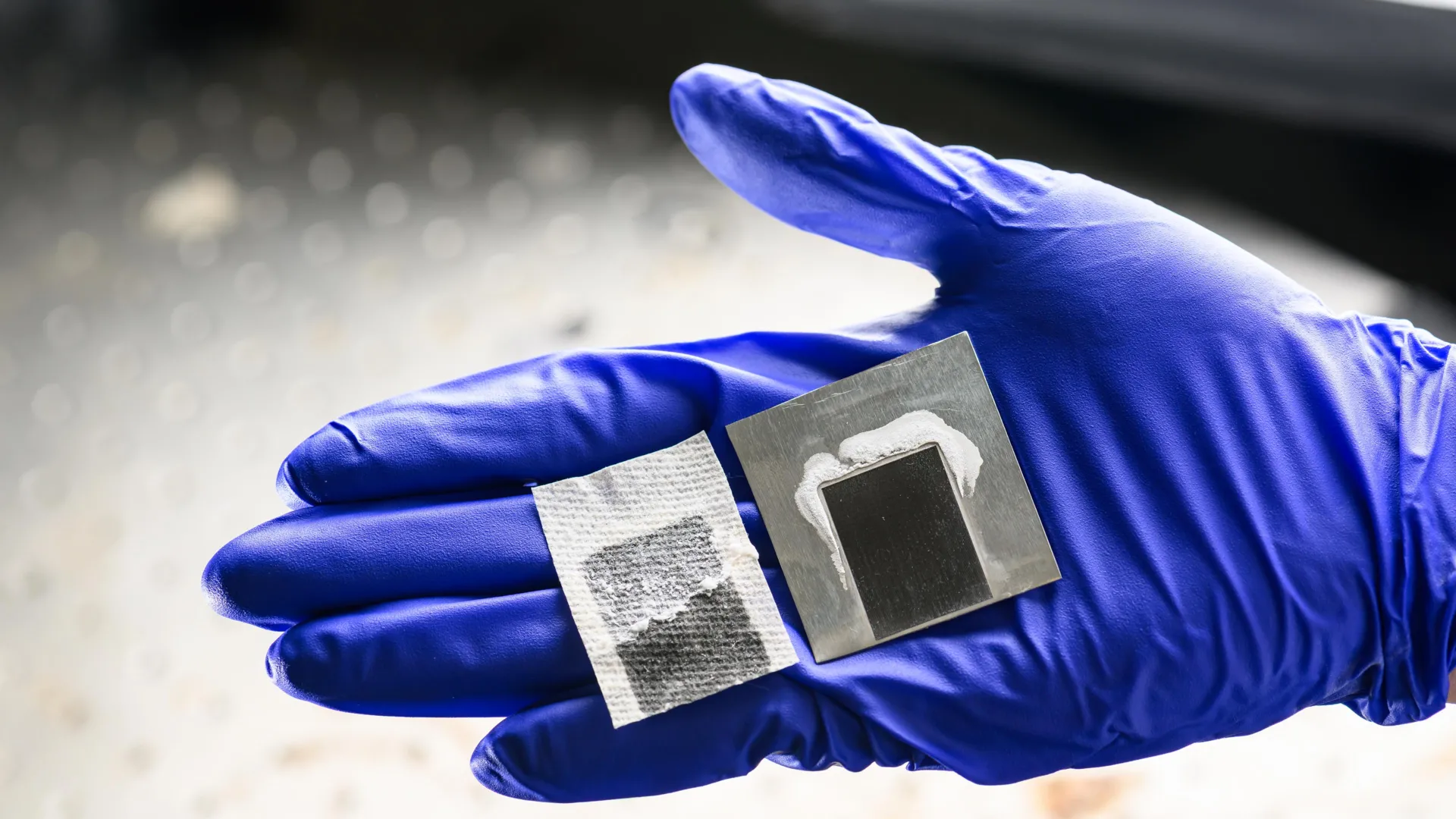
    The system utilizes a specially designed solar panel made of black metal that is textured with a femtosecond laser. This treatment imparts two important properties to the surface. It absorbs almost all incoming sunlight and strongly attracts water. This is a property known as super-hygroscopicity.

    Laser-patterned active areas draw a thin layer of seawater across the panel. When sunlight is absorbed, water evaporates and is distilled into fresh water. At the same time, dissolved salts and minerals are guided from the active area and deposited in the untreated part of the panel, called the passive area.

    By keeping salt away from the evaporation zone, the design prevents build-up that could impede continuous operation.

    Prevents clogging with coffee ring effect

    Guo points out that several solar desalination technologies have shown promising results in laboratory studies using simple seawater, which consists of only water and sodium chloride.

    In these experiments, sodium chloride crystals form in a loosely porous structure as water evaporates. Water can continue to flow through these crystals, dissolving them and making the system relatively easy to clean.

    Real seawater is much more complex.

    In addition to sodium chloride, the ocean contains many other dissolved minerals. Materials containing magnesium and calcium often form a hard, dense crust when crystallized. These deposits can block water flow and ultimately stop the desalination process.

    The problem is similar to mineral scale building up in a kettle or a shower head becoming clogged over time, except seawater has a much higher concentration of dissolved salts.

    To overcome this challenge, the Rochester team carefully designed microscopic grooves into the black metal surface. This pattern encourages salts and minerals to move away from active areas before they can build up.

    The researchers also exploited a well-known physical phenomenon known as the coffee ring effect.

    “When you drop coffee on a surface, the water eventually evaporates, leaving a ring of concentrated coffee particles on the outer edge,” Guo says. “We use the same principle to advance the salt into the passive region.”

    When the team tested the technology using water samples collected from the Pacific, Atlantic, and Indian oceans, it effectively cleaned surfaces automatically. Fresh water was continuously extracted, while salt was directed into a passive area where it could be collected later without reducing performance.

    Recovering valuable minerals without producing waste

    One of the most important advantages of this system is what happens to the leftover salt.

    Traditional desalination produces a liquid brine that must be treated, disposed of, or discharged into the environment. The new process recovers nearly all dissolved salts in solid form.

    These recovered materials can become a valuable resource. In addition to making table salt, the process could also be useful in extracting important minerals such as lithium, a key component of lithium-ion batteries used in electric cars and many consumer electronics products.

    In a related study published in Materials Chemistry Journal AGuo et al. demonstrated that the same superwicking solar panels can separate lithium from other salts.

    To achieve this, the researchers embedded hydrogen titanate nanoparticles into microscopic grooves on the surface of the black metal. These particles selectively separate lithium from other dissolved minerals.

    “Extracting lithium from the earth has proven to be very costly from an energy and environmental perspective, so extracting lithium directly from seawater could be a very important tool in the future,” Guo says.

    Using water from Utah’s Great Salt Lake, the research team was able to recover about 50 percent of the lithium in the salt left after desalination.

    Potential for large-scale freshwater production

    The technology has so far only been demonstrated in proof-of-concept devices, but Guo believes the approach can be scaled up significantly.

    Successful expansion of this system has the potential to increase access to clean drinking water while creating a more sustainable source of important minerals.

    This research was supported by the National Science Foundation, the Bill & Melinda Gates Foundation, and the World University Network. Additional contributors from the Optics Institute include principal investigator Subash Singh, alumnus Ran Wei ’24 (Ph.D.), and doctoral students Luheng Tang and Tainshu Xu, and Mingjiang Ma.


    Source link

    Visited 5 times, 5 visit(s) today
    Share. Facebook Twitter Pinterest LinkedIn Telegram Reddit Email
    Previous ArticleWhy is cancer more prevalent in middle age than in old age?
    Next Article Irregular brain maturation in childhood predicts emotional habits in early adolescence
    healthadmin

    Related Posts

    Why is cancer more prevalent in middle age than in old age?

    May 31, 2026

    Research reveals that chimpanzees and bonobos have human-like friend circles

    May 31, 2026

    Scientists have discovered a hidden switch that promotes brain inflammation in Alzheimer’s disease

    May 31, 2026

    Ocean health may depend on tiny microbes inside fish

    May 31, 2026

    Quantum metasurface breakthrough could finally close the terahertz gap

    May 31, 2026

    Navigating the 2025–2030 Dietary Guidelines: Resolving Confusion for Clinical Practice

    May 31, 2026
    Add A Comment
    Leave A Reply Cancel Reply

    Categories

    • Daily Health Tips
    • Discover
    • Environmental Health
    • Exercise & Fitness
    • Featured
    • Featured Videos
    • Financial Health & Stability
    • Fitness
    • Fitness Updates
    • Health
    • Health Technology
    • Healthy Aging
    • Healthy Living
    • Holistic Healing
    • Holistic Health & Wellness
    • Medical Research
    • Medical Research & Insights
    • Mental Health
    • Mental Wellness
    • Natural Remedies
    • New Workouts
    • Nutrition
    • Nutrition & Dietary Trends
    • Nutrition & Superfoods
    • Nutrition Science
    • Pharma
    • Preventive Healthcare
    • Professional & Personal Growth
    • Public Health
    • Public Health & Awareness
    • Selected
    • Sleep & Recovery
    • Top Programs
    • Weight Management
    • Workouts
    Popular Posts
    • 1773313737_bacteria_-_Sebastian_Kaulitzki_46826fb7971649bfaca04a9b4cef3309-620x480.jpgHow Sino Biological ProPure™ redefines ultra-low… March 12, 2026
    • pexels-david-bartus-442116The food industry needs to act now to cut greenhouse… January 2, 2022
    • the-pros-and-cons-of-paleo-dietsThe Pros and Cons of Paleo Diets: What Science Really Says April 16, 2025
    • 1773729862_TagImage-3347-458389964760995353448-620x480.jpgDespite safety concerns, parents underestimate the… March 17, 2026
    • 1773209206_futuristic_techno_design_on_background_of_supercomputer_data_center_-_Image_-_Timofeev_Vladimir_M1_4.jpegMulti-agent AI systems outperform single models… March 11, 2026
    • 1774403998_image_28620e4b6b0047f7ab9154b41d739db1-620x480.jpgGait pattern helps distinguish between Lewy body… March 24, 2026

    Demo
    Stay In Touch
    • Facebook
    • Twitter
    • Pinterest
    • Instagram
    • YouTube
    • Vimeo
    Don't Miss

    Standing ovation for RevMed, warning for Akeso

    By healthadminMay 31, 2026

    Scott Morgan/ASCO Adam Feuerstein is a senior writer and biotechnology columnist, reporting on the intersection…

    Rape myths are subtly ingrained in family conversations about safety

    May 31, 2026

    Irregular brain maturation in childhood predicts emotional habits in early adolescence

    May 31, 2026

    New solar desalination breakthrough allows you to create fresh water without toxic salt water

    May 31, 2026

    Subscribe to Updates

    Get the latest creative news from SmartMag about art & design.

    HealthxMagazine
    HealthxMagazine

    At HealthX Magazine, we are dedicated to empowering entrepreneurs, doctors, chiropractors, healthcare professionals, personal trainers, executives, thought leaders, and anyone striving for optimal health.

    Our Picks

    New solar desalination breakthrough allows you to create fresh water without toxic salt water

    May 31, 2026

    Why is cancer more prevalent in middle age than in old age?

    May 31, 2026

    Good members go to Congress because they choose to run, not because voters value their skills.

    May 31, 2026
    New Comments
      Facebook X (Twitter) Instagram Pinterest
      • Home
      • Privacy Policy
      • Our Mission
      © 2026 ThemeSphere. Designed by ThemeSphere.

      Type above and press Enter to search. Press Esc to cancel.