


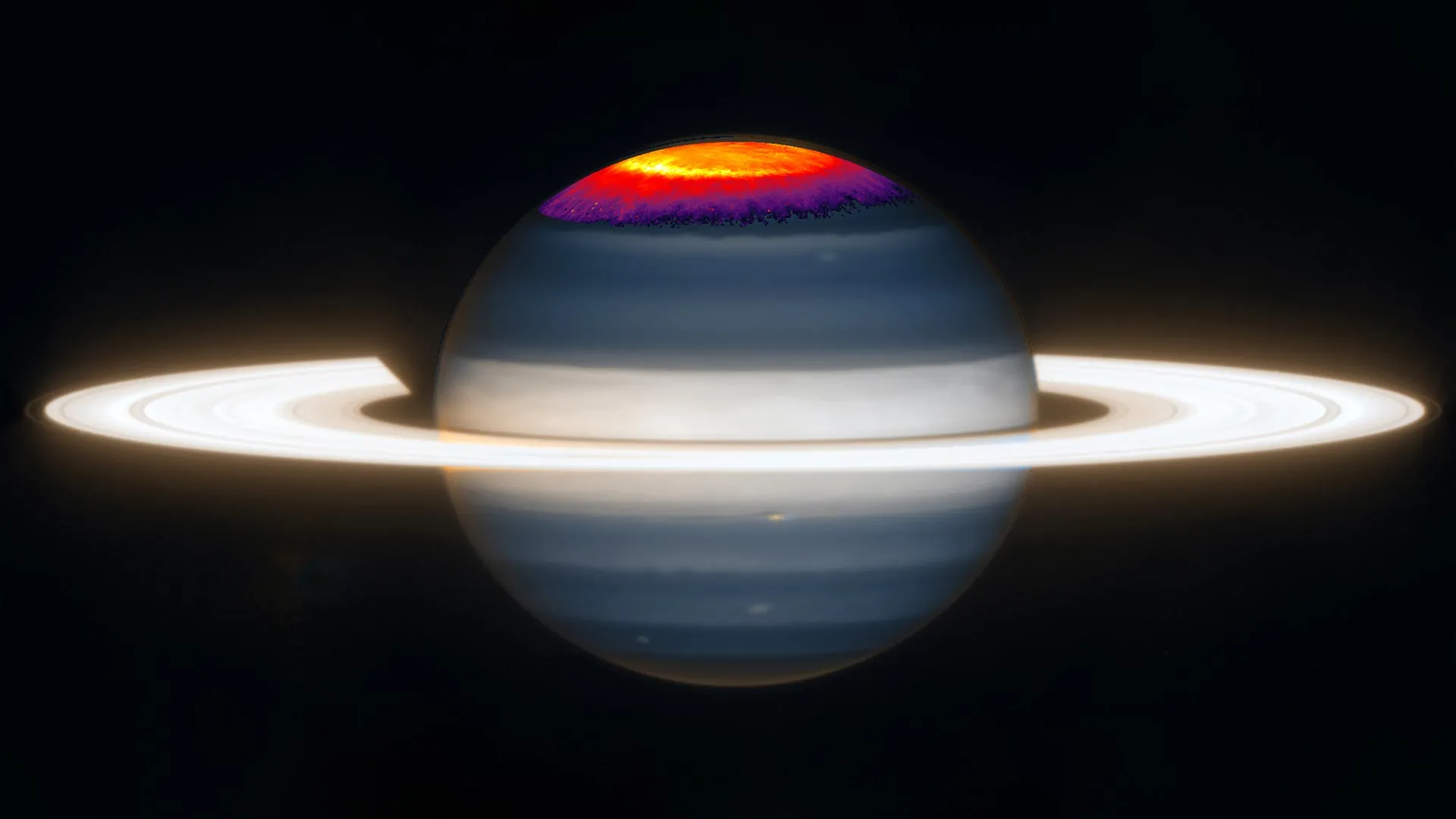
For years, Saturn seemed to be doing something impossible.
The measurements suggested that the giant planet’s rotational speed was changing over time, as if Saturn was accelerating or slowing down for some reason. This puzzling result left scientists searching for answers. Now, researchers using the James Webb Space Telescope (JWST) say they have finally solved the mystery.
The new discovery is Geophysical Research Journal: Astrophysicsreveals that Saturn’s spectacular auroras are at the center of the phenomenon. The study shows that Saturn’s auroras can cause powerful cycles involving heat, winds, and electrical currents, and that depending on how they are measured, Saturn can appear to rotate at different speeds.
The mystery of Saturn’s rotation
This puzzle dates back several decades, but was brought back to the spotlight in 2004 after observations by NASA’s Cassini spacecraft suggested that Saturn’s rotation rate was gradually changing.
This result was difficult to explain because planets do not simply change their rotation speed over short timescales.
In 2021, a team led by Professor Tom Stallard from Northumbria University proposed an alternative explanation. Their research showed that Saturn’s rotation is not actually changing. Instead, the electrical signals associated with Saturn’s auroras were influenced by winds in Saturn’s upper atmosphere. These winds produced electrical currents that changed the auroral signals that scientists were using to estimate the planet’s rotation.
That study explained the misleading measurements, but left one big question unanswered. It’s about what causes those atmospheric winds.
James Webb maps Saturn’s aurora borealis
To investigate, Stallard and colleagues from institutions across the UK and US turned to the James Webb Space Telescope.
The research team observed Saturn’s northern auroral region continuously throughout the planet. This observation provided a level of detail not achievable with previous instruments.
The researchers focused on the infrared light emitted by molecules known as trihydrogen cations. This molecule forms in Saturn’s upper atmosphere and serves as a natural indicator of temperature. By analyzing that glow, the team created the most detailed map ever created of the temperature and charged particle density within Saturn’s auroral regions.
The improvement in accuracy was dramatic. Previous measurements had an uncertainty of about 50 degrees Celsius, making it difficult to detect subtle changes. JWST’s observations were about 10 times more accurate, allowing scientists to identify local heating and cooling patterns for the first time.
Self-sustaining planetary heat engine
The new data closely matched predictions from a computer model developed more than a decade ago. But this model only worked if the source of atmospheric heating was located exactly where the most intense auroral particles enter Saturn’s atmosphere.
The results show that Saturn’s auroras do more than just produce a dazzling light show.
The energy stored by the aurora heats certain regions of the atmosphere. That heating creates wind, which generates an electric current. These currents power the aurora itself, continuing to heat the atmosphere and sustain the entire cycle.
Lead researcher Professor Tom Stallard said: “What we are essentially seeing is a planetary heat pump. Saturn’s auroras heat the atmosphere, the atmosphere creates winds, the winds create currents that power the auroras, and the auroras keep going. The system provides its own energy.”
“We’ve known for decades that something strange was going on with Saturn’s apparent rotation rate, but we couldn’t explain it. Then we showed that Saturn was driven by atmospheric winds, but we still didn’t know why those winds existed. These new observations made possible by JWST finally gave us the evidence we needed to close that loop.”
Influences beyond Saturn
This discovery may have significance far beyond a single planet.
Researchers have found evidence that Saturn’s atmosphere and magnetosphere are closely connected. The magnetosphere is a vast region of space shaped by a planet’s magnetic field. Atmospheric activity is thought to affect the state of the magnetosphere, which feeds energy back into the atmosphere.
This continuous exchange may help explain why the process remains stable over long periods of time.
Researchers say similar interactions could occur on other planets.
Professor Stallard added: “This result changes the way we think about planetary atmospheres more generally. If conditions in a planet’s atmosphere can conduct currents into the surrounding space environment, understanding what is happening in the stratospheres of other worlds may reveal interactions we have not yet imagined.”
international research activities
The James Webb Space Telescope is the world’s premier space science observatory. The telescope is designed to study celestial bodies throughout the solar system, investigate planets orbiting distant stars, and explore the origin and evolution of the universe. Webb is an international project led by NASA in collaboration with ESA (European Space Agency) and CSA (Canadian Space Agency).
The study was carried out by researchers at Northumbria University and collaborators from Boston University, Leicester University, Aberystwyth University, Reading University, Imperial College London, Lancaster University and Johns Hopkins University Applied Physics Laboratory. Funding for the study was provided by the Science and Technology Facilities Council (STFC).
