


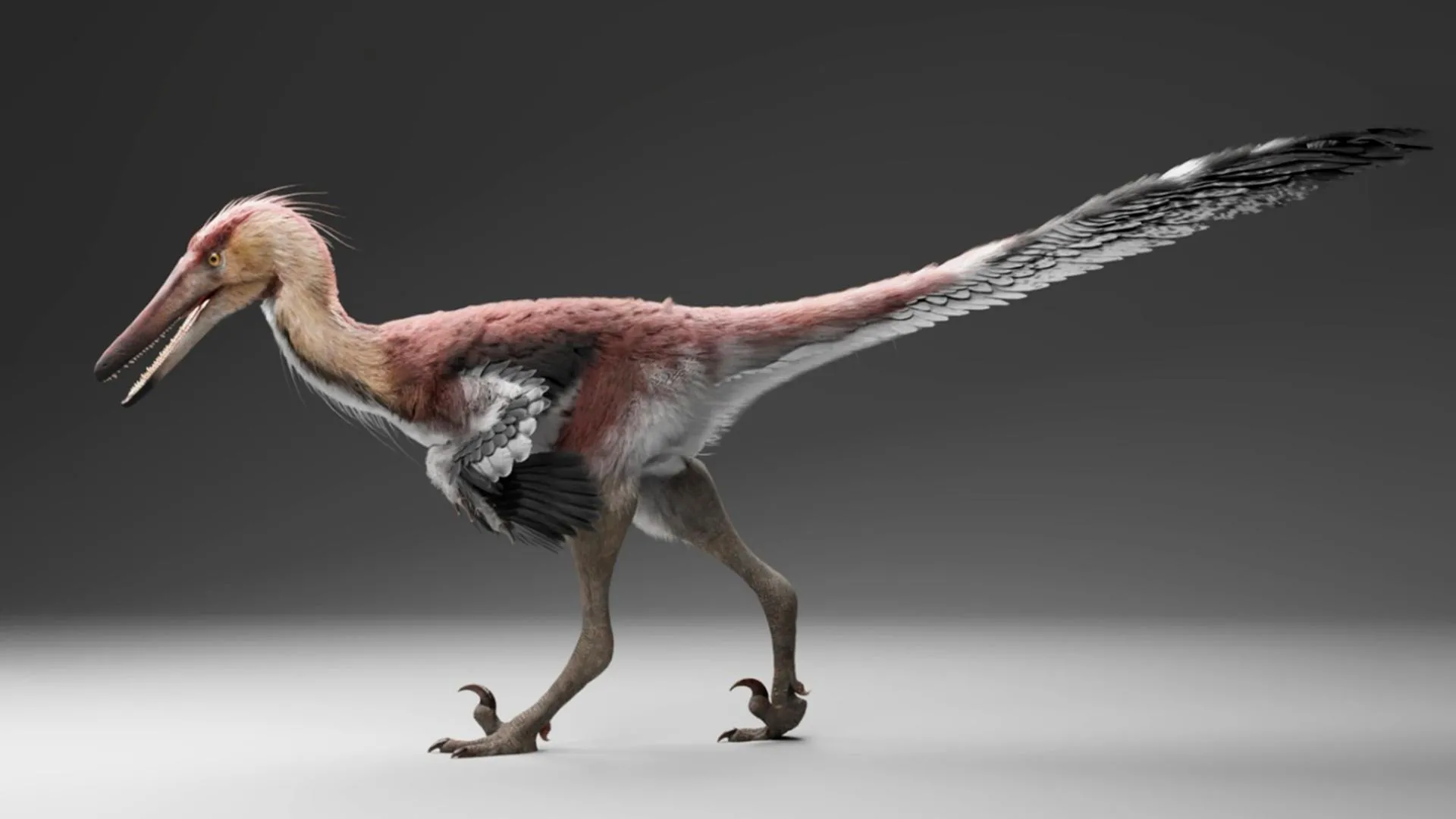
Paleontologists have identified a new species of raptor dinosaur that lived in what is now southern Patagonia about 70 million years ago. The name of that animal is canku australisIt appears to have been a fish hunter, and its eating habits may have been similar to that of modern herons.
The discovery is based on fossil remains that include teeth, vertebrae, and toe bones. The researchers placed the dinosaur in the family Uenlagidae, a group of small and medium-sized theropod dinosaurs known from Late Cretaceous rocks in South America, Antarctica, Australia, and Madagascar.
When compared with fossils, Neucenaraptor Argentinaanother genus that lived in northern Patagonia about 90 million years ago, and scientists believe the adult canku australis It reached about 2.5–3 meters (8–10 ft) in length.
This species was discovered by Dr. Matias Motta, a paleontologist at the Bernardino Rivadavia Museum of Natural Sciences in Buenos Aires (Argentine Museum of Natural Sciences “Bernardino Rivadavia”). Journal of Vertebrate Paleontology.
Wetland life in ancient Patagonia
According to Dr. Motta, Kanku They lived in landscapes shaped by meandering rivers, streams, and seasonal ponds.
“Kunks lived in landscapes with meandering rivers and seasonal ponds that were home to aquatic plants such as water lilies, and animals such as fish, insects, and various molluscs,” Dr. Motta said.
Evidence from ancient soils and fossil plants suggests that the region was very different from modern-day Patagonia.
Based on that evidence, Dr. Motta explains, “The climate 70 million years ago was warm, humid, with seasonal rainfall, very different from the cold and relatively dry conditions of today.”
Dinosaurs adapted to fishing
Fossilized bones provide clues about how it works. Kanku I might have hunted.
Researchers have discovered unusual features in dinosaur neck vertebrae that serve as attachment points for muscles and help protect blood vessels. Similar adaptations are found in modern birds that rely on precise and flexible neck movements.
“The kanku’s cervical vertebrae exhibit special structures for muscle attachment and protection of neck blood vessels, a feature that is particularly important in modern birds with complex neck movements, such as herons,” says Dr. Motta.
“This suggests that kanks may have been active fishermen, in contrast to common depictions of raptors as agile terrestrial predators, such as the velociraptors of the northern hemisphere.”
The discovery adds to the evidence that members of the family Urinidae had a different ecological role than their more famous northern relatives.
Filling gaps in the fossil record
The discovery will also help scientists better understand the distribution of anenrahids across South America.
Seven species have so far been confirmed in northern Patagonia. In contrast, in southern Patagonia there were only scattered fossils that could not be confidently assigned to a specific species.
“Kanku helped fill a gap in the Late Cretaceous distribution of southern Patagonia, linking known records from northern Patagonia and Antarctica and showing that this family was dispersed across different latitudes in South America.”
The fossils were recovered from the La Anita farm near El Calafate, Santa Cruz province, Argentina.
“Since 2018, on-site excavations have been carried out there, and fossils of a wide variety of plants and animals have been discovered,” says Dr. Motta.
The first fossils were discovered in 2018, but researchers initially lacked enough material to recognize them as a new species.
“The first canku fossil was discovered in 2018, but it was too fragmentary to identify it as a new species,” he added. “Following expeditions recovered additional material, and in 2024, the cervical vertebrae were discovered, which was key to the recognition of a new Unenragine dinosaur.”
Characteristics of Canku Australis
Like other non-enraged canku australis It had an enlarged claw on its second toe, often associated with raptor dinosaurs.
“However,” explains Dr. Motta, “they differ in that they have teeth with sharp, pronounced longitudinal ridges and, in particular, pneumatic cervical vertebrae (with internal air chambers).”
This species was also smaller and lighter than other related species.
“It is also smaller and more lithe than other non-enragid animals from the late Cretaceous. Austroraptor Kabazaithe giant (approximately 5 meters long) Unenragine of northern Patagonia. ”
Evidence of a fish-eating lifestyle
scientists believe Kanku This supports the claim that many oenidae specialize in catching fish.
“Their elongated snouts, numerous teeth, and long, flexible necks suggest that they were adapted for fishing, similar to modern herons,” explains Dr. Motta.
“In the case of the kanku, its remains were found together with fossilized fish, supporting this idea.”
Fish may have been an important food source, but dinosaurs may have also hunted other animals. Its ecosystem included frogs, lizards, turtles, and mammals such as: Patagorrhinx pasqualia semiaquatic monotreme related to modern echidnas and platypuses.
Kanku They also shared their environment with larger predators.
“The kanku coexisted with large carnivores, such as the fearsome megaraptorid dinosaur Mayp macrothoracic, which was over 10 meters long, and may have been capable of preying on the kanku,” Motta added.
Inspired by Patagonian indigenous mythology
The dinosaur’s name pays homage to the traditions of the Aoniken people, the southernmost group of Patagonia’s indigenous Tehuelche people.
“The kanku is an ancient giant rhea (a flightless South American bird) whose powerful running legs left paw prints in the sky, forming the constellation known as Choiolus,” Dr. Motta explains.
“In Latin, this constellation is called Crux, or Southern Cross, and refers to the southernmost region of Earth where Kanku was discovered.”
Species name AustraliaThis character, which means “from the south,” also reflects where dinosaurs were discovered.
More discoveries await
Researchers plan to continue excavating the Chorrillo Formation where the fossils were discovered.
“The site where Kanku was discovered provides extensive information about the Late Cretaceous environment of southern Patagonia, so it is important to continue excavations there,” explains Dr. Motta.
“Finding more cank fossils will help us better understand its biology and ecological role.”
At the same time, the research team is studying newly recovered fossils from four archaeological sites in northern Patagonia.
“These discoveries indicate that urnellagiids were widely distributed during the Late Cretaceous,” Dr. Motta says.
He added: “We are particularly interested in studying the environments in which they colonized and separated their species, particularly ecosystems dominated by large apex predators such as abelisaurids and megaraptors.”
