


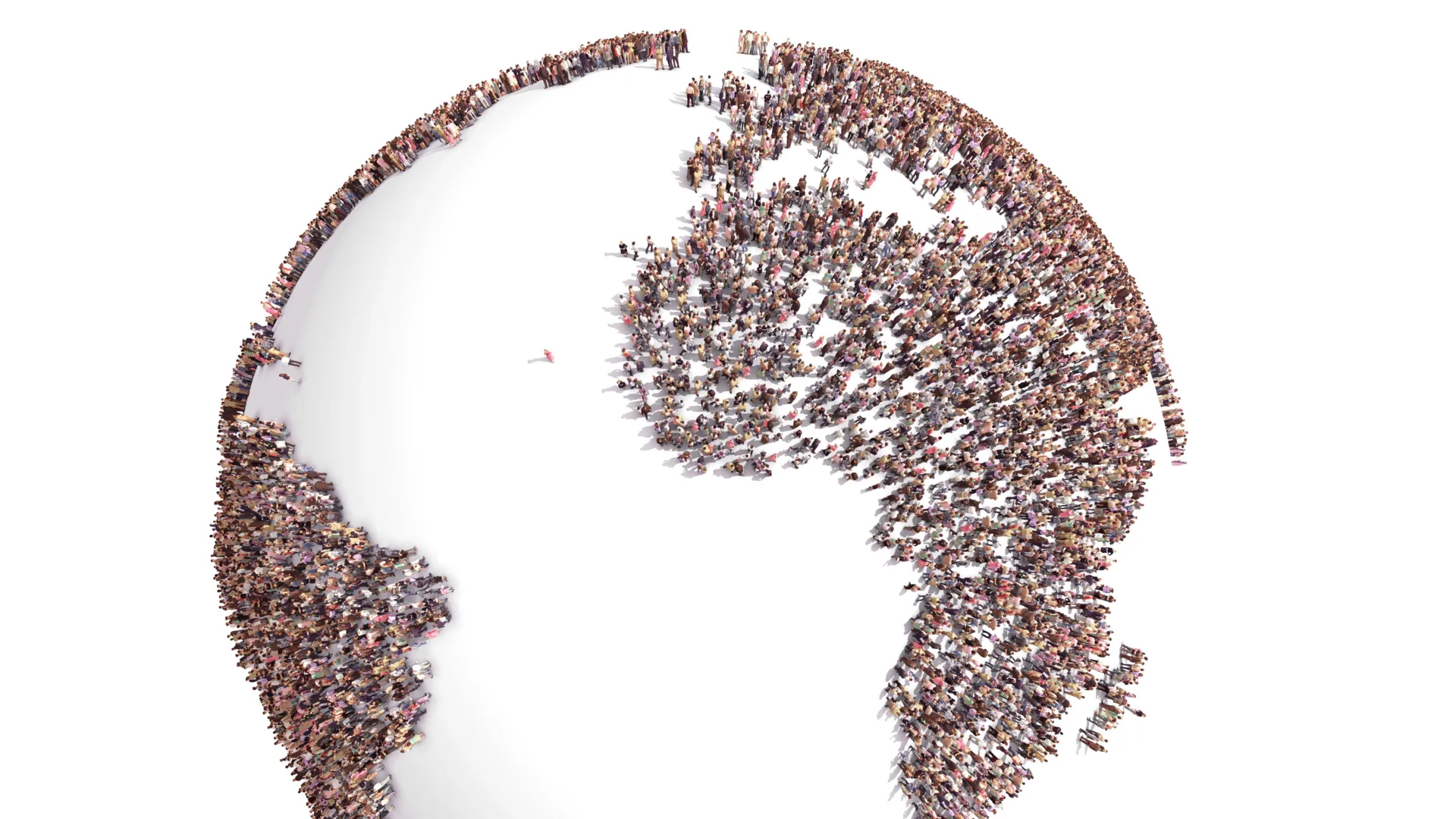
New research warns that humans are putting more pressure on the planet than it can sustain, raising concerns for future food security, climate stability and human well-being. Although researchers say the situation is serious, they also believe that slowing population growth and changing consumption patterns may still help reduce risks in the long term.
This study environmental research lettersconcludes that humanity has already exceeded the Earth’s sustainable carrying capacity. Scientists say the combination of continued population growth and current levels of resource use will place even greater strain on ecosystems and societies around the world.
The study examined more than 200 years of global population data and identified a major turning point in human population trends that began in the mid-20th century.
Lead author Corey Bradshaw, Matthew Flinders Professor of Global Ecology at Flinders University, said the findings reveal clear signs that humans are operating beyond Earth’s natural limits.
“The Earth cannot keep up with the way we use its resources. Without major changes, it cannot support even today’s demands. Our findings show that we are giving the planet more challenges than it can handle,” says Professor Bradshaw, from the School of Science and Engineering’s Earth Ecology Laboratory.
Population growth and the limits of the earth
An international research team, including the late Professor Paul Ehrlich, analyzed historical population records and used ecological growth models to study changes in population size and growth rates over time.
Researchers compared trends in different regions of the world and investigated how population growth is linked to climate change, carbon emissions and ecological footprints. Their goal was to better understand how increasing human numbers contribute to environmental stress.
According to the study, population growth accelerated before the 1950s as populations increased around the world. More people are innovating, energy usage is increasing, and technological advances are being made to support further growth.
This pattern changed in the early 1960s. Although the world’s population continued to grow, its growth rate began to slow.
“This change marked the beginning of what is called ‘negative demographics’,” Professor Bradshaw said.
“This means that population growth will no longer translate into rapid growth. When we examine this phase, we find that if current trends hold, world population is likely to peak at somewhere between 11.7 billion and 12.4 billion by the late 2060s or 2070s.”
Fossil fuels and ecological overshoot
Professor Bradshaw said this level of population growth was possible because society was heavily reliant on fossil fuels and was consuming natural resources faster than the earth could replenish them.
“The truly sustainable population is much smaller, approaching the population the world supported in the mid-20th century. Our calculations show that if everyone lived within ecological limits and within a comfortable and economically secure standard of living, a sustainable world population would approach about 2.5 billion people,” he says.
Researchers say the discrepancy between that sustainable estimate and the current world population of 8.3 billion highlights the scale of global overconsumption.
Research shows that dependence on fossil fuels supports food production, industrial growth, and energy supplies, temporarily masking the effects of ecosystem overshoot. But the same processes are also intensifying climate change, pollution, and environmental degradation.
Researchers also found a strong link between population size and rising global temperatures, a growing ecological footprint, and increasing carbon emissions during periods of population decline. The study concluded that total population size explains environmental change more strongly than per capita consumption alone.
Professor Bradshaw says both population growth and consumption patterns are increasing pressure on the planet.
“Unless major changes are made, humanity’s current path will push society into a deeper crisis,” he says.
“Earth’s life support systems are already under strain, and unless we rapidly change how we use energy, land, and food, billions of people will face further instability. Our research shows that these limits are not theoretical, but ongoing.”
Risks to climate, food and human stability
The researchers stress that their study does not predict a sudden collapse of civilization. Rather, they describe it as a realistic assessment of the increasing pressures shaping humanity’s future.
Risks associated with exceeding the Earth’s biological capacity include worsening climate impacts, loss of biodiversity, reduced food and water security, and increased inequality.
Professor Bradshaw says that if future generations are to live safely and sustainably, society needs to rethink the way it uses land, water, energy and raw materials.
“A smaller population and lower consumption produces better outcomes for both people and the planet,” he says. “While the space for action is shrinking, meaningful change is still achievable if countries work together.”
The researchers hope their findings will encourage governments, organizations and communities to focus on long-term planning, recognize environmental limits and support strategies to stabilize population growth, reduce consumption and protect natural systems.
“The choices we make in the coming decades will determine the well-being of future generations and the resilience of the natural world that supports all life,” concludes Professor Bradshaw.
This project received support from The Kids Research Institute Australia and Population Matters.
Paper “The world’s human population has exceeded the Earth’s sustainable carrying capacity” Corey JA Bradshaw, Melinda A. Judge (University of Western Australia), Daniel T. Blumstein (University of California, USA), Paul R. Ehrlich (Stanford University, USA), Aisha N. Dasgupta (University of Cambridge, UK), Mathis Wackernagel (University of California, USA), Lewis JZ Weeda (University of Western Australia) and Peter N. Le Souëf (University of Western Australia) But, environmental research letters.
