


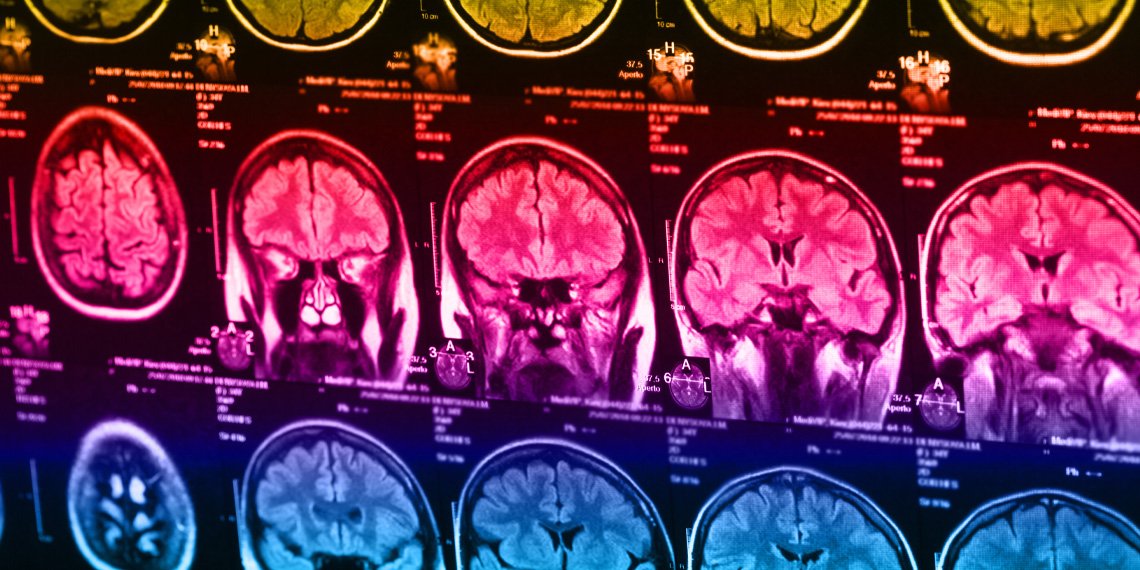
Children and adolescents with high BMI show distinct differences in brain activity and the way different brain regions communicate with each other. These neurological patterns indicate a decline in the brain’s natural inhibitory systems, which can make it difficult to change deeply ingrained habits. The results of this study were recently published in the journal Clinical Neurophysiology.
The human brain continues to develop and be significantly rewired throughout childhood and adolescence. The frontal cortex, the brain region responsible for impulse control and complex decision-making, is one of the last regions to fully mature. During this long period of development, the brain is highly sensitive to environmental factors. Such external influences include nutrition, physical activity, and overall body weight.
Animal models show that diets high in fat and sugar can disrupt the brain’s delicate balance. Brain cells communicate using a combination of excitatory signals that increase activity and inhibitory signals that quieten activity. Proper brain function depends on maintaining a stable balance between these two forces.
Researchers have found that in rodents, obesity-related diets damage specialized inhibitory cells in the frontal cortex. These cells are usually wrapped in a protective mesh called perineural netting. A high-fat diet appears to erode this protective mesh, making inhibitory cells more susceptible to damage.
When these inhibitory cells no longer function properly, the brain loses its ability to apply neurological brakes. The result is an overexcited state. The research team wanted to see if young, heavier humans exhibit a similar neurological pattern to this state of disinhibition.
Researcher Amy C. Reichert from Western University and the University of Adelaide led the study. She worked in collaboration with Benjamin T. Dunkley and a team of other experts at the Hospital for Sick Children in Toronto. Together, they designed a study to directly measure brain activity in young volunteers.
Researchers recruited 32 children and teenagers between the ages of 8 and 19. They calculated each participant’s body mass index, a standard medical metric based on the ratio of height to weight. The cohort was divided into two groups based on how BMI compared to standard growth curves for a given age and gender.
One group consisted of 15 young people with a low BMI within the average range. The other group included 17 young people with a high BMI and who fell into the overweight or obese category. Both groups were matched as closely as possible for age and height.
To measure brain activity, the research team used a non-invasive imaging technique called magnetoencephalography. The technology relies on sensitive sensors that detect tiny magnetic fields generated by the electrical activity of neurons. This method provides very detailed information about the timing and fast frequency of brain waves. Neural oscillations can be tracked in milliseconds.
Instead of asking participants to perform active cognitive puzzles, the researchers had them undergo a resting-state scan. Participants lay in the scanner and watched an abstract computer-generated video landscape for 5 minutes. This neutral video helped subjects to still while their minds naturally wandered. This approach allowed the scientists to record spontaneous background activity in the brain.
The researchers analyzed the resulting brainwave data, focusing on rhythmic oscillations. They found that young people with higher BMI showed significant differences in high-frequency rhythms known as gamma brain waves. Gamma waves are fast electrical rhythms produced when excitatory and inhibitory cells engage each other.
In the higher body weight group, gamma activity was greatly elevated across many different cortical lobes. The researchers found the boldest effects in the posteromedial cortex and temporoparietal junction, areas involved in directing attention. Increased gamma activity is often interpreted as a sign that the brain’s natural inhibitory systems are not exerting sufficient control.
The research team also looked at non-periodic activity, a constant background static electricity in the brain. They measured the slope of this background noise, a common metric used by scientists to measure the overall balance of excitation and inhibition in neural tissue. The higher weight group had a shallower slope, indicating a relative lack of neural inhibition.
These background noise differences were most pronounced in frontal cortex and midline parietal regions. The frontal cortex is deeply involved in top-down cognitive control and mental flexibility. Changes here suggest potential difficulties in controlling impulses and adapting to new rules.
In addition to isolating local brain regions, the researchers looked at how specialized brain networks communicate with each other. The brain relies on a web of interconnected areas that exchange information. For example, the default mode network is active during internal thought, whereas the central executive network handles intensive working memory tasks.
The saliency network is another structural web that is responsible for detecting relevant stimuli in the environment and determining what the brain should pay attention to. The researchers mapped the connections between these different networks by observing how the signals synchronized. Young people with a high BMI were observed to have weakened communication in low-frequency brain waves, such as delta and theta rhythms.
Specifically, connectivity between the saliency network and networks involved in driving motivated behavior was reduced. Conversely, the same group showed unusually strong connectivity in high-frequency gamma waves. These stronger high-frequency couplings emerged between the default mode network and the central executive network.
This particular combination of weakening of low-frequency coupling and strengthening of high-frequency coupling indicates an overall loss of efficiency. The typical pathways used to coordinate thought and behavior appeared to be reorganized in the higher weight group. This may mean your brain is working harder to send the same amount of information.
The researchers note that there are several caveats to the experimental approach. BMI is an imperfect tool that only takes into account height and weight. It is not possible to differentiate between muscle mass and adipose tissue. This means that it does not always accurately reflect an individual’s body fat percentage.
The relatively small number of participants also means that these results should be viewed as preliminary. The study’s observational design means the researchers cannot say that increased BMI caused changes in brain function. It’s still very possible that pre-existing brain differences predispose certain young people to excessive weight gain.
The scientists also did not track the participants’ daily diet or physical activity levels or conduct behavioral cognitive tests. As a result, it is not yet known how these neural changes will impact the real world. How these specific brainwave patterns influence daily decision-making, academic performance, or emotional regulation remains a mystery.
Future studies could incorporate detailed dietary tracking and extensive cognitive assessments and brain imaging. Researchers suggest that weakening inhibitory signaling in the frontal lobe may have a direct impact on food decisions over time. Without strong inhibitory control, it can be much more difficult to resist eating highly palatable foods.
Over time, eating habits can change brain development, creating a feedback loop in which the same eating habits stick. Understanding how weight is related to brain development during adolescence may ultimately help medical professionals develop better strategies to support both mental and physical health.
The study, “Elevated body mass index in youth is associated with neural disinhibition and disconnection of network function: a magnetoencephalographic study,” was authored by AC Reichelt, E. Daskalakis, J. Cohen, KG Solar, M. Saberi, M. Ventresca, M. Ali, R. Zamyadi, V. Bhat, SE Scratch, J. Hamilton, and BT Dunkley.
