


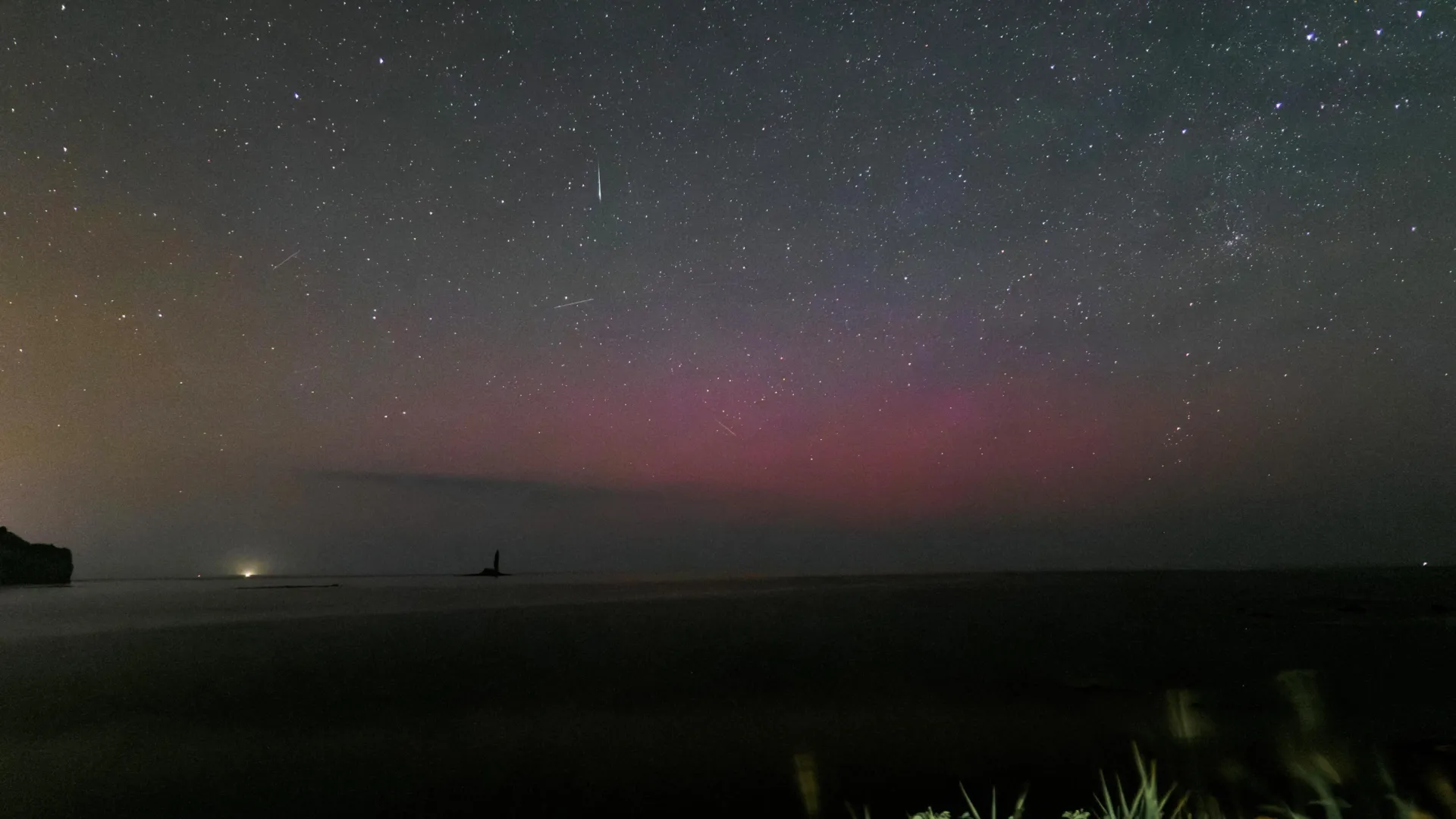
On certain nights in Japan, people may notice a faint red light spreading low over the horizon. The pink haze is often overlooked, but it is produced by powerful activity occurring far above Earth. A stream of charged particles from the Sun travels toward our planet and interacts with Earth’s magnetic field. When these particles collide with oxygen atoms higher up in the atmosphere, the atoms release energy in the form of soft red light, creating rare aurora borealis visible from the ground.
New research published in Journal of Space Weather and Space Climate Researchers from Hokkaido University and Okinawa Institute of Science and Technology Graduate University have reported that they have observed an unusual red aurora above Japan at a much higher altitude than expected. The glowing display extended approximately 500 to 800 kilometers above the Earth’s surface.
Rare red aurora reaches extreme heights
Auroras are most commonly seen near the polar regions, where charged solar particles interact with Earth’s atmosphere to create twinkling lights in the sky. In Japan and other areas further south, auroras are less common and are usually associated with powerful geomagnetic storms. These phenomena typically occur at altitudes of approximately 200 to 400 kilometers.
New discoveries challenge that understanding.
“We found that red auroras can extend to very high altitudes even in storms that are measured to be of moderate strength. We were really surprised as we did not expect such high auroras to appear even in storms of moderate strength,” said Tomohiro Nakayama, lead author of the study. “This suggests that these storms may actually be stronger than traditional indices indicate.”
The research team studied five auroral phenomena recorded in Hokkaido between June 2024 and March 2025. During that period, bursts of charged particles from the sun compressed Earth’s magnetosphere, the invisible magnetic shield that surrounds the planet. Although standard measurements classified the storm as moderate, the compression itself appeared to be unusually severe.
Solar winds may be hiding stronger storms
Researchers believe that the dense stream of solar wind squeezed Earth’s magnetic field so strongly that the upper atmosphere heated up and expanded upward. Because of this, areas where red auroras occur may have been pushed to much higher altitudes than scientists typically expect.
At the same time, the movement of charged particles may have masked the storm’s true strength, making it appear weaker to conventional space weather measurements.
To investigate this phenomenon, scientists combined satellite observations with photos taken by citizen scientists across Japan. By studying the angle of the auroras in these images and mapping them along Earth’s magnetic field lines, researchers were able to estimate the height at which the glowing structures reach the atmosphere.
The participation of skywatchers from around the country proved particularly valuable. Observations from multiple locations allowed the research team to study the rare auroral phenomenon in more detail than using traditional monitoring networks alone.
Why these auroras are important to satellites
This discovery could have important implications beyond the visual spectacle of aurora borealis. As Earth’s upper atmosphere heats and expands, satellites orbiting Earth experience greater atmospheric drag. This extra drag causes the satellite’s orbit to gradually change, potentially causing some spacecraft to lose altitude sooner than expected.
“As the number of satellites in low Earth orbit continues to grow, understanding these effects becomes increasingly important,” Nakayama says. “Our results could help improve space weather forecasting and support safer satellite operations.”
