


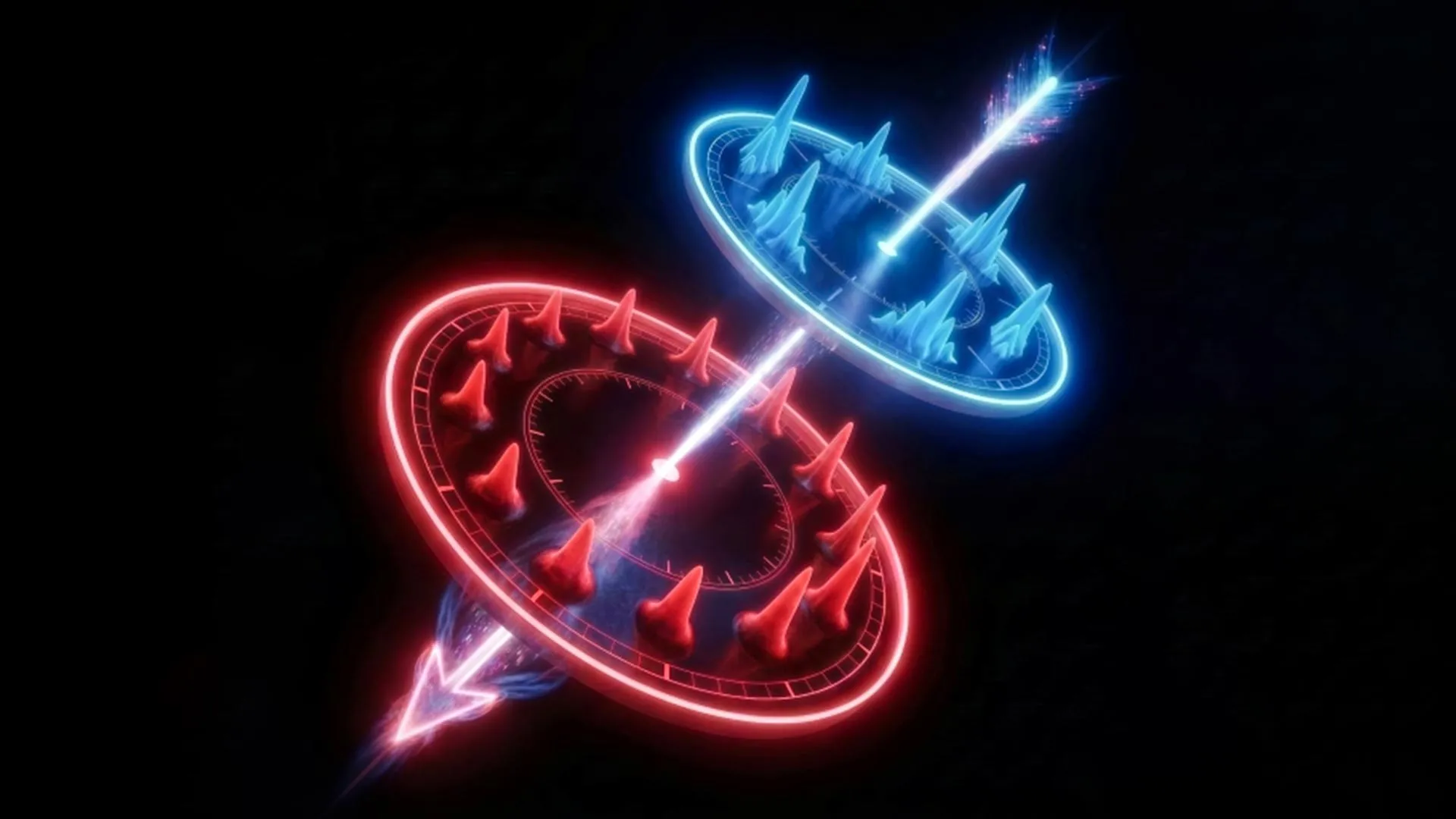
An international research team including scientists from Aston University has developed a new mathematical framework to explain the strange behavior of so-called “breather” laser pulses. This breakthrough combines two very different types of laser dynamics into one model for the first time.
Ultrafast lasers produce incredibly short bursts of light that last only picoseconds or femtoseconds. These lasers are widely used in technologies such as ophthalmic surgery, biomedical imaging, advanced manufacturing, and precision materials processing. A deeper understanding of how these lasers work could help scientists improve their stability and more effectively tune them for specialized applications.
Inside an ultrafast laser, pulses of light repeatedly pass through a structure known as a laser cavity. Under certain conditions, these pulses can form stable wave packets called solitons. Unlike normal light pulses that gradually spread out, solitons maintain their shape as they move.
In most cases, solitons behave in a stable and predictable manner, producing regular pulses similar to a heartbeat. However, in a “breather” laser, the pulse changes continuously over time. As it passes through the laser cavity, it grows and contracts repeatedly, creating rhythmic vibrations similar to breathing. This behavior represents a nonequilibrium condition in which the laser power does not remain stable but constantly changes.
Two types of laser “breathing”
Previous experiments revealed two different forms of breathing behavior in these lasers.
When the laser operates above the minimum power required to sustain pulsed radiation, known as the threshold, the soliton oscillates rapidly. In this method, the breathing cycle is repeated with just a few trips back and forth across the cavity.
Below the threshold, things slow down significantly. A soliton may require hundreds or even thousands of round trips to complete a single breathing cycle.
Until now, researchers have relied on two separate mathematical models to explain these different regimes. New research has changed this by showing that both behaviors can be described within one unified framework.
The research, in which Dr. Sonia Boscolo of the Aston Institute of Photonics took part, physical review letter It was published in a paper titled “An integrated model for breathing solitons in fiber lasers: Mechanisms spanning subthreshold and suprathreshold regimes.”
Unified explanation of complex laser dynamics
The researchers created a modified model that combines two key factors: the rapid evolution of light within the laser cavity and the slow changes that occur in the laser’s energy supply. By accounting for both processes together, the research team demonstrated that the two forms of breathing are not separate phenomena but result from related underlying physics.
Dr. Boscolo said:
“Suprathreshold and subthreshold breathing solitons exhibit markedly different behavior. Above-threshold breathers oscillate rapidly and can lock into the cavity, producing a comb-like high-frequency spectrum with characteristic sidebands in the optical spectrum and a high-order frequency-locked state. Below-threshold breathers Reasers evolve more slowly, producing a dense high-frequency spectrum without strict commensulability or optical sidebands. Our new simulations accurately predict both fast and slow cycles at once, which was previously thought impossible with a single model.
“In our work, we introduce a modified discrete model that incorporates the slow dynamics of the laser gain medium while preserving a detailed description of the cavity. This integrated framework combines all the experimentally observed behavior in both regimes. We accurately reproduce and reveal the underlying mechanism: subthreshold breathing arises from Q-switching combined with soliton shaping, whereas suprathreshold breathing is dominated by Kerr nonlinearity and dispersion.
“This discovery fills a long-standing gap in laser science and provides an important tool for designing the next generation of light-based technologies.”
Future applications of ultrafast lasers
The researchers believe their new framework could become an important tool for engineers developing future optical systems. As demand for more powerful and reliable laser technology increases, this model could help scientists more efficiently predict complex laser behavior without relying on multiple disconnected simulations.
The research team hopes that this work will ultimately serve as a practical guide for designing the next generation of ultrafast lasers for use in medicine, imaging, manufacturing, and other advanced technologies.
