


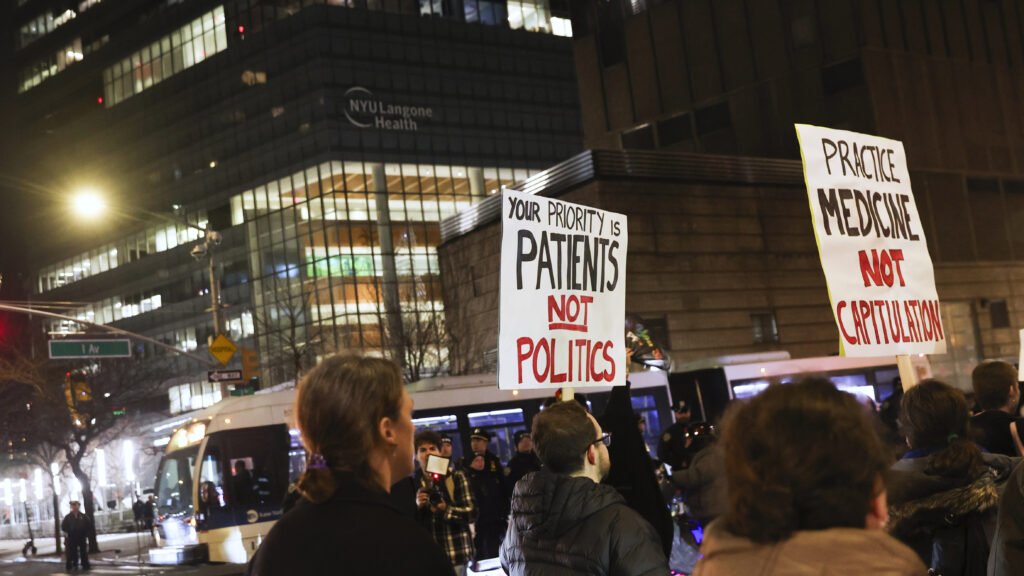
Several hospitals have received federal grand jury subpoenas regarding the provision of gender-affirming care to minors, a move that suggests the Justice Department has opened a criminal investigation, NYU Langone said in a statement.
An investigation into New York University’s records sent last week by the U.S. Attorney’s Office for the Northern District of Texas directs the hospital to submit information about the minors it treated between 2020 and 2026, the clinicians who examined them, and other parties involved.
“What we are seeing from NYU and other institutions that have received similar subpoenas is very different from the Department of Justice subpoenas that institutions received last year,” said Lindsey Dawson, director of LGBTQ health policy at KFF. Previous inquiries sent by the Justice Department to hospitals were administrative subpoenas, which did not require prior judicial review or authorization. If a grand jury is convened, she said, it would be “likely that (the subpoena) is related to a criminal investigation, which could result in more severe penalties.”
So far, New York University is the only hospital to publicly announce receipt of a grand jury subpoena, but the statement claims it is “one of several institutions” being investigated by the Justice Department. Last year, administrative subpoenas were sent to approximately 20 hospitals that provide pediatric gender care, requiring them to provide a wide range of identifiable patient records. Many were dismissed at the district court level before the Trump administration began appealing them.
The Justice Department declined to comment on the subpoena. New York University did not respond to STAT’s request.

Even transgender adults have difficulty finding care: ‘I couldn’t do it on my own’
Details of the federal investigation have not been made public, so it is unclear the focus of the investigation, including potential targets, and whether the new subpoenas relate to an ongoing investigation or an entirely new investigation. Last year, the Trump administration made allegations of potential fraud related to off-label promotion of gender-affirming hormones and puberty blockers. Administration officials and Justice Department attorneys have repeatedly said that even though off-label prescribing is legal, clinicians’ conversations about drugs and materials provided to patients are potentially fraudulent.
Some advocates of gender-affirming care, including Alejandra Caraballo, a lecturer at Harvard Law’s Cyber Law Clinic, say sending a subpoena to New York from a Texas-based court is an example of “judicial shopping,” suggesting the government is picking jurisdictions to file potential cases where it thinks it can win favorable rulings. The Northern District of Texas has long been favored by conservative litigants. In late April, the Justice Department filed a motion in the district seeking to enforce an administrative subpoena against a Rhode Island hospital, and a judge approved it within hours. The hospital appealed this decision, questioning whether the District of Texas was the correct jurisdiction for the case.
The subpoena to NYU could be a major test for New York’s shield law, which requires health care providers to notify patients at least 30 days before providing information in response to a judicial request for information. The law aims to end investigations by other state or federal agencies into the basic provision of politicized care. New York University said in a statement that it is considering its next move.
Over the past year, patients and gender-affirming care providers have been largely successful in challenging the Trump administration in court. The biggest victory for advocates of this care came this spring when a federal judge in Seattle decided to overturn Secretary of Health Robert F. Kennedy Jr.’s declaration that pediatric gender-affirming care did not meet medical standards.
Many advocates believe the decision, which also applies to “substantially similar policies” that replace state medical standards, could be used to block significant penalties for caregivers who affirm the gender of minors included in the Centers for Medicare & Medicaid Services’ proposed rules. However, President Trump’s Justice Department has repeatedly indicated that it intends to proceed with the campaign despite the judicial decision.

More hospitals are halting gender-affirming treatment for minors under pressure from the federal government
At an April hearing in federal court in Boston, Justice Department attorney John Bailey said that even if a judge were to invalidate federal guidance, including former U.S. Attorney General Pam Bondi’s executive order and subsequent directives, it would “not affect the ongoing Department of Justice investigation.”
For Carmel Shachar, director of the Health Law and Policy Clinic at Harvard Law School, the statement suggests that even if courts rule against the validity of the Trump administration’s sweeping directives on gender-affirming care, officials will seek to implement restrictive policies.
“This sounds like someone who still thinks they have a leg to stand on somewhere,” Shachar says. “They are trying to disallow the regulations that are currently being proposed.”
As the Trump administration targets gender-affirming care for young people, dozens of hospitals across the country are suspending or ending transgender services, citing legal pressure. Caraballo believes headlines about a possible criminal investigation may be more important to the Trump administration than the actual outcome. This is because this move alone could intimidate doctors into ceasing to provide treatment.
“All of this is adding to the pressure and creating a lot of stress for providers,” KFF’s Dawson said.
