


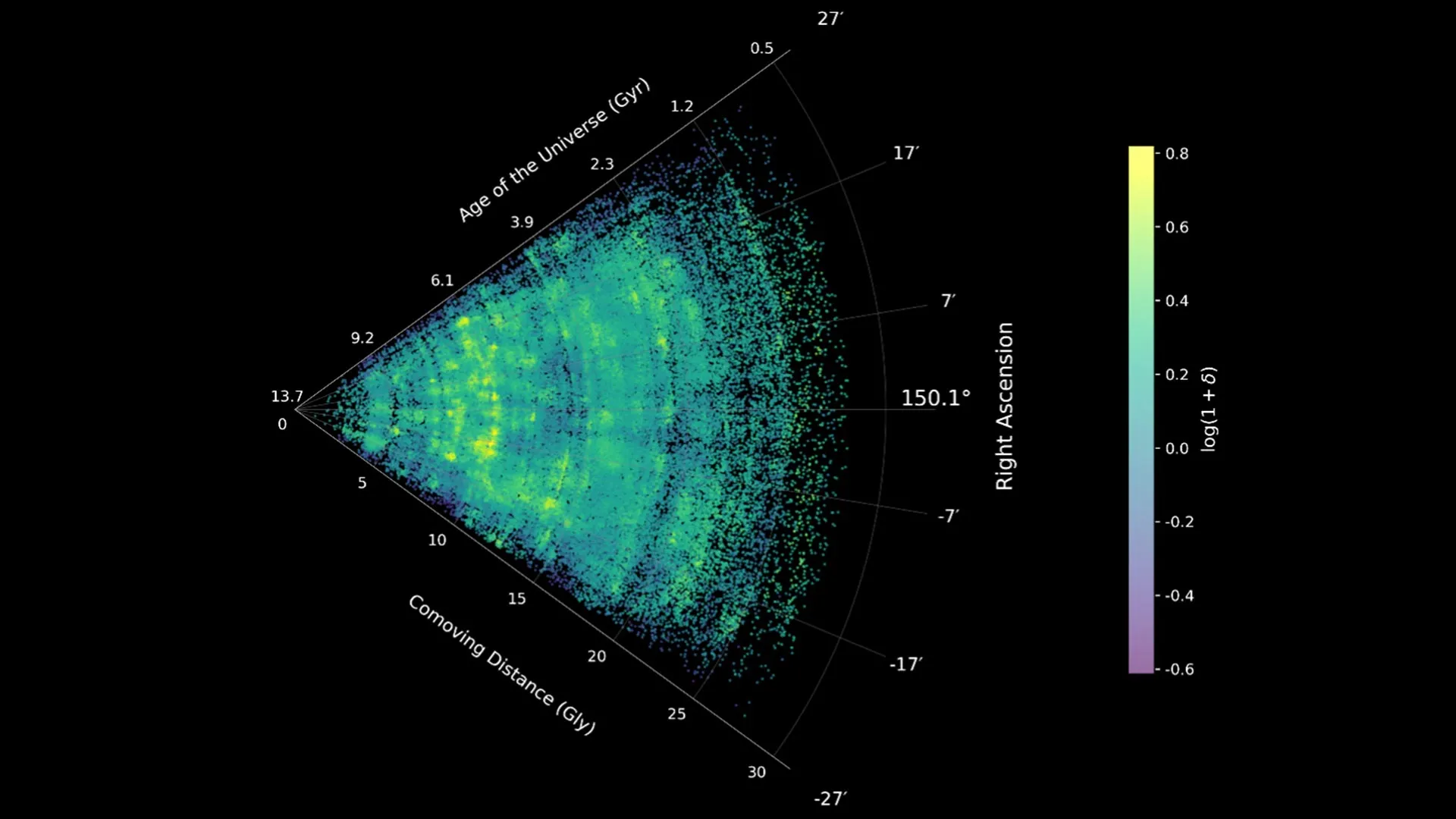
Astronomers using NASA’s James Webb Space Telescope (JWST) have created the most detailed map yet of the cosmic web, the vast structure that connects galaxies throughout the universe. A research team led by researchers at the University of California, Riverside traced this vast network back to just about 1 billion years after the birth of the universe.
The cosmic web is the giant skeletal framework of the universe. It is made up of filaments and sheets of dark matter and gas surrounding a huge, mostly empty region of space known as the void. Together, these structures form the large-scale structure of the universe, connecting galaxies and galaxy clusters over long distances.
The results of this research were published in “The Astrophysical Journal.” Researchers used COSMOS-Web, the largest JWST survey ever conducted, to study how galaxies have been arranged in the cosmic web over 13.7 billion years of cosmic history.
JWST opens new perspectives on the universe
Since its launch in 2021, JWST has dramatically expanded scientists’ ability to study the distant universe. Its sensitive infrared instruments can detect faint galaxies that previous telescopes couldn’t see, allowing astronomers to peer far back in time through thick clouds of cosmic dust.
To take advantage of these capabilities, an international team created COSMOS-Web, the largest selected general observer (GO) program for space telescopes. The GO program is the main process researchers use to earn observation time at JWST. The survey covers a contiguous section of the sky roughly the size of three full moons and is specifically designed to map the web of the universe.
“JWST completely changed our view of the universe. COSMOS-Web was designed from the beginning to provide the broad and deep perspective needed to see the web of the universe,” said Hossein Khatamnia, a graduate student at UCR and Carnegie Observatory and lead author of the study. “For the first time, we can now study the evolution of galaxy clusters and filament structures across cosmic time, from the first billion years of the universe to the nearby universe.”
Nearby space refers to the region within about 1 billion light years from Earth. One light year is approximately 5.88 trillion miles and measures the distance that light travels in one year.
The cosmic web revealed in more detail
Baharam Mobasher, a distinguished professor of physics and astronomy at UCR and an advisor to Khatamnia, said the new map based on JWST reveals much more information than previous observations of the same region by the Hubble Space Telescope. According to Mobasher, a direct comparison shows that the structure was blurred in the previous data and can now be clearly separated in JWST.
“The leap in depth and resolution is really significant, allowing us to see the cosmic web at a time when the universe was only a few hundred million years old, essentially out of reach before JWST,” Mobasher said. “What previously appeared to be a single structure is now broken down into many structures, and details that were previously smoothed out are now clearly visible.”
Mr Khatamnia said the clearer maps will come from the collaboration of two key strengths of JWST.
“This telescope will detect many more faint galaxies in the same part of the sky, and the distances to those galaxies will be measured much more precisely,” he said. “We can therefore place each galaxy in the correct slice of cosmic time, giving the map sharper resolution.”
Publication of Cosmic Web data
Continuing COSMOS’ tradition of open science, the research team has published a large-scale structural map.
“The pipeline used to build the map, a catalog of 164,000 galaxies and their cosmic density, and a video showing the web of the universe evolving over billions of years has been released,” Mobasher said.
The title of the paper is “Large-scale structure of the COSMOS-Web: Tracking galaxy evolution in the cosmic web from z~7 with the largest JWST survey.”
Researchers from the United States, Denmark, Chile, France, Finland, Switzerland, Japan, China, Germany and Italy also contributed to the study.
This research was funded by a grant provided through the European Union’s Horizon 2020 research and innovation program.
