

Close Menu

    Subscribe to Updates

    Get the latest creative news from FooBar about art, design and business.

    What's Hot

    New chemical kills 95% of termites without harming humans

    May 9, 2026

    Health Tech Trends 2026: Telemedicine, Wearables, and AI Diagnostics Revolutionizing Healthcare

    May 9, 2026

    Scientists discover hydraulic connection between abdomen and brain

    May 9, 2026
    Facebook X (Twitter) Instagram
    Facebook X (Twitter) Instagram
    Health Magazine
    • Home
    • Environmental Health
    • Health Technology
    • Medical Research
    • Mental Health
    • Nutrition Science
    • Pharma
    • Public Health
    • Discover
      • Daily Health Tips
      • Financial Health & Stability
      • Holistic Health & Wellness
      • Mental Health
      • Nutrition & Dietary Trends
      • Professional & Personal Growth
    • Our Mission
    Health Magazine
    Home » News » Ice Age humans in China created surprisingly advanced stone tools 146,000 years ago
    Nutrition Science

    Ice Age humans in China created surprisingly advanced stone tools 146,000 years ago

    healthadminBy healthadminMay 9, 2026No Comments4 Mins Read
    Ice Age humans in China created surprisingly advanced stone tools 146,000 years ago
    Share
    Facebook Twitter Reddit Telegram Pinterest Email


    Archaeologists working at ancient ruins in central China have found evidence that early humans may have become more inventive while surviving the harsh Ice Age. The discovery was made at the Lingjing site, where researchers have spent more than a decade excavating animal bones and sophisticated stone tools associated with extinct human relatives. man of july.

    New research has revealed that the site dates back some 146,000 years, and that it was located during a cold Ice Age, rather than during a warmer period as scientists once believed. The findings challenge the long-held idea that creativity and technological progress developed primarily in times of environmental stability and abundance.

    “People often imagine creativity as something that thrives in good times,” says Youchao Zhao, assistant curator of East Asian archeology at Chicago’s Field Museum and lead author of a paper describing the findings published in the Journal of Human Evolution. “Knowing that these stone tools were created during a harsh ice age tells a different story. In difficult times, we need to adapt.”

    Advanced stone tools of ancient China

    Zhao and colleagues, led by senior author Zhang Yangli of Shandong University, have been studying the unusually sophisticated stone tools discovered in Lingjing. This place was once occupied man of julyan ancient human group related to modern humans (wise person). Researchers believe these groups may have interacted with our own ancestors.

    man of july They had a combination of physical characteristics found in several groups of ancient humans. They had very large brains, characteristics associated with the ancient humans of East Asia and the Neanderthals of Europe.

    Archaeologists have long believed that early humans in East Asia during the late Middle Pleistocene (300,000 to 120,000 years ago) had relatively limited technological development compared to African and European populations. Reijing’s discovery is forcing scientists to reconsider that assumption.

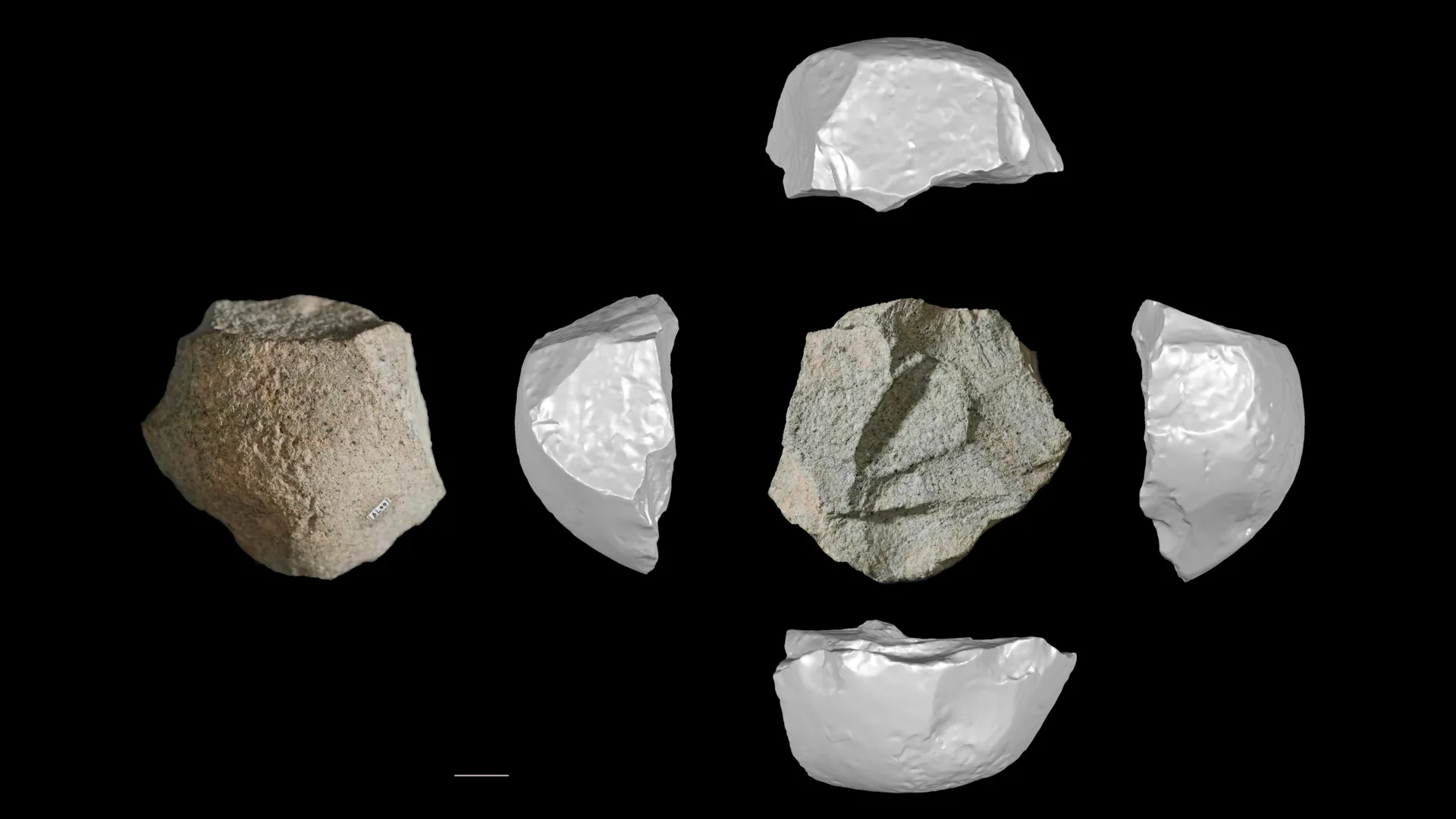
    At first glance, the disk-shaped stone core discovered at this site may seem unremarkable. However, detailed analysis revealed that they were created using a highly organized manufacturing process. man of july Small stones were carefully hammered into larger stone cores to form useful cutting flakes.

    Some of the cores are evenly machined on both sides, while others follow a more intentional design. In those cases, one side primarily served as a striking platform, while the other side was prepared to produce sharp flakes. The researchers say these asymmetrical designs show that toolmakers understood how to manage the stone as a three-dimensional object, rather than just chipping away at random.

    “This was no haphazard flake production, but a technique that required planning, precision, and a deep understanding of stone properties and fracture mechanics,” says Zhao. “The logic underlying this system, and the cognitive abilities it reflects, shows important similarities to the Middle Paleolithic technology often associated with European Neanderthals and African human ancestors, suggesting that advanced technological thinking was not confined to western Eurasia.”

    Crystals inside bones reveal the true age of this site

    The new research has also reshaped scientists’ understanding of when these tools were created.

    Lingjing seems to have been a slaughterhouse. man of july Processed products from animals such as deer. In addition to stone tools, archaeologists have discovered many animal bones. One of the deer-like animal’s ribs contained glowing calcite crystals, which proved important in determining the age of the site.

    Calcite crystals naturally contain trace amounts of uranium. Over a long period of time, uranium slowly transforms into thorium. By measuring the ratio between two elements, scientists can determine the age of crystal formation.

    “The calcite crystals inside the bone functioned like a natural clock, allowing us to accurately estimate the age of the site,” Zhao said.

    Previous estimates suggested Lingjing’s tools were no older than about 126,000 years. Analysis of the new crystals pushed the date back about 20,000 years, to about 146,000 years ago.

    The difference may seem small, but it dramatically changes the environmental context of your site.

    ice age creativity

    “These tools are just a little bit older than we used to think, but the whole landscape has changed,” Zhao says. “During the Pleistocene, the Earth repeatedly changed between colder ice ages and warmer periods in between. We thought these tools were made during a warmer interglacial period 126,000 years ago, but based on new dates suggested by the crystals, we now know that some of these tools were actually made during a harsher, colder ice age 146,000 years ago.”

    The revised chronology suggests that these ancient humans developed complex technology while dealing with extreme environmental stress, rather than in comfortable environments. Researchers say the findings support the idea that hardship itself may have fostered innovation and adaptability.

    “Overall, this study reveals a richer story of innovation, intelligence, and human evolution in East Asia,” Zhao says.


    Source link

    Visited 1 times, 1 visit(s) today
    Share. Facebook Twitter Pinterest LinkedIn Telegram Reddit Email
    Previous ArticleChildhood ADHD traits are associated with midlife distress, and social exclusion plays a major role
    Next Article Scientists discover hydraulic connection between abdomen and brain
    healthadmin

    Related Posts

    New chemical kills 95% of termites without harming humans

    May 9, 2026

    Scientists have discovered a ‘holy grail’ gene that could one day help humans regenerate limbs

    May 9, 2026

    New obesity discovery rewrites decades of fat science

    May 8, 2026

    A common laxative shows surprising power to protect the kidneys

    May 8, 2026

    Scientists make surprising discoveries that could change our understanding of the universe

    May 8, 2026

    Scientists discover new way to prevent periodontal disease without killing friendly bacteria

    May 8, 2026
    Add A Comment
    Leave A Reply Cancel Reply

    Categories

    • Daily Health Tips
    • Discover
    • Environmental Health
    • Exercise & Fitness
    • Featured
    • Featured Videos
    • Financial Health & Stability
    • Fitness
    • Fitness Updates
    • Health
    • Health Technology
    • Healthy Aging
    • Healthy Living
    • Holistic Healing
    • Holistic Health & Wellness
    • Medical Research
    • Medical Research & Insights
    • Mental Health
    • Mental Wellness
    • Natural Remedies
    • New Workouts
    • Nutrition
    • Nutrition & Dietary Trends
    • Nutrition & Superfoods
    • Nutrition Science
    • Pharma
    • Preventive Healthcare
    • Professional & Personal Growth
    • Public Health
    • Public Health & Awareness
    • Selected
    • Sleep & Recovery
    • Top Programs
    • Weight Management
    • Workouts
    Popular Posts
    • 1773313737_bacteria_-_Sebastian_Kaulitzki_46826fb7971649bfaca04a9b4cef3309-620x480.jpgHow Sino Biological ProPure™ redefines ultra-low… March 12, 2026
    • the-pros-and-cons-of-paleo-dietsThe Pros and Cons of Paleo Diets: What Science Really Says April 16, 2025
    • pexels-david-bartus-442116The food industry needs to act now to cut greenhouse… January 2, 2022
    • 1773729862_TagImage-3347-458389964760995353448-620x480.jpgDespite safety concerns, parents underestimate the… March 17, 2026
    • Improve Mental Health10 Science-Backed Practices to Improve Mental Health… March 11, 2025
    • 1773209206_futuristic_techno_design_on_background_of_supercomputer_data_center_-_Image_-_Timofeev_Vladimir_M1_4.jpegMulti-agent AI systems outperform single models… March 11, 2026

    Demo
    Stay In Touch
    • Facebook
    • Twitter
    • Pinterest
    • Instagram
    • YouTube
    • Vimeo
    Don't Miss

    New chemical kills 95% of termites without harming humans

    By healthadminMay 9, 2026

    Drywood termites are good at staying hidden. They live in wooden structures, silently feeding and…

    Health Tech Trends 2026: Telemedicine, Wearables, and AI Diagnostics Revolutionizing Healthcare

    May 9, 2026

    Scientists discover hydraulic connection between abdomen and brain

    May 9, 2026

    Ice Age humans in China created surprisingly advanced stone tools 146,000 years ago

    May 9, 2026

    Subscribe to Updates

    Get the latest creative news from SmartMag about art & design.

    HealthxMagazine
    HealthxMagazine

    At HealthX Magazine, we are dedicated to empowering entrepreneurs, doctors, chiropractors, healthcare professionals, personal trainers, executives, thought leaders, and anyone striving for optimal health.

    Our Picks

    Ice Age humans in China created surprisingly advanced stone tools 146,000 years ago

    May 9, 2026

    Childhood ADHD traits are associated with midlife distress, and social exclusion plays a major role

    May 9, 2026

    Scientists have discovered a ‘holy grail’ gene that could one day help humans regenerate limbs

    May 9, 2026
    New Comments
      Facebook X (Twitter) Instagram Pinterest
      • Home
      • Privacy Policy
      • Our Mission
      © 2026 ThemeSphere. Designed by ThemeSphere.

      Type above and press Enter to search. Press Esc to cancel.