


BLOOMFIELD, Colo.—Colorado wildfire officials say they expect the risk of wildfires to significantly increase this summer, and that their resources will be tested while coordinating with neighboring states as much as possible.
Disastrous snowfall this winter could leave dry landscapes and tinder-like conditions from Colorado’s forested ski mountains to the grassy eastern plains. Officials here are predicting a very dire situation in the state and beyond in the coming months.
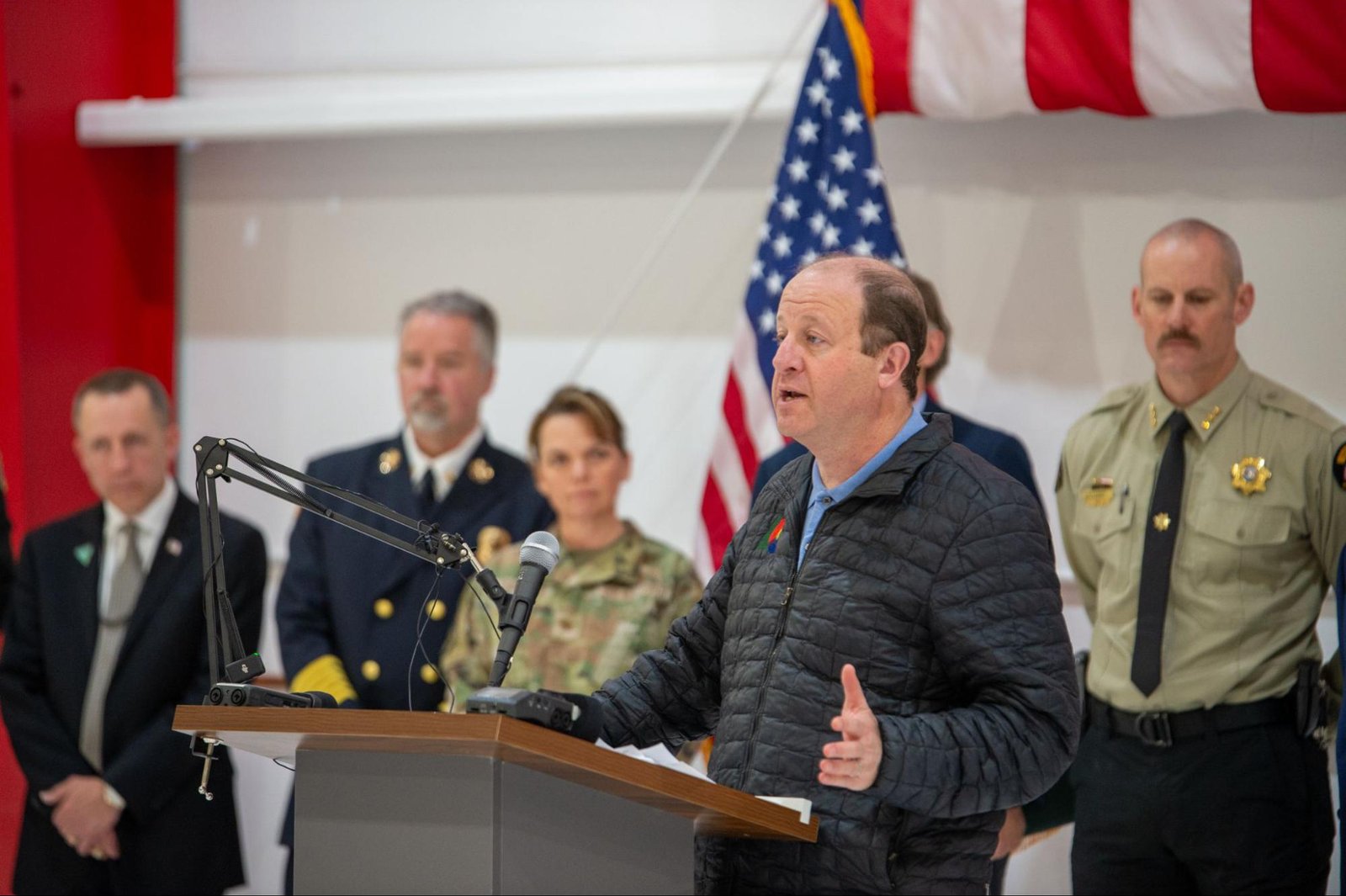
“Increased fire risk is widespread across multiple states,” Colorado Democratic Governor Jared Polis said at the state’s annual wildfire outlook briefing in Broomfield on April 30, where officials announced Colorado’s 2026 Wildfire Preparedness Plan.
He said the upcoming summer will be severe across the West, with “increased fire danger” threatening Colorado as well as Utah, New Mexico and Arizona.
Resources are tight across the West
Surrounded by the state’s top fire managers Thursday, Polis said Colorado has state-of-the-art equipment to fight and prevent fires from the air and the ground.
In his final firefighter conference, the governor, who is retiring due to a term limit, stated that these resources had increased in his two terms since taking office. He said his eight years in office saw three of the largest fires in state history, including the grass-fueled Marshall Fire in late December 2021, which destroyed more than 1,000 homes outside Boulder.
“We have two national multi-purpose aircraft,” Polis said. “We own single-engine tankers, we lease large air tankers, we have Type 1 and Type 2 helicopters for rapid response, we have multiple engines, multiple maneuver personnel, and we have more intelligence than ever before, both satellite- and air-based. Our preparedness has increased exponentially while the risks have increased.”
As for assistance to other Western states with unique resource backbones, Polis said he would consider it on a case-by-case basis, but said the priority is within Colorado’s own borders.
“The benefit of having control over the resources is we want to be able to respond quickly here,” he said. “And we don’t want to sacrifice that.”
Polis said the state’s increased wildfire risk is due to the effects of climate change, drought and population growth, leading people to move more into the Wildland-Urban Interface (WUI), where homes and communities are adjacent to flammable wilderness.
Matt McCombs, head of the Colorado Forest Service, said more than half of Colorado’s residents live in the WUI. “Ultimately, Coloradans know that we have to learn how to coexist with wildfires. We all understand that,” he said.
So far this year, 24,222 fires have burned nearly 2 million acres across the United States, significantly higher than the 10-year average for this time of year. In a typical year, there are between 6,000 and 7,000 wildfires in Colorado. The largest fires are human-caused, and many have unknown causes.
More than 200,000 gallons of water and fire retardant were dropped from the air in Colorado during the first 117 days of 2026, during more than 50 days of flight missions, said Colorado Department of Public Safety Director Stan Hilkey.
“We are facing a very difficult fire year that will test our resources not only in Colorado but across the West,” said Michael Morgan, director of the state’s Office of Fire Protection.
federal friction
At the federal level, the Departments of the Interior and Agriculture announced the new National Fire Protection Agency.
Inside Climate News previously reported that layoffs, turmoil and budget cuts have raised doubts about the agency.
U.S. Wildland Fire Department Rocky Mountain Region Geographic District Fire Chief Paul Horn said Thursday that the agency has the same amount of personnel as last year in what it calls its “legacy” stations.
“We are aware that some federal agencies have implemented deferred retirement programs and that some positions have not been eligible for rehiring over the past several years,” he said. “That doesn’t apply to firefighters or fire support personnel.”
As Colorado prepares and coordinates its response to a potentially devastating summer, state officials have been dealing with friction with the federal government under the new administration of Republican Donald Trump.
This story is funded by readers like you.
Our nonprofit newsroom provides free advertising for our award-winning climate coverage. We rely on donations from readers like you to continue our work. Donate now to support our work.
donate now
Earlier this month, Polis criticized the federal government for rejecting his plea to classify two wildfires as major disasters. He said these measures are making the recovery process difficult, slow and more difficult.
“We’re hoping that the partnership with the federal government that we’ve been looking forward to for years will come back with a disaster,” he said. “As with the denial of disaster declarations in Colorado and many others, if it were to go away it would fundamentally change the nature of the relationship between the federal government and the states, and would negatively impact fire preparedness and recovery in all 50 states.”
Last week, Colorado’s two Democratic U.S. senators, Michael Bennet and John Hickenlooper, introduced the Disaster Declaration Transparency Act of 2026, which would allow Congress to override the president’s denial of a disaster declaration.
The FEMA Press Office declined to comment on the bill.
“Rapid and aggressive initial attack”
Days before Colorado’s annual fire report, two of the state’s former governors wrote provocative guest columns for the Denver Post.
In it, Democrat Bill Ritter and Republican Bill Owens denounced anonymous “loud voices” opposing forest management practices such as strategic thinning, fuel reduction, logging, and prescribed burning when necessary.
“Colorado needs a more mature dialogue, especially as it grapples with prolonged drought, rising temperatures, pine and ponderosa beetles, and other threats to forest health,” they wrote. “Management is not abuse. Forest management is not the enemy of a healthy ecosystem. If anything, refusing to use a proven tool in a fire-prone environment is itself a form of recklessness.”
The former governors said Coloradans “deserve better than another season of hardship followed by another disaster. They deserve leaders who are willing to act proactively, not just talk solemnly after an emergency occurs.”
In an interview Thursday, Polis said he had not yet read the column but emphasized that his state is “light years” ahead of where it was 10 years ago. “I’m very confident in saying that Colorado has more resources and is better prepared for fires than it has ever been,” he said.
In recent decades, the U.S. Forest Service has retreated from aggressive suppression tactics like the 1935 “10 a.m. Policy,” which aimed to prevent catastrophe by extinguishing fires as quickly as possible.
This policy continued until the early 1970s, when scientific research increasingly demonstrated the positive effects of fire on forest ecosystems and suggested that wildfires that survived an initial attack became more severe when suppressed. Enabling wildfires to burn safely has become an important tool in addressing the growing crisis.
Colorado Fire Secretary Morgan said during a Thursday briefing that much of the state’s strategy this year will focus on a “quick, aggressive initial attack” to prevent fires from spreading.
“If we can stop every fire, that’s one less stressed and overworked firefighter,” Morgan said.
The City of Polis declared May as Wildfire Awareness Month and urged Coloradans to do their part.
With a tough fire season just around the corner, officials have stressed the need to ease pressure on firefighters wherever possible. Public Safety Director Hilkey called on the public to increase fire awareness as part of their daily lives.
“We want everyone to be able to think like a firefighter,” he said.
Meanwhile, the Colorado Forest Service’s McCombs emphasized the importance of mitigation efforts to reduce flammable fuels to prevent the fires from turning into uncontrollable, destructive blazes that have turned vast areas into hellscapes and destroyed thousands of homes.
That and other investments, such as home hardening, may not make the headlines, but they are preventative, he said.
On Thursday, Polis acknowledged that in Colorado, the prescribed incineration process for mitigation can require extensive documentation, preparation and evaluation of various environmental conditions. He also suggested that some of the bureaucracy involved could be cut, saying it “sounds like a lot of red tape.”
Colorado fire officials said they expect a difficult year, but there are limits to what the state can do. The real work begins at the individual level.
“Do your part to protect your home, protect your community, prevent fuel processing fires, and make your home and everywhere more resilient,” Morgan said. “That will make a huge difference in the short and long term for the future of Colorado and the entire West.”
Nolan Diffley, Eva Dye, Anna Hay, Shayden Higgs, Corey Hutchins, Rowan Keller, Sol Lorio, Rachel Phillips, Josefina Rodríguez Poggio, and Amelia Vinton contributed to this report as students and staff members of the University of Colorado Career Catalyst Block “Burning Questions: Wildfire Journalism and Ecology in Colorado Fire Camps.”
About this story
As you may have noticed, this article, like all news we publish, is free to read. That’s because Inside Climate News is a 501c3 nonprofit organization. We don’t charge subscription fees, keep our news behind paywalls, or fill our website with ads. We provide climate and environmental news free to you and anyone who wants it.
That’s not all. We also share our news for free with dozens of other news organizations across the country. Many of them cannot afford to do their own environmental journalism. We’ve established bureaus across the country to report on local news, partner with local newsrooms and co-publish stories to ensure this important work is shared as widely as possible.
The two of us started ICN in 2007. Six years later, we won the Pulitzer Prize for national reporting and now run the nation’s oldest and largest dedicated climate newsroom. We tell the story in its entirety. We hold polluters accountable. We expose environmental injustice. We debunk misinformation. We explore solutions and inspire action.
Donations from readers like you fund all aspects of our work. If you haven’t already, will you support our ongoing work, our coverage of the biggest crises facing our planet, and help us reach more readers in more places?
Please make a tax-deductible donation. Each one makes a difference.
thank you,
