


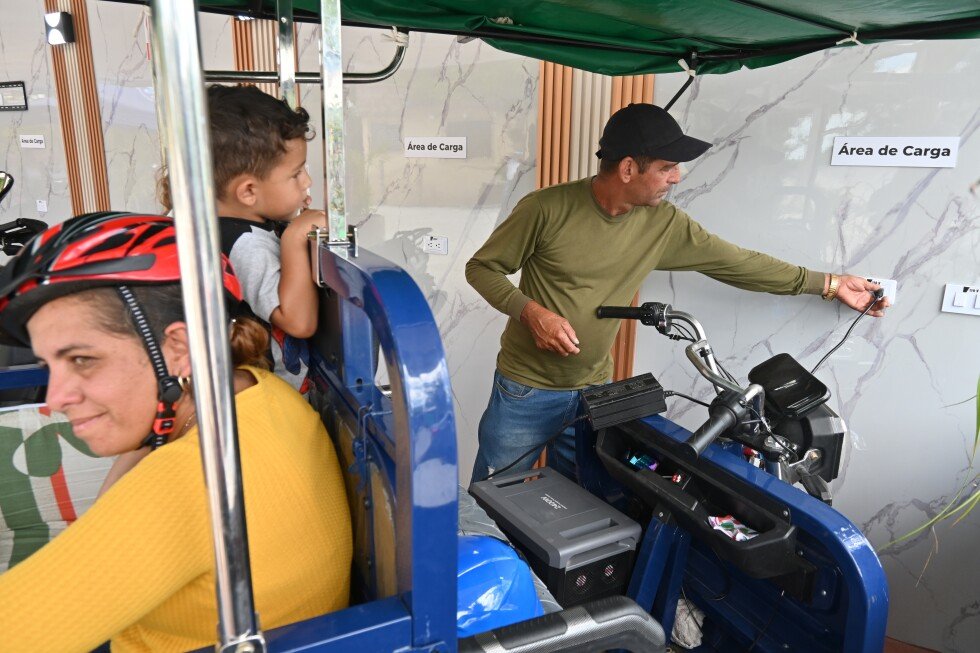
SANTA CLARA, Cuba (AP) — Yuderaymis Valero Muñoz spent up to three hours in the hot sun waving money to drivers on the side of the highway as he hitchhiked from Cienfuegos. Cuba She goes to Santa Clara, where she buys supplies to resell and support her husband and two children.
The 43-mile (70-kilometer) trip was impossible on her husband’s bicycle, which was once the family’s only means of transportation, and they then relied on a rechargeable tricycle that didn’t have the battery capacity for the round trip.
And in early April, a local business owner opened what is believed to be Cuba’s first solar-powered charging station, and it’s free. Cubans quickly flocked to solar power plants, or “solineras.” Cuba — Charge everything from electric cars to UV nail lamps.
The Cuban government has increased the installation of solar panels in hospitals and other public places and established solar power plants. chronic power outage And in the last few months, serious gas shortage arises from US energy blockade.
Renewable energy now accounts for about 10% of the island’s electricity, up from 3.6% in 2024, but electricity distribution remains limited and few Cubans can afford such systems. Globally, just over 30% of electricity is generated. renewable energy According to energy think tank Ember, these include solar power, wind power and hydropower.
With gasoline scarce for cars these days, Cubans travel miles to the Santa Clara solar farm on rechargeable motorcycles and tricycles. Others walk to the station. They carry all the equipment, appliances, and vehicles that require power, such as mobile phones with dying batteries, rice cookers, pressure cookers, and more.
“They’ve solved a lot of problems for a lot of people,” Valero Muñoz said.
She and her husband, along with their children, ages 3 and 4, regularly drive to Santa Clara now that they can charge their tricycle at a solar station.
“Without this, I wouldn’t have been able to continue selling,” she said.
Valero Muñoz now buys rice, sugar, hot dogs, mortadella, soap, shampoo, deodorant and other items, regardless of weight. This is because when I had to hitchhike, I could put everything in the car instead of carrying two bags and a backpack as I used to.
“We have more products, so we have more customers,” she says with a smile.
A historic city where life is not so hectic
There are almost no cars on the highway Havana To Santa Clara. Horse-drawn carriages are more common in the countryside, where the Cuban crisis is inevitably more acute.
With a population of approximately 250,000 people, Santa Clara is one of Cuba’s most populous cities and is best known as the “City of Malta and El Che.”
Che — Ernesto Guevara de la Serna — He led a key battle in Santa Clara during the Cuban Revolution in 1959, and his remains lie in a mausoleum.
It is also the town of Marta de los Ángeles González Abreu y Arencibia, a prominent philanthropist who helped promote Santa Clara and Cuba’s independence.
Santa Clara is home to people like Danairis Alboráez Perez, a 32-year-old mother of two who sells sandwiches, coffee, beer and cigarettes from her home. It’s just a short walk from the solar station.
“Almost everyone in this neighborhood goes there,” she said.
Wanting to save money on natural gas, Alboráez Pérez used a solar station to cook rice and beans, and even fried fish, even when he had electricity.
She also noted that she was charging two fans to cool the rooms of her 2-year-old son and 7-year-old daughter as Cuba’s temperatures begin to rise. power outage Last year was “apocalyptic.”
She’s grateful that she no longer has to jump out of bed when the power suddenly turns on and be forced to cook or do laundry at off-hours, like 2 a.m.
“We don’t run around that much,” she said. “I cook slowly and calmly. …If the power goes out, I take the pot there.”
Free charging changes people’s lives
Alexander Gutierrez Altuve works for a neighboring company that helped finance and install a solar farm in Santa Clara.
The cost of the project is unknown, and the company’s owners, who were not available for an interview, said they worked with the government to install solar panels that provide 30 kilowatts of energy and a 60 kilowatt battery. That’s enough energy to power the average American home for one day.
The station has 20 sockets for charging devices, 16 sockets for charging vehicles, and 12 sockets for cooking.
“This has never really been done before,” Gutierrez Altuve said.
Some people are too embarrassed to try it.
“They’re really surprised when we tell them it’s free,” said Lisandra Couto Perez, a colleague of Gutierrez Altuve’s who helps track usage.
On a recent afternoon, Valero Muñoz’s husband, Lorenzo Ravello, drove his tricycle to the station, turned it on, and his wife and two young children jumped out of the back.
Before buying the small tricycle, Ravello borrowed money from a neighbor to rent a car when her children needed medical care, and “paid for it later whenever I could.”
At the time, he only had a bicycle, so he couldn’t take his family on fun road trips to escape the daily hustle and bustle of Cuba. He tearfully explained that he could now drive his own car to the beach.
“It’s a great solution,” he said.
___
Follow AP’s coverage of Latin America and the Caribbean. https://apnews.com/hub/latin-america
