


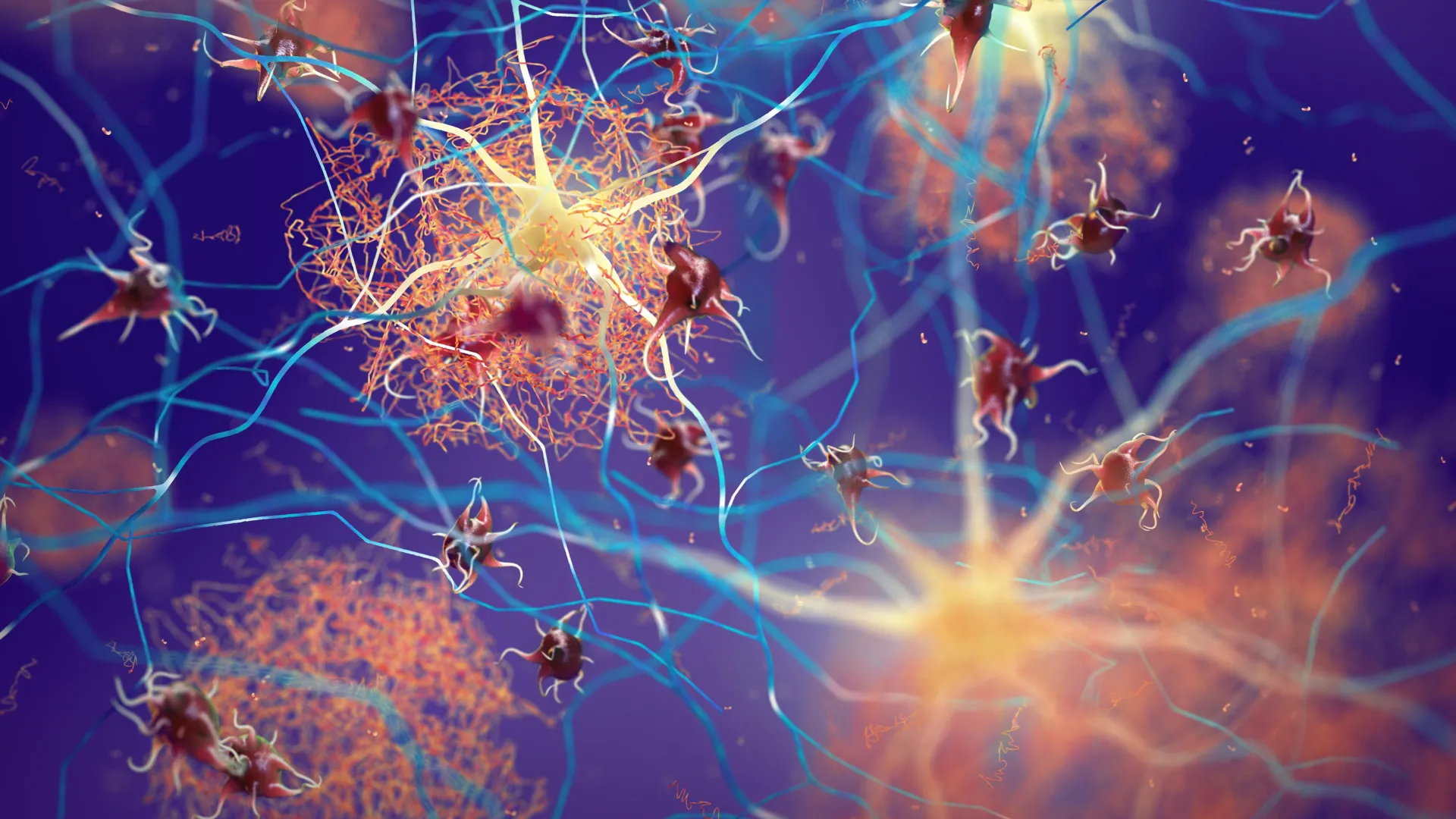
Researchers at Baylor College of Medicine have discovered a built-in process that removes existing amyloid plaques from the brains of mice in an Alzheimer’s disease model while also helping maintain memory and thinking skills. The discovery focuses on astrocytes, star-shaped supporting cells in the brain that are directed to clear toxic plaque deposits common in Alzheimer’s disease.
The research team found that increasing levels of Sox9, a protein that plays a key role in regulating astrocyte activity as we age, significantly improved the ability of these cells to clear amyloid plaques. The survey results are natural neurosciencepoints to the possibility of therapeutic strategies focused on strengthening the brain’s own support systems to slow cognitive decline in neurodegenerative diseases.
Astrocytes and brain function
“Astrocytes perform a variety of tasks essential for normal brain function, including facilitating brain communication and memory storage. As the brain ages, astrocytes exhibit significant functional changes, but the role these changes play in aging and neurodegeneration is not yet understood,” said lead author Dong-Joo Choi, Ph.D., who conducted the study while at Baylor University’s Center for Cell and Gene Therapy and Department of Neurosurgery. Choi is currently an assistant professor in the Center for Neuroimmunology and Glial Biology at the Institute for Molecular Medicine at the University of Texas Health Science Center in Houston.
Sox9 and aging astrocytes
In this study, researchers set out to better understand how astrocytes change with age and how these changes are associated with Alzheimer’s disease. They focused on Sox9, which controls the activity of many genes in aging astrocytes.
“We manipulated the expression of the Sox9 gene to assess its role in maintaining astrocyte function in the aging brain and Alzheimer’s disease models,” said corresponding author Benjamin Deneen, Ph.D., professor of neurosurgery, Russell J. Blattner and Marian K. Blattner Professor, director of the Center for Cancer Neuroscience, member of Baylor’s Dan L. Duncan Comprehensive Cancer Center, and principal investigator in the Jean and Dunn Institute. Duncan Neurological Institute at Texas Children’s Hospital.
Testing on mice with established symptoms
“An important aspect of our experimental design was that we studied a mouse model of Alzheimer’s disease that had already developed cognitive impairment such as memory loss and had amyloid plaques in the brain,” Professor Choi said. “We believe these models are more relevant to what we see in many patients with Alzheimer’s disease symptoms than other models in which these types of experiments are performed before plaques form.”
To test their approach, the researchers increased or removed Sox9 in these mice and tracked the mice’s cognitive performance over a six-month period. Animals were assessed for their ability to recognize familiar objects and the environment. At the end of the study, the team measured the amount of plaque that had accumulated in the brain.
Increased Sox9 improves plaque removal and memory
The results showed a clear contrast. Low Sox9 levels lead to faster plaque accumulation, simpler astrocyte structure, and reduced ability to clear amyloid deposits. Increased Sox9 had the opposite effect, increasing astrocyte activity, improving structural complexity, and promoting plaque clearance.
Importantly, mice with higher Sox9 levels maintained better cognitive function, suggesting that activating astrocytes to clear plaque may help slow the decline in mental function associated with Alzheimer’s disease.
“We found that when Sox9 expression increases, astrocytes take up more amyloid plaques and remove them from the brain like a vacuum cleaner,” Deneen said. “Most current treatments focus on neurons or try to prevent the formation of amyloid plaques. This study suggests that increasing the natural purifying capacity of astrocytes may be equally important.”
New directions for Alzheimer’s disease treatment
The researchers emphasize that further research is needed to understand how Sox9 functions in the human brain over time. Still, this discovery opens the door to new treatments aimed at harnessing astrocytes as a natural defense against neurodegenerative diseases.
Research team and funding
Additional contributors to this study from Baylor College of Medicine include Sanjana Murali, Wookbong Kwon, Junsung Woo, Eun-Ah Christine Song, Yeunjung Ko, Debo Sardar, Brittney Lozzi, Yi-Ting Cheng, Michael R. Williamson, Teng-Wei Huang, Kaitlyn Sanchez, and Joanna Jankowsky.
This research was supported by National Institutes of Health grants (R35-NS132230, R01-AG071687, R01-CA284455, K01-AG083128, R56-MH133822). Additional funding was provided by the David and Eula Winterman Foundation, the National Institutes of Health’s Eunice Kennedy Shriver National Institute of Child Health and Human Development (award number P50HD103555), and shared resources from Houston Methodist and Baylor College of Medicine.
