


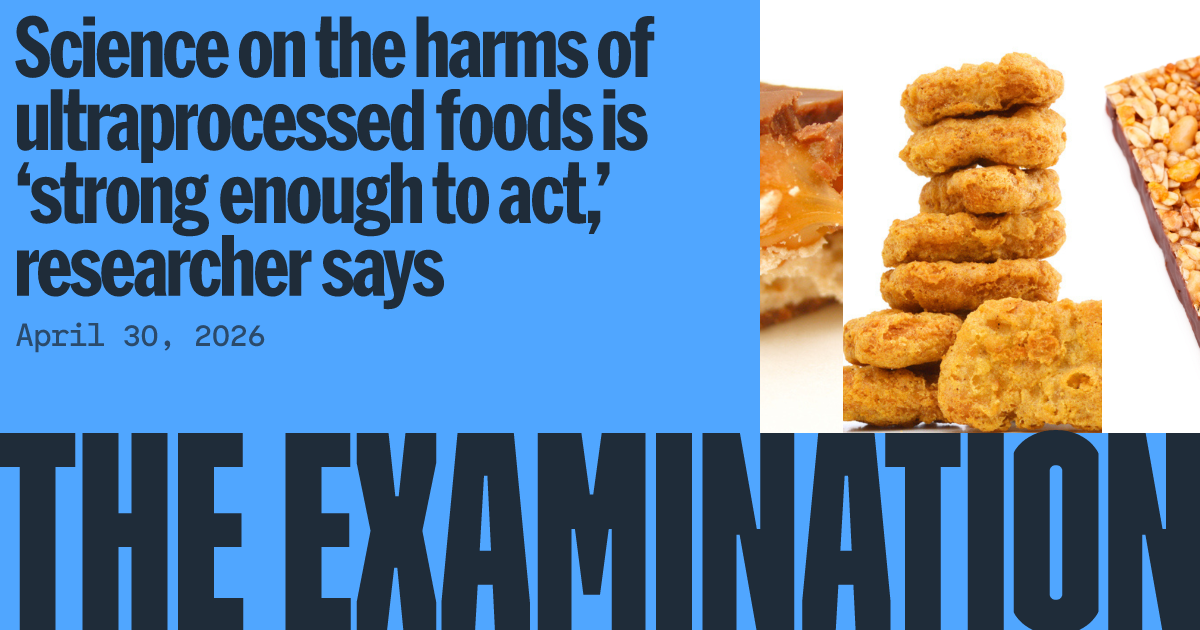
Daily intake of ultra-processed foods 5% increased risk of stroke, heart attack, or cardiac arrest. This is the stark finding of a study published last month in the Journal of the American College of Cardiology, the latest study to show a link between industrially produced foods and health problems such as diabetes, heart disease and obesity.
From breakfast cereals to chicken nuggets to candy bars, ultra-processed foods are mass-produced products that contain ingredients such as preservatives, emulsifiers, and other additives not found in home kitchens.
Although some countries have adopted policies aimed at reducing the consumption of ultra-processed foods, the root causes of the global epidemic of diet-related diseases continue to be scientifically debated.
The food industry and some independent academics argue that the ultra-processed food category is too broad because it includes everything from carbonated drinks and processed meats, which have known health risks, to nutritious foods like whole-grain bread. some experts say It is wrong to focus on the level of processing of food If other factors are the real culprit, such as calorie density or amount of sugar, salt, or fat. These debates often stall or thwart policies aimed at cracking down on highly processed foods and promoting natural foods.
In a statement sent to The Examining, the Consumer Brand Association, a U.S. industry group, Manufacturers of food, beverages, and other packaged consumer goodssaid there is no agreed-upon scientific definition of ultra-processed foods and that companies adhere to federal safety and nutrition standards. Unfounded fears about these foods could leave American families with fewer options and higher bills, the spokesperson said.
Neha KhandpurHe is a professor at Wageningen University in the Netherlands and has written extensively, including co-authoring books, on ultra-processed foods and heart health. Major study in 2024 also finds association with cardiovascular disease. We spoke to her to discuss the latest science on ultra-processed foods and heart disease, and what it means for policymakers and the average consumer.
The following interview has been edited for length and clarity.
I wanted to start with this recent study that showed a very specific and alarming finding that daily consumption of ultra-processed foods increases the risk of cardiac events. How do you interpret these results and how do they compare to your own research?
It was very interesting to read about yet another group of study participants, this time a more diverse sample that replicated the patterns that we seem to have seen fairly consistently. This is a pattern that has been replicated across different samples and different regions, not just within the United States but around the world.
It’s essentially saying that there’s something about a seemingly diverse collection of foods and drinks that can have negative health effects when people consume them in large quantities.
We have looked at type 2 diabetes, chronic kidney disease, overweight or obesity, coronary heart disease or mortality, and cardiovascular disease or mortality. Diets high in ultra-processed foods are consistently associated with increased risk compared to diets low in ultra-processed foods. There is always uncertainty, and there is always an increase in risk, but there is no doubt that it is pointing in the same direction.
Increased calorie consumption is a very clear mechanism. The more ultra-processed foods you have in your diet, the more calories you may be consuming. Nutrient imbalances are occurring, including increased added sugars and increased saturated fat. Dietary fiber is also reduced, and protective micronutrients such as potassium, zinc, and magnesium are also reduced.
Based on current science, how strong do you think the link between ultra-processed foods and cardiovascular disease is? Is this a theory, an emerging pattern, or something well-established at this point?
If you look at the totality of evidence from the field of nutritional science, I think there is enough strong evidence to act on this. This goes beyond appearance. This requires policy intervention. I am so convinced of the direction, scale and significance of what we are seeing here.
Your study and a recent study published in the Journal of the American College of Cardiology found that ultra-processed foods overall are associated with heart risk. In your group’s analysis, these risks were strongly associated with processed meats and sugar-sweetened beverages, but not with breakfast cereals or yogurt, reducing the risk. Are there any specific types of products that are causing these adverse heart effects?
There is no single uniform product. For example, cola is a plant-based product because it contains no animal-derived ingredients. So, like a homemade pot of lentils, cola can also fall into the category of plant-based foods.
Ultra-processed foods are similarly diverse. What unifies them is that they are all ready-to-heat, ready-to-eat, industrially processed products containing additives and ingredients that would not have been added had they been cooked from scratch. It is also packaged, sold, and produced in a certain way. Therefore, although they have many similarities, that does not mean that one ultra-processed product is identical to the other and therefore has the same health risks. What we’re saying is that it’s the sum of all the different ultra-processed foods you consume that is of concern.
Subscribe to newsletter
Get global health reports delivered straight to your inbox
Do you know which types of ultra-processed foods are bad for us from a consumer perspective?
We target some ultra-processed foods more than others. Sugar-sweetened beverages, for example, are an obvious target for policy because they provide little more than water and sugar. And we know that we are consuming too much sugar at a population level. These are easier products to target, and I think there will be more political consensus to target them than, say, unsweetened breakfast cereals or whole-grain breads, which are important sources of fiber in the American diet.
There are similarities in how alcohol and alcohol products are regulated. There is continuity. Certain products with high alcohol content and high risk of poor health are targeted differently than products with low alcohol content. This model is potentially interesting in addressing the consumption of ultra-processed foods.
Another surprising finding in a study published last month is that Black Americans have a higher additional risk of heart events from eating ultra-processed foods than other ethnic groups. Are certain people particularly at risk from eating these products? If so, why?
Food environments feel different to different groups of people. In general, people with fewer resources are more likely to consume foods that are quickly heated and ready to eat, often ultra-processed foods. In the United States, we find that marketing is more prevalent in poorer areas. They consume more ultra-processed foods, which puts them at higher risk of negative health effects.
At the global level, there is one pattern that is very clear and very difficult to ignore. That is, there are more young people than older people who consume ultra-processed foods. The largest consumers of ultra-processed foods are children and adolescents.
Some researchers involved in the food industry are conducting research on ultra-processed foods. What kinds of scientific arguments are these researchers making, and do they influence policy?
I’m actually writing a paper on this, which will be published soon. A lot of the discussion we see is that the ultra-processed food category is so diverse that we don’t fully know which mechanisms are causing the health risks.
I think these discussions are distracting because we don’t expect food to work the way we expect a single compound, a drug, to work. For example, we do not believe that the benefits of consuming a Mediterranean diet are caused by a single mechanism. As with ultra-processed foods, there’s a lot of variety out there.
The effect of that distraction is essentially to stall the policy dialogue. And a stagnation in the policy dialogue will only benefit the food industry. Because we continue to maintain the status quo, and the status quo is exactly what the food industry wants.
The advantage of ultra-processed products, unlike tobacco and alcohol, is that natural alternatives exist. That’s what we’ve been trying to promote through decades of nutritional science research, and what many dietary guidelines refer to as well: eating whole foods.
You mentioned that some of the science around these products is misunderstood by the food industry and some academics. What misconceptions have you seen?
There’s a lot of talk about how it’s not about ultra-processing, it’s about the relative amounts of salt, sugar, and fat among other nutrients. Although it is not super processed, it is the texture of the product. It’s not super processing, but energy consumption rate. You can eat these products faster. And I say this is misunderstood because the question is not whether it is ultra-processing or nutrition, ultra-processing or texture, ultra-processing or energy density that leads to poor health. It’s unlikely that it’s responsible for all the health effects we’re seeing.
Why is winter associated with depression? You can focus on cold, snow, gray, or you can say it’s a combination of all of them. Winter includes many more aspects than just focusing on the individual elements that make up winter.
Taking it a step further, that simplification has significant policy implications. Because if we really believe that it’s just sugar, or just texture, or just one aspect of this whole thing, then that’s all that we’re targeting through policy. And that’s what we’ve always done.
It’s a terrible idea to think that restricting one aspect of your food will solve your problem. It has been proven time and time again that it is absolutely not true.
