


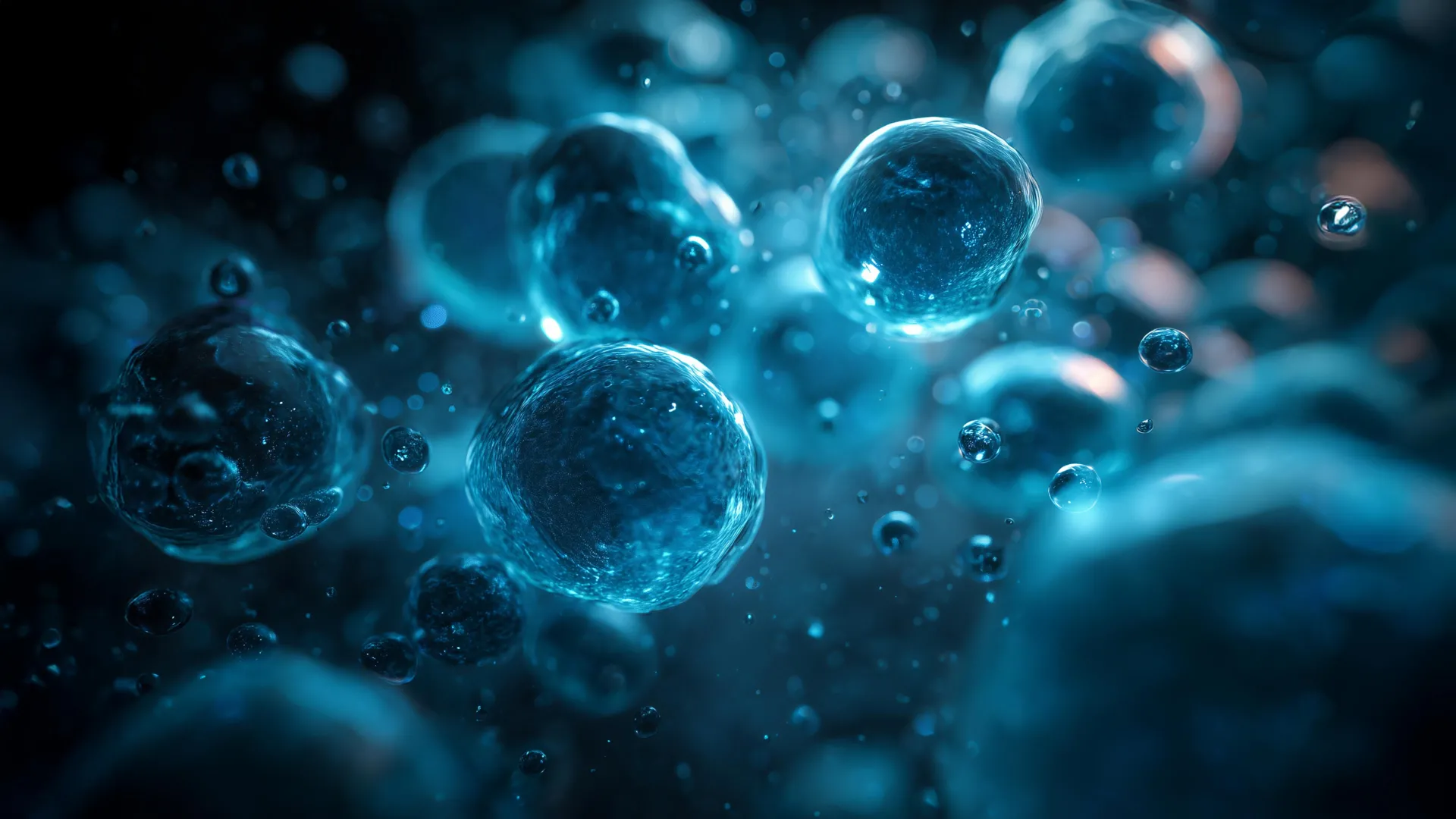
Modern cells are highly complex systems. They contain internal scaffolding, tightly controlled chemical processes, and genetic instructions that guide nearly all of their actions. This complexity allows them to survive in diverse environments and compete based on physical fitness. In contrast, early cell-like structures were very simple. These primitive compartments were essentially tiny bubbles, with lipid membranes encasing basic organic molecules. Understanding how these simple protocells ultimately gave rise to the complex cells we see today remains a central question in origin of life research.
A recent study led by researchers at Tokyo University of Science’s Earth and Life Science Institute (ELSI) takes a closer look at how these early structures behaved on ancient Earth. Rather than proposing a single explanation for how life began, the researchers focused on experiments that simulate realistic environmental conditions. Specifically, we studied how changes in membrane composition affect the ability of protocells to retain critical molecules during proliferation, fusion, and freeze/thaw cycles.
Construction of model protocells using different lipids
To investigate this, the research team created small spherical compartments known as large unilamellar vesicles (LUVs). These were constructed using three types of phospholipids: POPC (1-palmitoyl-2-oleoyl-glycero-3-phosphocholine; 16:0-18:1 PC), PLPC (1-palmitoyl-2-linoleoyl-sn-glycero-3-phosphocholine; 16:0-18:2 PC). (1,2-di-oleoyl-sn-glycero-3-phosphocholine; 18:1 (D9-cis) PC).
“We used phosphatidylcholine (PC) as a membrane component because of its chemical structure continuity with modern cells, its availability under prebiotic conditions, and its ability to retain essential contents,” said Tatsuya Shinoda, a doctoral student at ELSI and first author.
Although these molecules are similar, their structures differ in subtle but important ways. POPC contains one unsaturated acyl chain with a single double bond. PLPC also has one unsaturated acyl chain, but two double bonds. DOPC contains two unsaturated acyl chains, each with one double bond. These differences affect how tightly the molecules stick together. POPC tends to form stiffer films, whereas PLPC and DOPC form more fluid films.
Freeze-thaw cycles promote growth and fusion
The researchers then subjected these vesicles to repeated freeze/thaw cycles (F/T) to mimic temperature changes that might have occurred on early Earth. After 3 cycles, there was a clear difference. POPC-enriched vesicles did not fully fuse and clustered. In contrast, those containing PLPC or DOPC fused into larger compartments. The more PLPCs present, the more likely the vesicles will coalesce and grow.
This behavior highlights the role of membrane chemistry. Lipids with many unsaturated bonds are thought to reduce membrane density, which promotes fusion. “Under the stress of ice crystal formation, membranes can become destabilized or fragmented, requiring structural rearrangement upon thawing. Loosely packed lateral organization due to high unsaturation may expose more hydrophobic regions during membrane rearrangement, facilitating interactions with neighboring vesicles and making fusion energetically favorable.” ELSI researcher Natsumi Noda said.
Mixing molecules and retaining DNA
Fusion is important because it allows the contents of separate compartments to mix. On the early Earth, when organic molecules were dispersed throughout the environment, this type of mixing may have brought together important components. This interaction may have supported chemical reactions that led to more complex cell-like systems.
The researchers also tested how well these vesicles were able to capture and retain DNA. They compared vesicles made entirely of POPC and vesicles made entirely of PLPC. The results showed that PLPC vesicles better captured DNA even before freeze/thaw cycles. Even after repeated cycles, they continued to retain more DNA than POPC vesicles.
Ice environments could be the cradles of life
Scientists have traditionally focused on environments such as dry pools on land or deep-sea hydrothermal vents as likely places where life originated. This study adds another possibility. It suggests that the icy environment may also have played an important role.
Early Earth may have experienced repeated freezing and thawing cycles over long periods of time. When water freezes, the growing ice crystals force the dissolved molecules into the remaining liquid, concentrating them in a small space. This process may have increased the possibility of interactions between molecules and vesicles. At the same time, membranes made with more unsaturated phospholipids were more likely to fuse, which may have facilitated mixing. However, there are trade-offs. Although the fluid film supports fusion, it can also become unstable and leak during freeze-thaw stress.
Balancing early cell stability and evolution
In early protocells, it would have been important to maintain a balance between stability and permeability. The membrane must retain its contents, but it also allows for interactions that cause chemical changes. The most successful film composition is likely to depend on environmental conditions.
“Transgenerational recursive selection of F/T-induced grown vesicles could be achieved by integrating division mechanisms such as osmotic pressure and mechanical shearing. As molecular complexity increases, intravesicular systems, and thus genetically encoded functions, may eventually take over the fitness of protocells, thus leading to the emergence of progenitor cells capable of Darwinian evolution,” concludes Professor Tomoaki Matsuura. ELSI and the principal investigator of this study.
Taken together, these findings suggest that simple physical processes such as freezing and thawing may help guide the transition from basic molecular compartments to the first evolving cells.
