


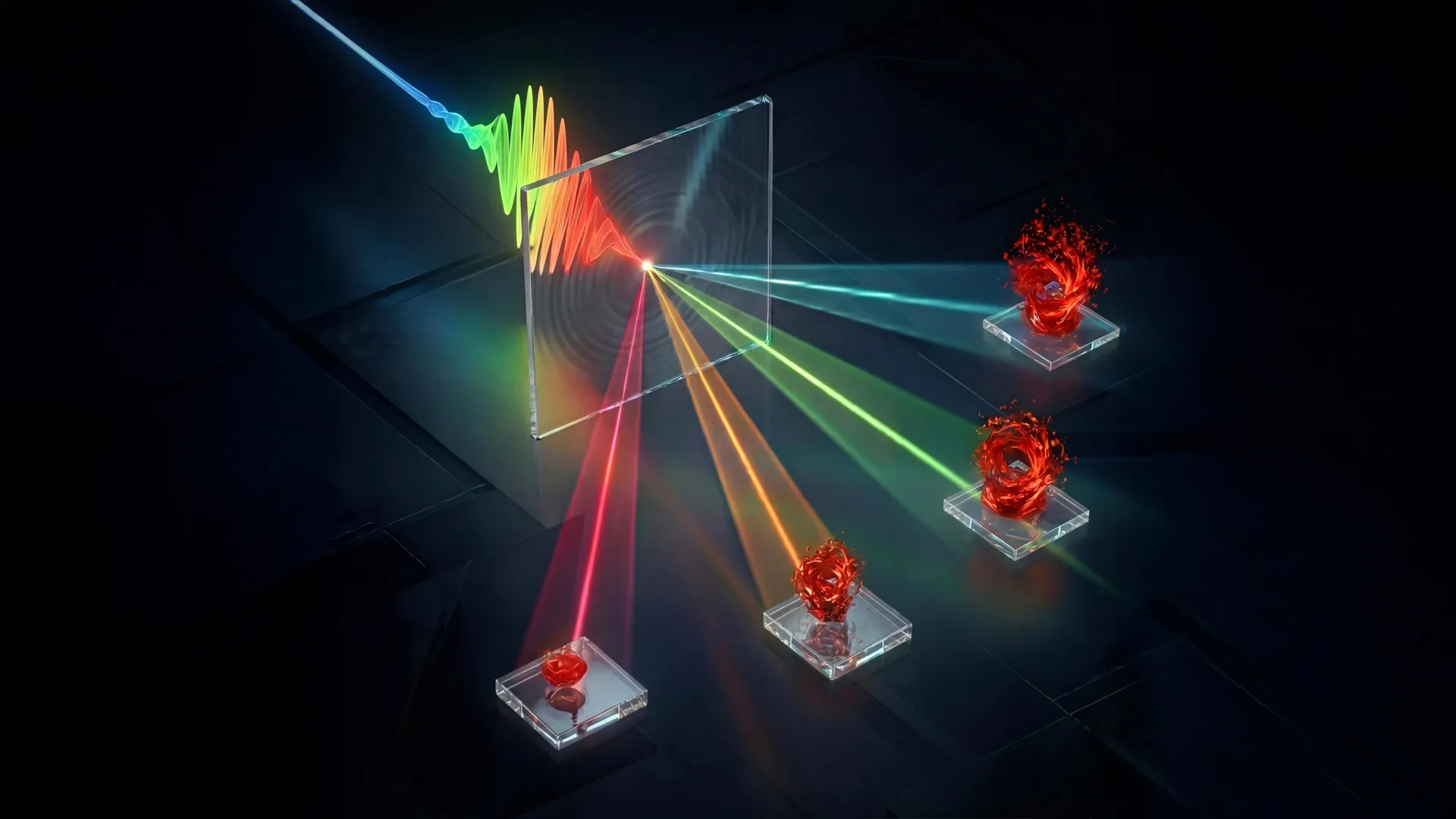
Researchers have developed a powerful new imaging technique that reveals ultrafast phenomena in the microscopic world in far more detail than ever before. These processes have traditionally been difficult to study because they occur incredibly quickly, often within a few hundred femtoseconds. New approaches will allow scientists to observe and analyze these rapid changes with great clarity and speed.
“Many important phenomena occur incredibly quickly in the fields of physics, chemistry, biology and materials science,” said Yunhua Yao, research team leader at East China Normal University. “Our new technique can capture the complete evolution of both an object’s brightness and internal structure in a single measurement. This is a major step forward in understanding the fundamental properties of matter, designing new materials, and even unraveling the mysteries of biological processes.”
The team explained their method: opticalOptica Publishing Group’s high-impact research journal. This technique is known as compressed spectrum-temporal coherent modulation femtosecond imaging (CST-CMFI). Using this system, the researchers were able to track ultrafast activities such as plasma forming in water after femtosecond laser pulses and the behavior of excited charge carriers in ZnSe.
“CST-CMFI not only helps scientists study materials that change instantaneously in response to laser light, chemical reactions that rearrange atoms at lightning speeds, and the dynamic behavior of biomolecules on incredibly short time scales, but also has the potential to help improve high-power laser technologies used in clean energy research, advanced manufacturing, and scientific instrumentation,” Yao said. “It will allow us to better understand how materials behave on very fast timescales, which could also lead to the development of more efficient electronics, improved solar cells, and faster devices.”
Capturing more than just brightness with ultra-high-speed imaging
This research is part of ongoing efforts at East China Normal University’s Extreme Optical Imaging Laboratory to advance ultra-high-speed camera technology. The main focus is single-shot ultra-fast optical imaging. This captures events that cannot be repeated by recording everything in one exposure, similar to snapping a single frame that contains the entire sequence.
Previously, these techniques primarily recorded changes in brightness, also known as light intensity. However, light also contains phase information, which tells us how the light bends and changes speed as it passes through matter. The researchers set out to capture both intensity and phase simultaneously, providing a more complete picture of the ultrafast process.
To achieve this, they combined temporal spectral mapping, compressed spectral imaging, and coherent modulation imaging. Each method has specific advantages, such as the ability to follow very fast changes, collect more data in a single measurement, and preserve image details.
How the CST-CMFI method works
This system uses chirped laser pulses made up of multiple wavelengths that arrive at slightly different times. This setting effectively links time and wavelength. When the pulse interacts with rapidly changing events, the scattered light carries detailed spatial, spectral, and phase information. This information is compressed into a single image using dispersion-coded coherent modulation imaging.
Physics-based neural networks process this data by separating wavelengths and reconstructing both intensity and phase over time. Because each wavelength represents a specific moment in time, the result is a series of frames that form an ultra-fast movie captured in a single shot.
Displaying plasma and electron behavior in real time
To test the technique, the researchers looked at two types of ultrafast phenomena. One experiment focused on plasma generated underwater by a femtosecond laser. Understanding how this plasma forms and evolves could support applications such as laser-based medical procedures. Imaging results revealed both brightness and phase changes within the plasma channel, including the formation of a dense free-electron plasma that affects how light is absorbed and passes through the water.
The research team also studied carrier dynamics in ZnSe to better understand how charge moves after being excited by light. Such insights are important for improving optical and electronic devices made with this material and could lead to faster and more efficient technologies.
“Using CST-CMFI, we were able to see changes in phase related to carrier dynamics even when there were no significant changes in intensity,” Yao said. “This highlights an important advantage of our method: phase measurements can be much more sensitive than intensity measurements in detecting subtle ultrafast processes.”
Expanding applications and future improvements
Looking to the future, the researchers plan to apply the method to study further phenomena such as interfacial dynamics and ultrafast phase transitions. This new technique is particularly valuable in these regions, where extremely small changes in the phase of light need to be detected.
Currently, CST-CMFI converts spectral information into temporal information, which limits its ability to study processes that are highly sensitive to spectral changes. To address this, the team aims to combine CST-CMFI with compressed ultra-fast photography. This next step allows spectral and temporal information to be obtained separately, greatly expanding the range of applications and increasing the overall versatility of the technique.
