


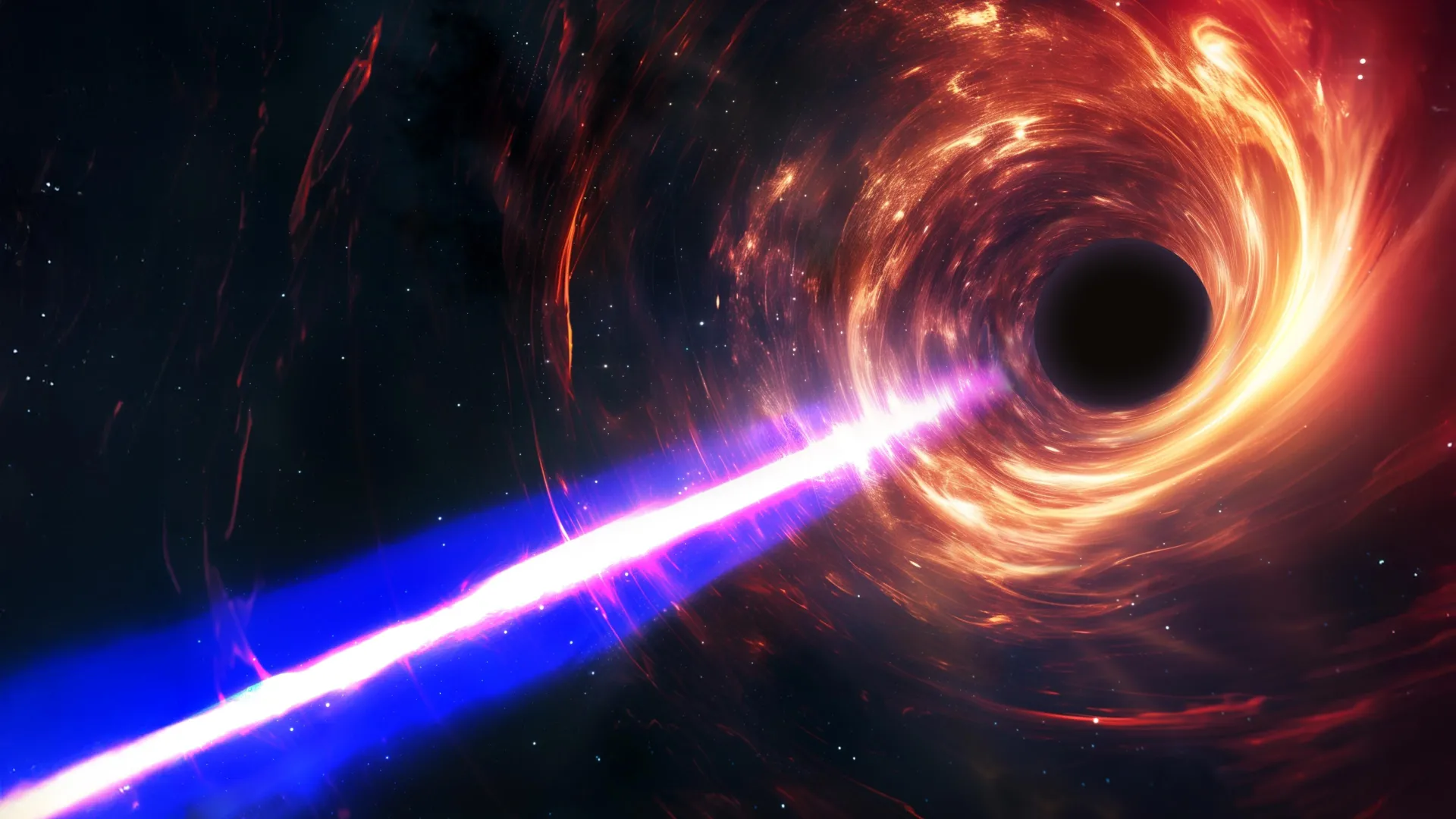
Researchers have taken a major step toward understanding how black holes affect the universe by directly measuring the power of their jets. A team led by Curtin University used a network of radio telescopes spread across the world to take detailed images that reveal just how energetic these jets are. The discovery supports long-standing theories about the role black holes play in shaping the structure of galaxies.
This research natural astronomyfocused on Cygnus X-1, a well-known star system containing the first identified black hole and massive supergiant star. Scientists determined that the jets emitted from this black hole carry an energy output equivalent to about 10,000 suns.
To make this measurement, the team utilized telescopes that are widely spaced and work as one. This setup allowed researchers to observe how powerful winds from nearby stars push and distort the black hole’s jet as it moves along its orbit. This effect is similar to how strong gusts of wind can bend the flow of water from a fountain on Earth.
Using stellar winds to reveal the strength of jets
By calculating the strength of the star’s winds and tracking how much the jet was deflected, researchers were able to determine the jet’s power at any given moment. This is the first time scientists have directly measured the instantaneous energy of a black hole jet, rather than relying on long-term averages.
The researchers also measured the jet’s speed and found that it was traveling at about half the speed of light, or about 150,000 kilometers per second. Determining this speed has been a long-standing challenge for scientists.
The project was led by the Curtin Institute for Radio Astronomy (CIRA) and the Curtin Node at the International Center for Radio Astronomy Research (ICRAR), with a donation from the University of Oxford.
‘Dancing Jets’ offers new insights
Lead author Dr Steve Prabhu, who worked at CIRA during the study and is now at the University of Oxford, explained that the team used a series of images to track what he described as a “dancing jet”. The term refers to the way the jet repeatedly changes direction, pushed by the supergiant’s strong winds, while both objects orbit each other.
Dr. Prabhu said these observations revealed the extent to which the energy generated near the black hole is transferred to its surroundings and affects the surrounding environment.
“The key finding from this study is that about 10 percent of the energy released when matter falls toward a black hole is carried away by the jet,” Prabhu said.
“This is something scientists typically assume in large-scale simulation models of the universe, but until now it has been difficult to confirm with observations.”
Check out theories about black hole physics
Co-author Professor James Miller-Jones from CIRA and ICRAR’s Curtin node pointed out that earlier techniques could only estimate jet power over very long periods of time, in some cases spanning thousands or millions of years. This made it difficult to directly compare the jet’s energy to the X-ray emissions that occur when matter falls into a black hole.
“And because our theory suggests that the physics around black holes is very similar, we can use this measurement to anchor our understanding of jets, whether they come from black holes 10 million times the mass of the sun or 10 million times the mass of the sun,” Professor Miller-Jones said.
“Radio telescope projects such as the Square Kilometer Array Observatory currently under construction in Western Australia and South Africa are expected to detect jets from black holes in millions of distant galaxies, and the anchor point provided by this new measurement will help calibrate the overall output.
“Black hole jets provide an important source of feedback to the surrounding environment and are critical to understanding the evolution of galaxies.”
Other collaborators in the research include the University of Barcelona, the University of Wisconsin-Madison, the University of Lethbridge, and the Space Sciences Institute.
