


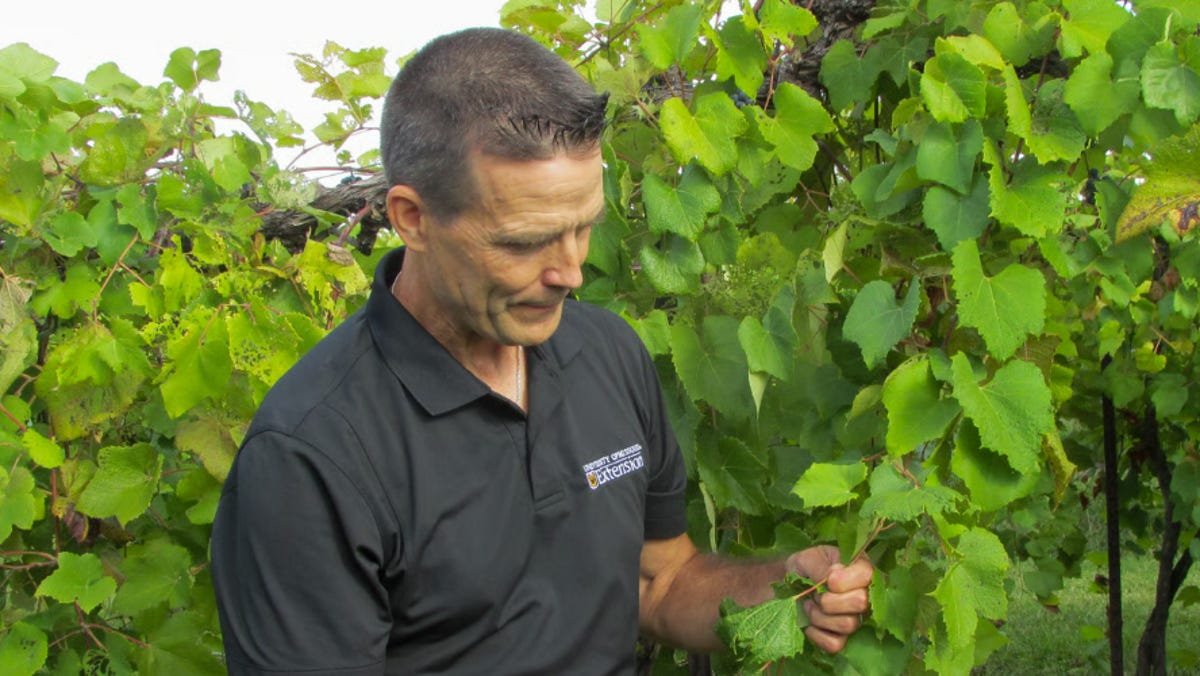
For 20 years, Nick Pere’s grapes have been pressed and distilled to fill the glasses of wineries across Missouri. The vines on his 20-acre farm in Etras are filled most seasons with a variety of varieties, including Vignoles, Allomera and Chambourcin.
Last year was different.
In May, before the vine blooms, the leaves begin to curl into a small bowl shape. As the fruit grew, most of it remained green and never fully ripened.
Pere’s harvest was about 40 tonnes less than in previous seasons. Compared to the previous year, the harvest was cut by almost half, and profits were down about $50,000.
“There are some dead plants out there, and the number is increasing every year,” Pere said.
Pere doesn’t know exactly why his fruit is dying. However, symptoms indicate pesticide drift.
Crops genetically bred to withstand high doses of herbicides exist everywhere. An estimated 28 million pounds of pesticides were sprayed on cash crops in Missouri in 2019, according to the U.S. Geological Survey. This doesn’t include the pesticides that seep into suburban lawns, golf courses, and roadsides.
Pesticides, such as fungicides, insecticides, and herbicides, have been around for decades. But 21st century chemical upgrades such as 2,4-D and dicamba have accelerated the negative effects.
Herbicides that were once applied to individual weeds are now being sprayed across entire fields. If mishandled, they can drift and invade areas they shouldn’t be, potentially damaging sensitive crops.
Drift is a major concern for many farmers. That’s according to a University of Missouri report that interviewed 50 fruit and vegetable farmers in the state.
In 2024, a federal court threw out the Environmental Protection Agency’s approval of dicamba, one of the most notorious castaways. But President Trump’s administration is taking a different approach. In February, the EPA reauthorized the use of dicamba for the 2026 growing season. The new approval includes new temperature limits, a halving of the amount farmers can apply annually, and conservation measures aimed at preventing the spread.
Vineyards are particularly sensitive to pesticides. Applications to row crops are often measured in pounds per acre, but less than an ounce can cause injury in grapes.
When Dean Volenberg, viticulture program leader at the University of Missouri-Columbia, received a call from Nick Pere detailing the damage to his vineyard, he knew it would not be his last call of the season. For Volenberg, grapes are the “canary in the coal mine” that create a larger drift problem.
“Every year we see some kind of damage,” Volenberg said in an interview last fall. “In 2025, it will be everywhere.”
Drifting clouds of chemicals now sweep across farmland every year, impacting large wineries, small-town vineyards, organic farms, and more.
Squeeze the profits along with the grapes.
changing wind
Outsiders may be unaware of Missouri’s storied and still-evolving winemaking history. 1,700 acres of vineyards perched on the rocky bluffs of the Show Me State pump out 1 million gallons of wine each year. After accounting for tourists, taxes and wages, the industry drives nearly $5.5 billion in economic activity, the industry group said.
These winemaking traditions are deeply rooted, following the course of the Missouri River from the west, through the east, and along the central part of the state. Credit goes primarily to the German immigrants who brought their viticultural traditions and settled in what has since become known as Missouri’s Rhineland.
By 1835, nearly 60 wineries had taken root around Herman and Augusta, making Missouri one of the nation’s largest wine producers before Prohibition.
Nowhere is that tradition more evident than at Stone Hill, the state’s oldest winery.
Approximately 200 acres of Stone Hill Vineyards dot the Hermann Escarpment. For thousands of years, winds swirling over the river lifted rich soil from the banks of the Missouri River onto the surrounding bluffs, creating fertile hilltops perfect for growing grapes.
Now this bountiful wind brings destruction. Nathan Held is Vice President of Sales and Marketing at Stone Hill Winery and a third-generation winemaker.
“On the north side, it’s almost all row crops,” Held said, pointing to the fields across the river. “Right now, that’s driving some of that variation. And it seems like farmers are using more volatile chemicals now.”
Stone Hill Winery’s vineyards are spread throughout Hermann, so one big drift won’t ruin the entire harvest. However, signs of pesticide drift are becoming more common.
“We’ve seen that every year in recent history,” Held said. “We’re not going to see it in every vineyard site, but at least we’re going to see it a little bit in most sites.”
One way the state tracks the frequency of pesticide drift is through voluntary reporting from farmers.
According to the Missouri Department of Agriculture, 133 pesticide drift complaints were filed in 2025, 10 of which were from grape growers. This compares to 7 out of 89 in 2024.
Volenberg advises everyone he talks to to tell state regulators and file a complaint if they are stranded. But vineyards may be holding us back.
“Some people are almost used to it, but they don’t even know the exact terminology,” Volenberg said.
Some people call it “too much”
The release of Roundup Ready seeds in 1996 was a turning point in agriculture. These seeds harbor genetic code that gives plants resistance to glyphosate, the active ingredient in Roundup herbicide.
Instead of spraying individual weeds, farmers can apply herbicides to entire fields. This gave rise to the term “excess” pesticide. By 2004, 85% of all soybeans grown in the United States were engineered to be herbicide tolerant.
However, this breakthrough in resistance had unexpected consequences. Herbicide-resistant weeds began to thrive in competition with plants that were once easy to kill, and species such as waterhemp, ragweed, and amaranth developed resistance to glyphosate. Twenty years after Roundup Ready hit the market, eight glyphosate-resistant weeds have been identified in Missouri.
In 2016, pesticide company Monsanto released another genetically engineered weapon in the fight against weeds. These seeds were resistant to dicamba, a synthetic auxin discovered in the 1950s.
Auxin is to plants what growth hormone is to humans. They regulate virtually every aspect of development. As chemical messengers, they are essential for plant growth and easy to imitate.
Synthetic auxin does just that. When sprayed on broadleaf plants such as dandelions and milk thistle, the chemical mimics auxin, binding to its hormone receptors and overstimulating them. After one dose, the plant will grow and die.
Farmers can now target glyphosate-resistant weeds with dicamba at their disposal. However, dicamba was prone to drift.
Drift occurs primarily in two ways. One is when sprayed pesticide droplets are deflected when the wind is strong or blowing toward sensitive crops.
The second method is as steam. As already applied chemicals rehydrate, they can evaporate and colonize plants miles away from their intended targets. Even pesticides that are initially applied in perfect conditions can become stranded due to volatilization.
In 2017, when a chemical cloud settled across the U.S. Corn Belt, farmers saw their crops wither in their fields. According to the University of Missouri-Columbia, an estimated 3.1 million acres of farmland west of the Rocky Mountains were damaged by dicamba drift during the growing season.
“Is there really a way to build an organic production system in Missouri where all these materials are constantly flowing into Missouri?” Volenberg said. “It really makes me wonder. At least I do.”
To University of Illinois professor Aaron Hager, dicamba’s drifting tendencies were no surprise. Since its introduction in the 1960s, dicamba has been known as a volatile herbicide.
“I’ve lived here for 33 years,” Hager said. “And year after year, we’ve seen evidence of dicamba movement that’s off the mark.”
Hager said what made the 2017 drift event different from the previous 50 years of dicamba use was the area, amount and timing of spraying.
By 2018, Monsanto’s dicamba-resistant seeds had germinated in nearly one-third of Missouri’s soybean fields. Dicamba has traditionally been used on crops that are planted much earlier in the season, such as corn. The later the application time, the higher the temperature and the greater the chance of wandering.
Since the record outbreak of dicamba, new pesticide-resistant crops have entered the market.
The use of 2,4-D, an ingredient in America’s infamous Operation Agent Orange during the Vietnam War, skyrocketed. Illinois counties have seen a median increase of 341% since 2017. Although 2,4-D is less likely to volatilize, it is much more potent than dicamba against grapevines.
Grape growers like Nick Pehle see the problem getting worse before it gets better. Alongside his vineyard, Pere runs a consulting business, installing vines and advising other grape growers. Of the roughly 40 producers he works with, he said he sees symptoms of drift in nearly every vineyard.
It doesn’t matter whether they get swept away or not, it matters how bad this year will be.
“I now call this chemical intrusion rather than pesticide drift,” Pere said. “The bottom line is if you can’t continue to do what you’re doing to protect your property, then you shouldn’t do it.”
Pele still considers himself lucky. He received partial compensation after a drift accident in 2022 when a neighbor unknowingly sprayed his crops with a herbicide containing 2,4-D.
However, he is concerned about the strength of his vines, having already uprooted two vineyards that experienced several years of continuous drift.
“I’m still monitoring and hoping for the best,” Pere said. “We have great hope in becoming farmers, especially specialty crop farmers in Missouri.”
This story is Mississippi River Basin Agriculture and Water Deskan independent reporting network based in . University of Missouri In partnership with Report for Americais generously funded by the Walton Family Foundation.
