


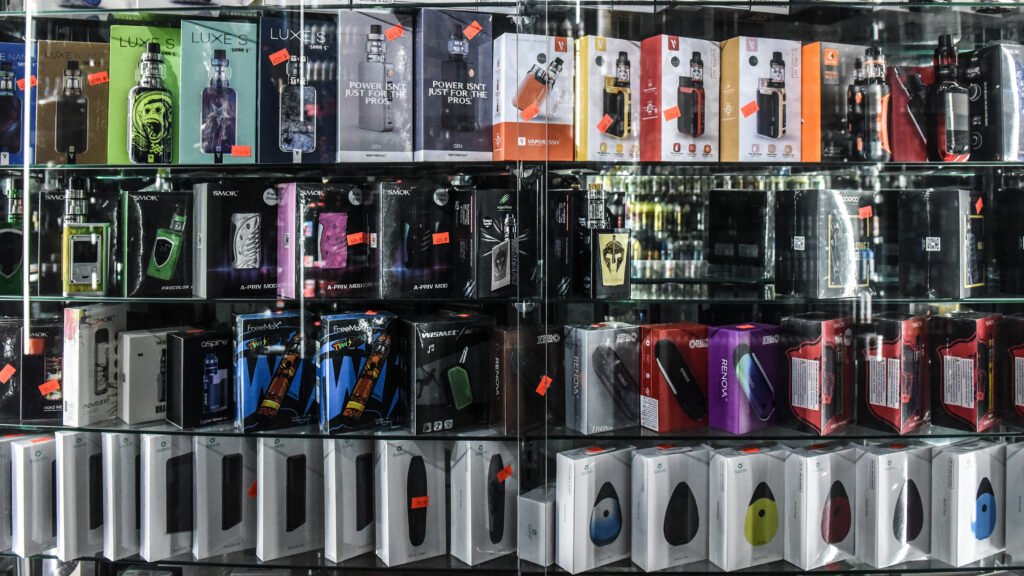
Thousands of illegal e-cigarettes are sold in the United States, and the Trump and Biden administrations have vowed to crack down on illegal fruit- and candy-flavored e-cigarettes that are especially appealing to minors. But a new government report suggests that the Justice Department’s enforcement efforts are far behind the scope of the problem.
According to the Government Accountability Office report, most of the Justice Department’s enforcement actions from fiscal years 2022 to 2025 (50 of 88 total) involved adding the names of remote e-cigarette sellers to the list of unauthorized operators. The second most common type of enforcement action cited in the report (20 out of 88) was an injunction to stop violations of the law.
Because GAO’s report focuses on actions involving the Department of Justice, these tallies do not take into account enforcement actions, such as the seizure of more than 6 million illegal products by the Food and Drug Administration and U.S. Customs and Border Protection between 2024 and 2025. To put these seizures into context, the large-scale seizure of products (3 million e-cigarettes) worth $76 million in 2024 represents about 4% of China’s e-cigarette exports. “It came to the United States in a month,” said Stephen Hsu, an adjunct assistant professor at the University of Waterloo who studies e-cigarettes.
Sen. Dick Durbin (D-Ill.), who requested the report, said it shows more needs to be done to combat the public health threat posed by illegal e-cigarettes.
“This GAO report helps illuminate the failure of the FDA and Department of Justice to protect children from lifelong nicotine addiction. Despite court orders and Congressional deadlines, thousands of dangerous and child-friendly e-cigarettes remain illegally on the market,” Durbin said. “Instead of being intimidated by the tobacco industry, the FDA and Department of Justice must use their enforcement tools to their advantage.”

Public health experts are upset by FDA action on flavored e-cigarettes
Kathy Crosby, president and CEO of the anti-nicotine addiction nonprofit Truth Initiative, shared that sentiment. “GAO’s report highlights an alarming disparity between the scale of illegal e-cigarette sales and the priorities to address this problem at the federal level,” she said, adding, “The burden of closing this enforcement gap should not be placed on states. This is a national problem that requires a coordinated federal response, with the full support of federal regulatory and enforcement authorities.”
The Justice Department did not respond to requests for comment.
According to the latest data available from the Centers for Disease Control and Prevention, there are approximately 6,000 e-cigarette products on sale in the United States as of June 2024. So far, only 41 of these products have been approved for sale by the FDA from the Glas, Logic, Juul, NJOY, and RJ Reynolds Vapor Company brands. The majority of illegal e-cigarettes on the market are manufactured in China, illegally imported into the United States, and sold everywhere from convenience stores to gas stations to tobacco stores. In 2025, the export value of e-cigarettes from China to the United States will exceed $10.6 billion.
Although youth e-cigarette smoking rates have declined in recent years in the United States, public health experts warn that recent data shows 1.6 million children still use e-cigarettes, and that children are drawn to sweeter flavored varieties that are not FDA-approved due to concerns about their outsized appeal to young people.
In June 2024, recognizing that the black market for illegal e-cigarettes is exploding, the government established an interagency task force led by the Department of Justice and the FDA, and including Customs and Border Protection, the U.S. Postal Inspection Service, and the Federal Trade Commission, aimed at increasing enforcement against illegal e-cigarettes.
Mitch Zeller, who led the FDA’s tobacco division from 2013 to 2022, said the agency’s ability to take independent action against the wave of illegal e-cigarettes is limited to pursuing warning letters and civil penalties. Everything else involves other agencies. His biggest takeaway from the report is that the FDA “is not getting the support from the Department of Justice and other law enforcement agencies that it needs to aggressively crack down on illegal e-cigarette products.”
Zeller said it was also “disappointing” that the largest category of actions taken by the Justice Department was to place unlicensed online e-cigarette sellers on a list for distribution to carriers such as the U.S. Postal Service.
Xu said the overwhelming majority of illegal e-cigarettes are sold at physical locations such as gas stations, convenience stores and e-cigarette shops. “There is a mismatch between Department of Justice resources and the actual retail industry,” he said in an email.
Last month, a group of members of Congress urged the Trump administration to focus on halting the wave of illegal e-cigarettes in trade negotiations with China. When it comes to enforcement, Zeller said he believes the single most impactful option is to go after the middlemen, the wholesalers and distributors, who illegally import e-cigarettes and deliver them to the sellers.
“It’s very difficult to prevent goods from coming into the country. There are too many ports,” Zeller said. “And on the back end, we’re talking about probably tens of thousands, if not more, with retailers.” Just one or two major crackdowns going after the top intermediaries responsible for moving the e-cigarette supply from the door to stores and warehouses “could go a long way toward cleaning up the market,” he said.
STAT’s chronic health coverage is supported by a grant from. bloomberg philanthropy. our financial supporter It has no role in any of our journalism decisions.
