


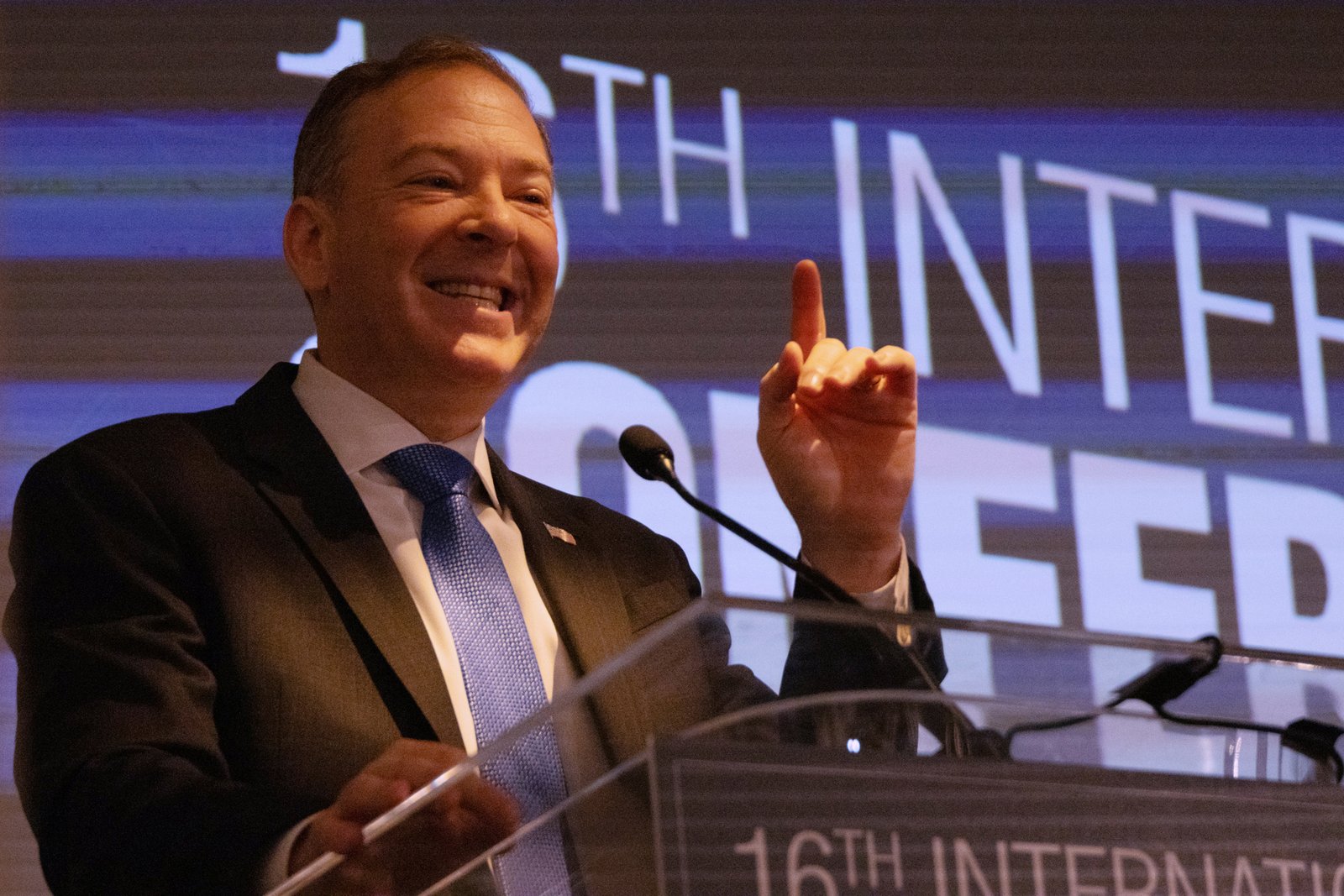
WASHINGTON—Environmental Protection Agency Administrator Lee Zeldin addressed a conference of climate change-skeptical scientists and other experts Wednesday, praising the decision to repeal so-called “endangerment findings” that form the basis of federal regulation of greenhouse gas emissions.
“Today is a day to celebrate innocence!” he said.
The study’s reversal in February will allow the federal government to end regulations on climate-changing emissions from sources such as cars, trucks and power plants.
“We’re going back to basics, and we’re not going to accept everything the left says without question or pushback,” Zeldin told a cheering audience at the 16th International Conference on Climate Change, hosted by the conservative Heartland Institute, the Carbon Coalition, What’s Up with That, and the Committee for a Constructive Tomorrow (CFACT).
Wednesday’s event was an opportunity for the Trump administration to bask in praise from those who support rolling back climate change regulations. But 24 states have already joined in suing the EPA over the decision in federal court.
“Reversing EPA’s decision would undermine the progress we have made to address climate change by eliminating EPA’s existing greenhouse gas emissions standards for vehicles and undermining EPA’s mission to regulate the harmful air pollution that causes climate change,” Illinois Attorney General Kwame Raoul said in a March 19 statement about the lawsuit.
Ahead of Zeldin’s speech, experts criticized the administration for abdicating leadership on climate change, even as the risk of climate change impacts including wildfires, heat waves and even more devastating hurricanes increases.
“Climate change is creating more risks everywhere, threatening our security and stability,” Peter Zalzal, vice president of the Environmental Defense Fund, said in a statement. “But Administrator Zeldin’s response is very similar to the Heartland Institute’s rhetoric: ‘There’s nothing worth seeing here.'”
Nancy Goodnight, a former teacher from Texas, saw Zeldin speak for the first time at a conference.
“He spoke the truth,” she said after the speech. “This guy is very knowledgeable and a great fit for EPA. He showed a lot of depth about what’s going on at EPA and what needs to move forward at EPA.”
In his speech, Zeldin questioned the science that the Obama administration cited in 2009 to show that greenhouse gas emissions endanger public health and welfare. At the time, the EPA also announced findings that emissions from new gasoline-powered vehicles were a “cause or contributor” to climate change.
Mr. Zeldin specifically attacked the range scientists were using to talk about the possible effects of climate change.
“We want to know if it’s going to rain or shine,” Zeldin said. “We don’t want to know your range, we want to know exactly what’s going on. The question is science, do you want to be completely honest? Science comes with a range of possibilities.”
Scientists use ranges because they can’t predict the future with certainty, but they can describe probabilities and probabilities, said Dana Fisher, director of the Center for Environment, Community and Equity at American University.
“Based on the research, we can say with 95% confidence that temperatures will rise within a certain range,” said Fisher, a sociologist who studies how political elites respond to climate change. “He says he doesn’t want to have that interval. He just wants to know yes or no. And that’s not how science works. That’s not how statistics work. That’s too bad.”
This story is funded by readers like you.
Our nonprofit newsroom provides free advertising for our award-winning climate coverage. We rely on donations from readers like you to continue our work. Donate now to support our work.
donate now
Zeldin also noted that the agency has canceled about 800 grants to communities affected by environmental issues. He claimed that these funds were being spent on “left-wing activist groups training other activists to come to Washington, D.C. and advocate that their next dollar be donated to them.”
Fisher said this was a “misrepresentation of how the funds will be used.” She said the grant is aimed at supporting communities that are overburdened by pollution, the effects of climate change and other environmental hazards. He said environmental nonprofits that received grants are not allowed to lobby Congress or federal agencies because of their 501(c)(3) tax status. To be allowed to lobby, a group must have 501(c)(4) status.
Just outside the conference, Austin Matheny Kawesh, senior communications manager for advocacy on behalf of EDF’s partner organization EDF Action, spun a colorful wheel filled with examples of the impacts of climate change.
“Editing the truth about the planet’s overheating will not solve the problem,” he says. “We’re reminding people that the Trump administration’s climate denial policies won’t lower your energy bills or insurance premiums, reduce pollution, or make you healthier.”
The Heartland Institute has been a leading advocate of climate change denial and skepticism of the scientific consensus on global warming. According to the New York Times, the institute sent copies of its book “Climate at a Glance” to thousands of science teachers to provide “data showing that the planet is not in a climate crisis.”
At the time of the repeal announcement, President Donald Trump called the findings a “radical rule” and “the basis for Green New fraud.” Since 2012, President Trump has been vocal about his skepticism about climate change and expressed support for reversing President Obama’s 2013 Climate Action Plan. In both his first and second terms, he pulled the United States out of the 2015 Paris climate accord. Under the Paris Agreement, more than 193 other countries are voluntarily committing to reduce emissions and curb global warming.
Fisher said Zeldin’s rhetoric will harm science because even though global warming and many climate impacts are scientifically understood, the federal government appears intent on rejecting grant proposals that don’t align with its position.
“It’s going to have implications for all of us in the actual sciences because it’s laying the foundation for the argument that inconclusive research like the one being discussed at this conference is ideologically motivated,” she said. “It also means that if you don’t follow the ideological trends that administrators are pushing, you can’t get funding to do this kind of research.”
About this story
As you may have noticed, this article, like all news we publish, is free to read. That’s because Inside Climate News is a 501c3 nonprofit organization. We don’t charge subscription fees, keep our news behind paywalls, or fill our website with ads. We provide climate and environmental news free to you and anyone who wants it.
That’s not all. We also share our news for free with dozens of other news organizations across the country. Many of them cannot afford to do their own environmental journalism. We’ve established bureaus across the country to report on local news, partner with local newsrooms and co-publish stories to ensure this important work is shared as widely as possible.
The two of us started ICN in 2007. Six years later, we won the Pulitzer Prize for national reporting and now run the nation’s oldest and largest dedicated climate newsroom. We tell the story in its entirety. We hold polluters accountable. We expose environmental injustice. We debunk misinformation. We explore solutions and inspire action.
Donations from readers like you fund all aspects of our work. If you haven’t already, will you support our ongoing work, our coverage of the biggest crises facing our planet, and help us reach more readers in more places?
Please make a tax-deductible donation. Each one makes a difference.
thank you,

Gabriel Matias Castillo
fellow
Gabriel Matias Castillo reports on the Washington, DC area. Previously, he worked at Capitol News in Illinois, covering environmental policy, energy and utilities across the state. He is currently pursuing a master’s degree at Northwestern University.
