


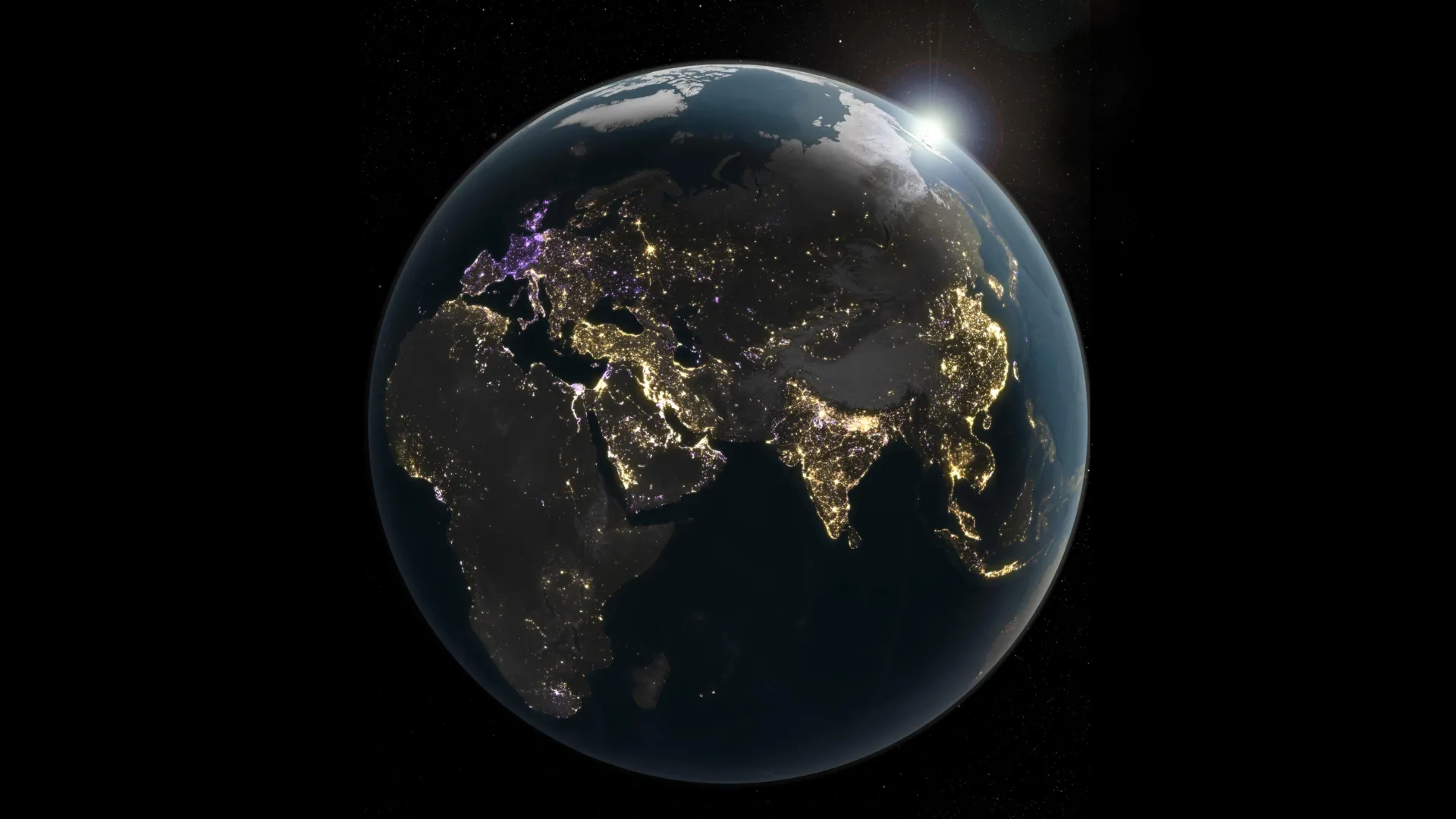
Satellite observations show that Earth’s nights are steadily getting brighter, but the trend is not uniform. Data from the VIIRS DNB instrument, covering the period 2014 to 2022, shows that global nighttime lighting is increasing by approximately 2% each year.
“We’re seeing a total increase of 16% worldwide, but that doesn’t mean we’re increasing lighting everywhere,” Christopher Kaiba explained. “We found that global emissions increased by 34% in regions where lighting increased. This was offset by an 18% decrease in emissions from other regions.”
These findings reveal that changes in nighttime illumination are more dynamic and localized than previously understood. Due to the rapid growth of cities, countries such as China and India brightened significantly during the study period. In contrast, some developed countries have seen a decline in light emissions, often associated with the adoption of LED technology and policies aimed at reducing light pollution.
Regional changes reflecting policy and conflict
Not all change happens gradually. After the Russian invasion, night lighting in Ukraine sharply decreased. France also saw a significant decline, with nighttime brightness dropping by 33 percent as many cities turn off street lights after midnight to save energy and reduce light pollution.
“In Germany, luminescence remained almost constant overall, despite regional variations,” Kaiba reports. “Light radiation increased by 8.9% in bright areas of Germany, but decreased by 9.2% in dimly lit areas.”
Across Europe, satellite measurements show a 4% reduction in nighttime light radiation. However, satellites detect light differently than the human eye, so this drop may not perfectly match what humans perceive on the ground.
High-resolution data reveals faster changes
A key advance in this research is the use of full-resolution nighttime data. Previous analyzes relied on monthly or annual averages, making it difficult to identify short-term or local changes.
“Until now, no global analysis has been performed using full-resolution nighttime data,” Kaiba emphasizes.
The research team also applied a new algorithm that takes into account the angle at which the satellite views Earth. For example, residential areas tend to appear brighter when viewed from an angle, while dense urban centers often appear brighter when viewed from directly above. By incorporating these differences, we are now able to more accurately understand how the luminescence changes.
How satellites track the Earth at night
This study is based on data from the Visible Infrared Imaging Radiometer Suite (VIIRS) Day/Night Band (DNB) carried by the Suomi Nuclear Power Plant, NOAA-20, and NOAA-21 satellites operated by NOAA and NASA.
These satellites collect images after midnight, typically between 1 a.m. and 4 a.m. local time, scanning nearly the entire Earth from 70 degrees north to 60 degrees south latitude each night. Each pixel in the image represents approximately 0.5 square kilometers.
To ensure accuracy, the researchers focused only on artificial light sources. Natural phenomena such as wildfires and aurora borealis, which can also be detected by satellite, were excluded from the analysis.
Promoting next-generation satellites in Europe
Understanding how lighting changes at night is of practical importance. “Artificial light is a major consumer of electricity at night, and light pollution has a negative impact on ecosystems,” says Christopher Kaiba. “So it’s important to understand how both of these are changing.”
Kyba is leading the development of a new satellite specifically designed to monitor nighttime lighting as part of the European Space Agency’s (ESA) Earth Explorer 13 mission. The proposed system detects much fainter light sources, provides significantly higher resolution, and reduces uncertainties about global illumination trends.
“The United States and China each have multiple satellites that observe nighttime light, but there are currently no European satellites designed for this purpose,” Kaiba says.
