


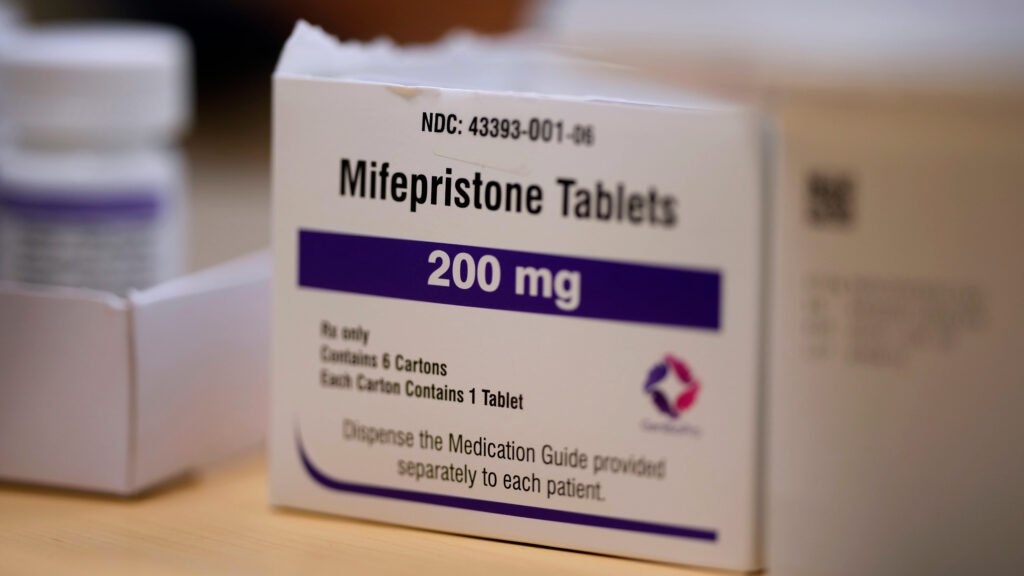
A federal judge on Tuesday refused to block mail-in prescriptions for the abortion drug mifepristone nationwide, at least for now, in response to a Louisiana effort to block a group that sends the drug to states where abortion is prohibited.
U.S. District Judge David Joseph in Lafayette, Louisiana, ruled against Louisiana Attorney General Liz Murrill, who sought to suspend a U.S. Food and Drug Administration rule allowing mifepristone to be dispensed by mail while a challenge to the 2023 regulation is heard in court.
He accepted the government’s request to put the case on hold for now, but warned that the hold would not be indefinite and that he could side with Louisiana later.
Murrill said in a statement that he will ask the appeals court to overturn the federal rule, noting that the judge concluded that the current rule “concludes that Louisiana suffers irreparable harm every day.”
Joseph, who was appointed to the bench by President Donald Trump, said in his opinion he would follow the FDA’s ongoing research into the drug. He also told authorities to provide an update on the status of the investigation within six months.

A new approach to combating state abortion bans
“If the agency does not complete its review of the regulations and make the necessary modifications within a reasonable period of time, the court’s analysis and the weight given to these factors will necessarily change,” he wrote.
He also said he believes the plaintiffs have a “high probability of success on the merits.”
Murrill argues that allowing prescriptions to be mailed would undermine the abortion ban in Louisiana, one of 13 states that currently bans abortion at all stages of pregnancy. Other Republican state officials have filed similar court challenges in other districts.
Abortion rights groups also emphasized that Tuesday’s ruling is not a final verdict.
“From the courts to the Trump administration to state legislatures across the country, mifepristone and access to abortion remain under attack,” Alexis McGill Johnson, president and CEO of Planned Parenthood Federation of America, said in a statement.
Mifepristone, which is typically taken in combination with a second drug, misoprostol, has moved to the center of legal battles over access to abortion since the 2022 U.S. Supreme Court decision that overturned Roe v. Wade and allowed states to ban abortions.
In 2024, the country’s highest court refused to block the filling of prescriptions for mifepristone by mail. This case was different because it was brought by anti-abortion doctors, but the court said they had no legal standing to challenge the rule.
While conservative states have moved to ban or restrict abortion, liberal states have moved to protect access to abortion. Currently, eight states have laws in place that protect health care providers who prescribe abortion pills via telemedicine and mail them to states where it is prohibited.


Sign up for daily summary
All the health and medical news you need today in one email
One study found that by the end of 2024, one in four abortions will be accessed via telemedicine, a five-fold increase in two years. Another study found that in 2025, women in states with abortion bans were more likely to obtain an abortion by obtaining the medication through telemedicine than by traveling to another state.
Mr. Murrill is pursuing a criminal case against two doctors accused of sending the pills to patients in Louisiana, one in California and one in New York. These states have been reluctant to extradite doctors to face charges.
Joining Murrill as plaintiffs is a Louisiana woman who claims her boyfriend was forced to take mifepristone by a California doctor.
Discussions of coercion, particularly when abusive partners control the victims’ reproductive care, were a central theme in the plaintiffs’ cases. They argue that without in-person requirements for abortion pills, intimate partner abuse will only increase. Some anti-domestic abuse advocates pushed back, arguing that telemedicine could be a valuable lifeline for survivors.
President Donald Trump’s administration infuriated anti-abortion groups last year when it approved additional generic versions of mifepristone.
A Hawaii judge ruled last year that the FDA violated the law by imposing restrictions on mifepristone, which is also used to treat miscarriages.
— Jeff Mulvihill, Kimberly Crusi
