


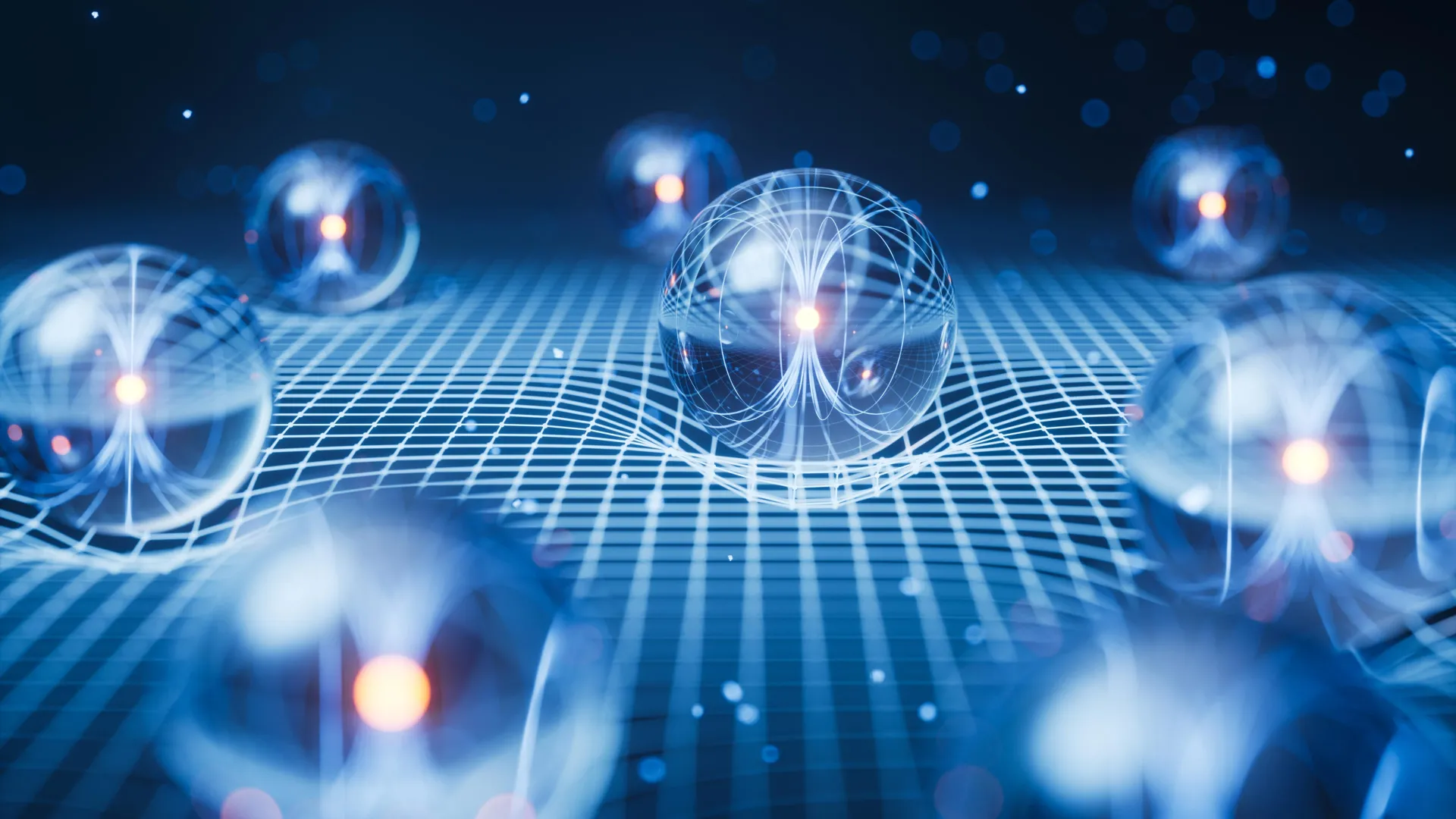
Imagine setting up an elaborate chain of dominoes, where each piece must hit the next in perfect order to produce a satisfying end result.
Quantum circuits work similarly. They are made up of many small steps called (“operations”) that work together to process information in a highly coordinated manner.
Now imagine that these dominoes are a little unstable. In quantum systems, that instability is known as “noise.” Although they may seem trivial at first, small failures can accumulate over time and disrupt the entire sequence.
How noise limits quantum computing power
This raises an important question. If every step in a quantum circuit is affected by noise, is there still an advantage to increased complexity? Quantum circuits are essential to technologies such as quantum computers, which aim to solve problems that are beyond the reach of classical machines.
New theoretical research has looked into this issue in more detail. The researchers found that noise imposes a hard practical limit on the depth of quantum circuits, or the number of steps they can perform in succession. They also showed that noise makes it easier to simulate some of these circuits using classical computers.
The study was led by Armando Angrisani and Yihui Quek from EPFL, Antonio Anna Mele from Free University of Berlin, and Daniel Stilck França from the University of Copenhagen. The result is natural physics.
Why only the last step matters
To understand the effects of noise, the team examined a large group of quantum circuits built from simple two-qubit operations. Their model included realistic conditions in which each qubit experiences noise at every step.
They used mathematical analysis to track how the influence of each layer moves through the circuit. The results revealed that in most noisy quantum circuits, only the last few steps have a significant impact on the result.
Even if the circuit is designed very deeply, the effects of previous behavior will gradually disappear. In a domino comparison, it is as if only the last piece determines the final outcome.
This has practical implications. When quantum computers are used to calculate properties of qubits, such as energy and state, the results are primarily determined by the final layer. Previous operations effectively “fade out of memory” as noise accumulates.
Why you can train even noisy quantum circuits
The discovery also helps explain why even noisy quantum circuits can be tuned or “trained” for specific tasks. Changing the circuit settings can affect the results, but the main reason is that the final layer continues to play an active role.
As a result, deep circuits affected by noise behave much like shallow circuits. Adding more steps does not necessarily improve performance, as most of the previous steps no longer contribute in a meaningful way.
What this means for future quantum technologies
This research provides a clearer picture of what current quantum machines can realistically achieve. Simply increasing circuit depth is unlikely to yield better results for many common tasks, especially those based on local measurements.
Future advances will likely depend on reducing noise or designing circuits that can function effectively despite noise. The study also highlights potential misconceptions. Noisy circuits may appear trainable, but this is partly because the noise already reduces the circuit’s substantial complexity. Treating noise as just a blur can lead to unrealistic expectations about the true capabilities of quantum computing.
contributor
- Free University of Berlin
- EPFL
- Sorbonne University
- University of Chicago
- Fraunhofer Heinrich Hertz Institute
- ENS Lyon
- and
