


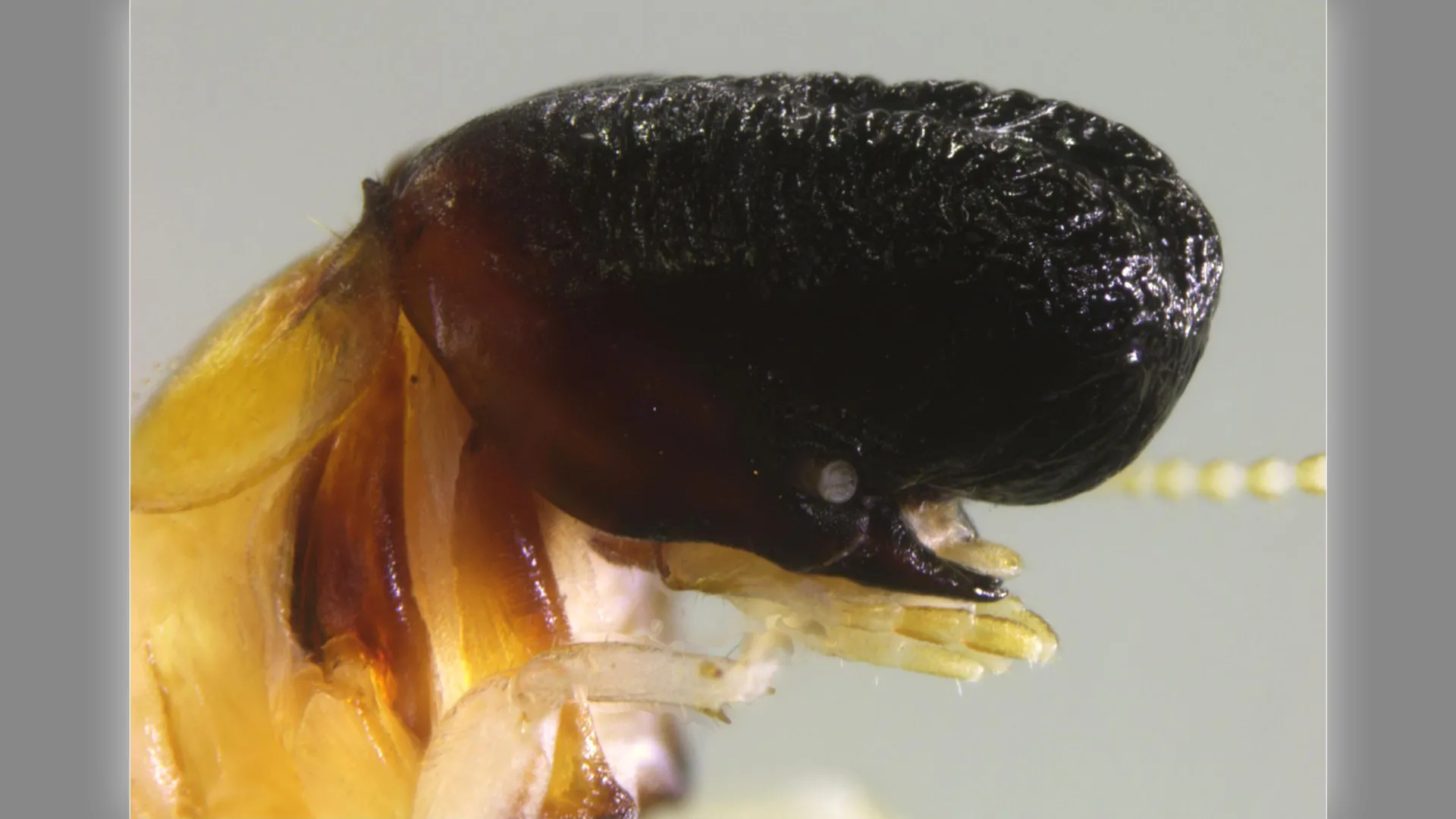
High in the treetops of a South American rainforest, scientists have discovered a tiny soldier termite that looks strikingly similar to a whale. This rare insect caught the attention of an international research team, who were struck by how different it looked from known species.
named Cryptotermes mobidickithis termite was reported by an international research team led by scientists from the University of Florida. It has a long, rounded head and an almost invisible lower jaw. Its shape closely resembles the sperm whale, the famous marine animal featured in Herman Melville’s novel, from which it takes its name.
“This termite is unlike any termite we’ve ever seen,” said Rudolf Scheffran, professor of entomology at the UF Institute of Food and Agricultural Sciences (UF/IFAS).
Scientists are surprised by whale-like head shape
Scheffran said the insect’s appearance was so unusual that researchers initially thought it belonged to an entirely new genus. His taxonomic research is based at the UF/IFAS Fort Lauderdale Research and Education Center.
“The soldier’s frontal ridge and elongated head profile resemble the head of a sperm whale, and in both creatures the lower jaw is covered by the head,” he said. “The whale’s eyes and the soldier’s antennal sockets are relatively located. After I noticed the resemblance to a sperm whale, my co-authors thought the name was appropriate and quirky, much like ‘ghost orchid’ or ‘dumbo octopus.'”
New species added to termite evolution puzzle
This discovery revealed a known number. Cryptotermes There are 16 species found in South America. As a result of genetic analysis, Cryptotermes mobidicki It is closely related to other species found throughout the Neotropics, including populations in Colombia, Trinidad, and the Dominican Republic. These findings provide new insights into how this group of termites has evolved and spread.
The colony was located in a dead tree about 8 meters above the forest floor. Their unusual body structure highlights how diverse termite species are and shows how many are undocumented in tropical environments.
Increased biodiversity and no threat to homes
“The discovery of this distinctive new species of termite highlights the vast number of unnamed organisms that have yet to be discovered on our planet,” Scheffran said.
Each new species improves scientists’ understanding of biodiversity, especially for groups like termites, which include only about 3,000 known species worldwide.
There’s also some encouraging news for Florida property owners. As a drywood termite, Cryptotermes mobidicki It poses no risk to buildings or trade. Unlike the invasive termites that damage structures in parts of the southeastern United States, this species is restricted to its native rainforest habitat and does not spread beyond it.
