


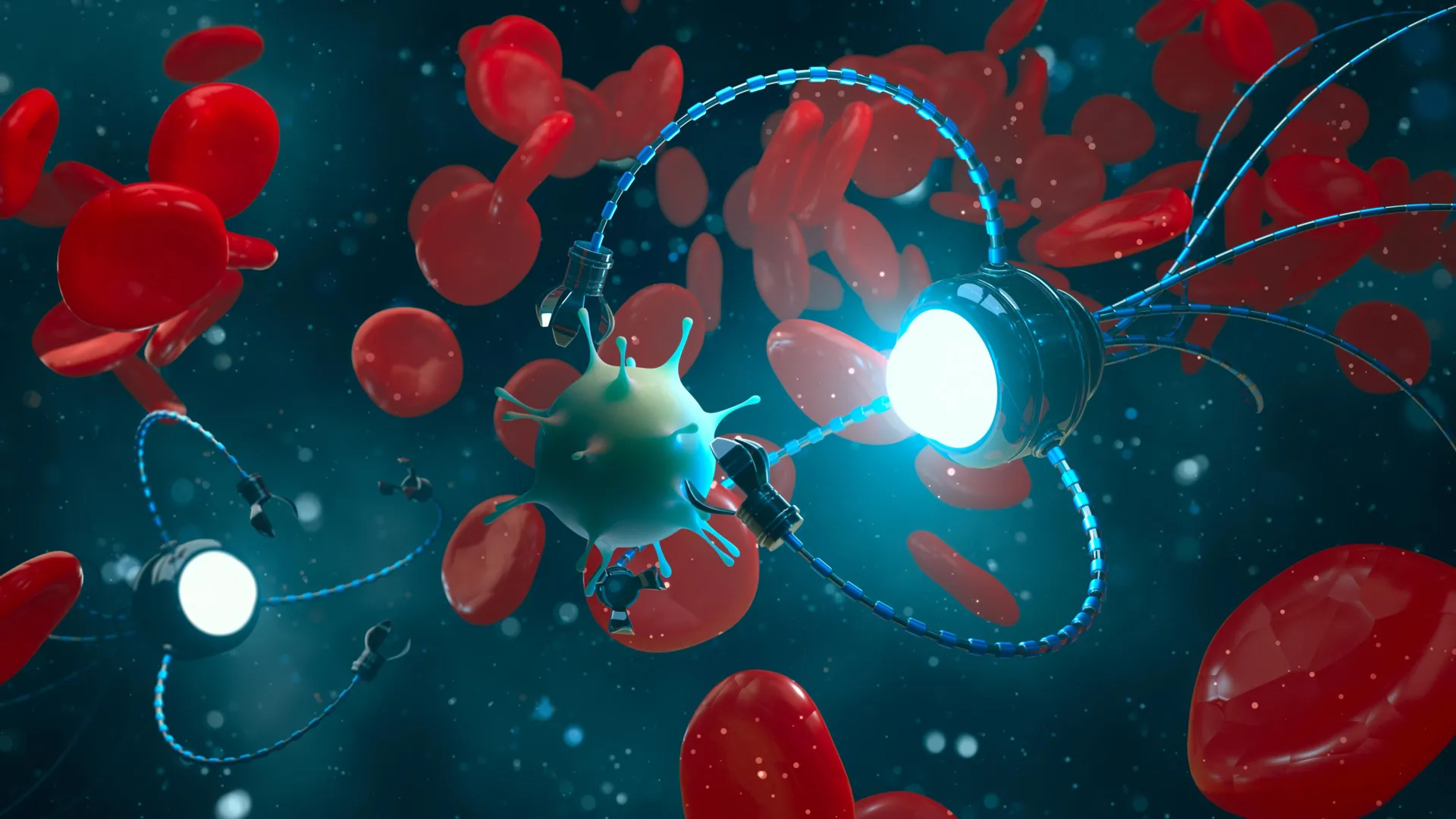
Imagine tiny robots made from DNA traveling through the bloodstream, delivering drugs exactly where they are needed, targeting cancer cells, viruses, and other threats. These microscopic machines can also assemble ultra-high precision data storage systems and computing devices at the nanometer scale. Although the potential is remarkable, most DNA robots today are still in their early experimental stages and are understood as proofs of concept rather than practical tools.
Researchers are using creative design approaches to study how DNA can be manipulated and put into working machines. These include building rigid DNA joints, incorporating flexible components, and using folding techniques inspired by origami. Scientists are adapting familiar mechanical concepts to the nanoscale by applying principles of large-scale robotics, such as rigid, compliant, and origami robots. This allows DNA-based systems to perform controlled and repeatable tasks despite their very small size.
Controlling the movement of DNA nanorobots
Guiding the movement of DNA robots in a constantly changing molecular environment is a major challenge. To address this, scientists have developed control systems that help these machines operate in a predictable manner. One important method involves DNA strand displacement, a biochemical process that allows precise programming of movement using specific DNA sequences labeled as “fuel” and “structure.”
In addition to biochemical controls, external physical signals such as electric fields, magnetic fields, and light can also control the movements of these robots. Together, these approaches provide a toolkit for fine-tuning the behavior of DNA machines with high precision.
DNA robots in medicine and technology
The potential applications for DNA robots go far beyond laboratory experiments. In medicine, they could act as “nanosurgeons”, finding diseased cells and delivering targeted treatments with precision. Researchers are also investigating whether these machines can capture viruses like SARS-CoV-2, and future systems could operate as fully autonomous drug delivery platforms.
DNA robots could also play a role in advanced manufacturing. It acts as a programmable template and can position nanoparticles with subnanometer precision. This capability could lead to breakthroughs in molecular computing and optical devices with higher efficiency than current technologies.
Challenges in scaling DNA robotics
Despite rapid progress, several obstacles remain. Moving from large-scale systems to molecular machines introduces challenges such as Brownian motion, which makes precise control more difficult. Many current DNA robot designs remain relatively simple and operate independently, limiting their usefulness in complex real-world environments.
There are also gaps in basic knowledge. Researchers still lack a detailed database describing the mechanical properties of DNA structures, and simulation tools to predict behavior at this scale are not yet fully developed.
what needs to happen next
To overcome these barriers, scientists emphasize the need for cross-disciplinary collaboration. Proposed solutions include creating standardized DNA “part libraries,” improving design and simulation using artificial intelligence, and advancing biomanufacturing methods. Advances in these areas are essential to extend and integrate DNA robots into practical applications in medicine, manufacturing, and other fields.
“Tomorrow’s robots will not just be made of metal and plastic,” the research team said. “They will be biological, programmable, and intelligent. They will be the tools that will ultimately allow us to master the molecular world.”
