


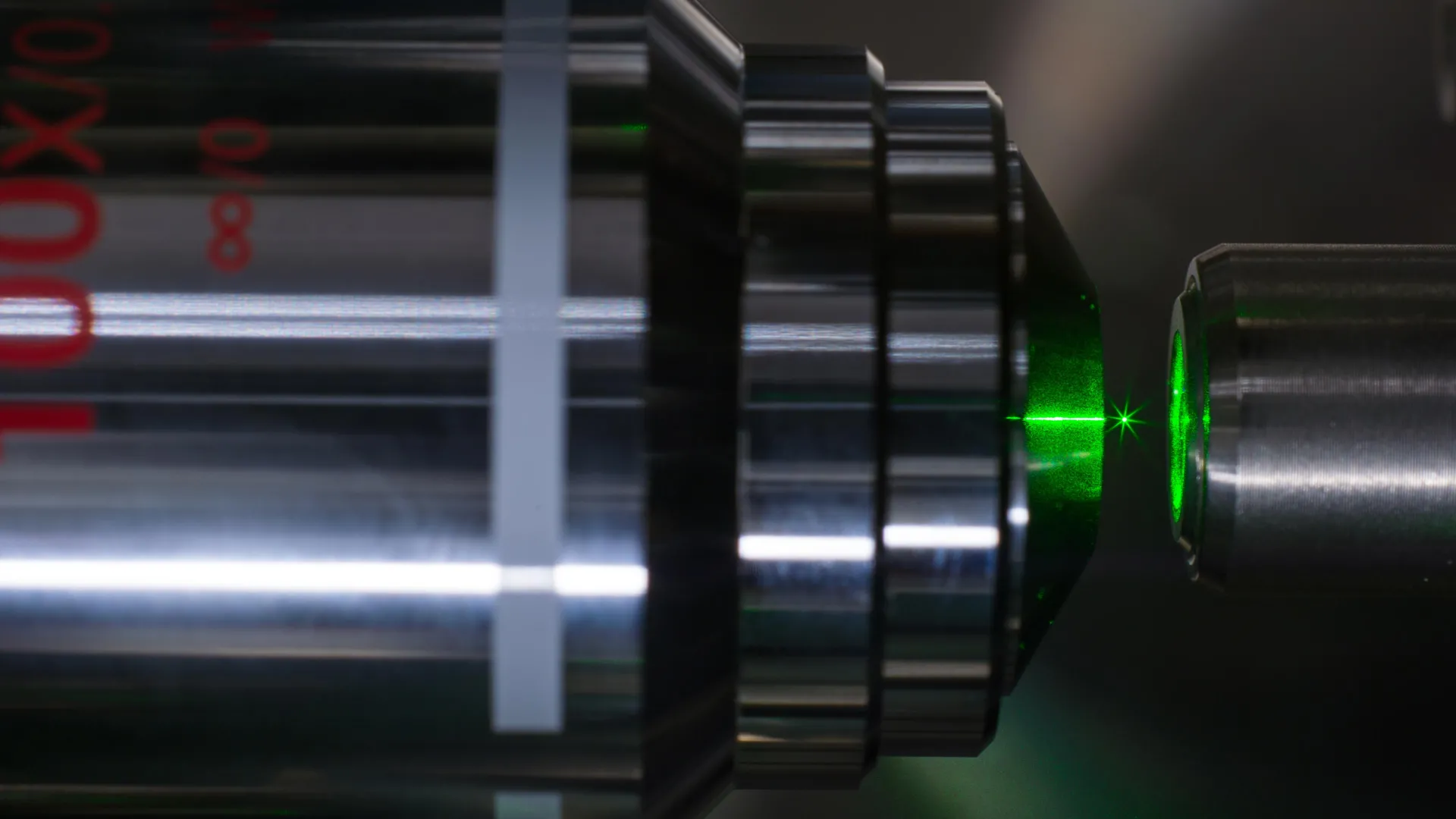
Since their invention in the 1960s, lasers have transformed both science and everyday life, powering everything from grocery store scanners to vision-correcting surgeries. Traditional lasers work by controlling photons, which are individual particles of light. But in recent decades, researchers have extended this idea to other types of particles, such as phonons, tiny units of vibration and sound. Mastering phonons can unlock entirely new capabilities, including access to rare quantum effects such as entanglement.
Scientists at the University of Rochester and Rochester Institute of Technology have developed a new type of squeezed phonon laser that can precisely control these oscillations at the nanoscale. This level of control could help researchers investigate fundamental questions about gravity, particle motion, and quantum behavior. Their discovery is nature communicationsdescribes how these microscopic vibrations were coaxed to operate in a tuned laser-like manner.
Overcoming phonon laser noise
Marie C. Wilson and Joseph C. Wilson Professor of Photophysics Nick Bamivacas of the Eurochester Optics Institute demonstrated a phonon laser in 2019 by using optical tweezers to trap and suspend vibrations in a vacuum. This was a significant advance, but before the system could be used for accurate measurements, a major challenge common to all lasers had to be solved: noise. These unwanted variations interfere with the signal and limit accuracy.
“To the naked eye, the laser appears to be a stable beam, but in reality there is a lot of variation, which introduces noise when using the laser for measurements,” Vamivakas says. “By pushing and pulling the phonon laser with light in the right way, we can significantly reduce the fluctuations in the phonon laser.”
Reduce noise and improve accuracy
To address this issue, the team used a technique known as squeezing to reduce the natural thermal noise present in phonon lasers. Reducing this noise allows for more accurate measurements. Vamivakas says this approach can measure acceleration more accurately than methods based on traditional optical lasers or radio frequency technology.
Future applications in navigation and physics
With improved precision, phonon lasers could become powerful tools for measuring gravity and other forces with great precision. This feature could play an important role in future navigation systems. Researchers have proposed a quantum compass as a high-precision, “unjammed” alternative to satellite-free GPS, and phonon lasers could help bring such concepts closer to reality.
This research was supported by the National Science Foundation.
