


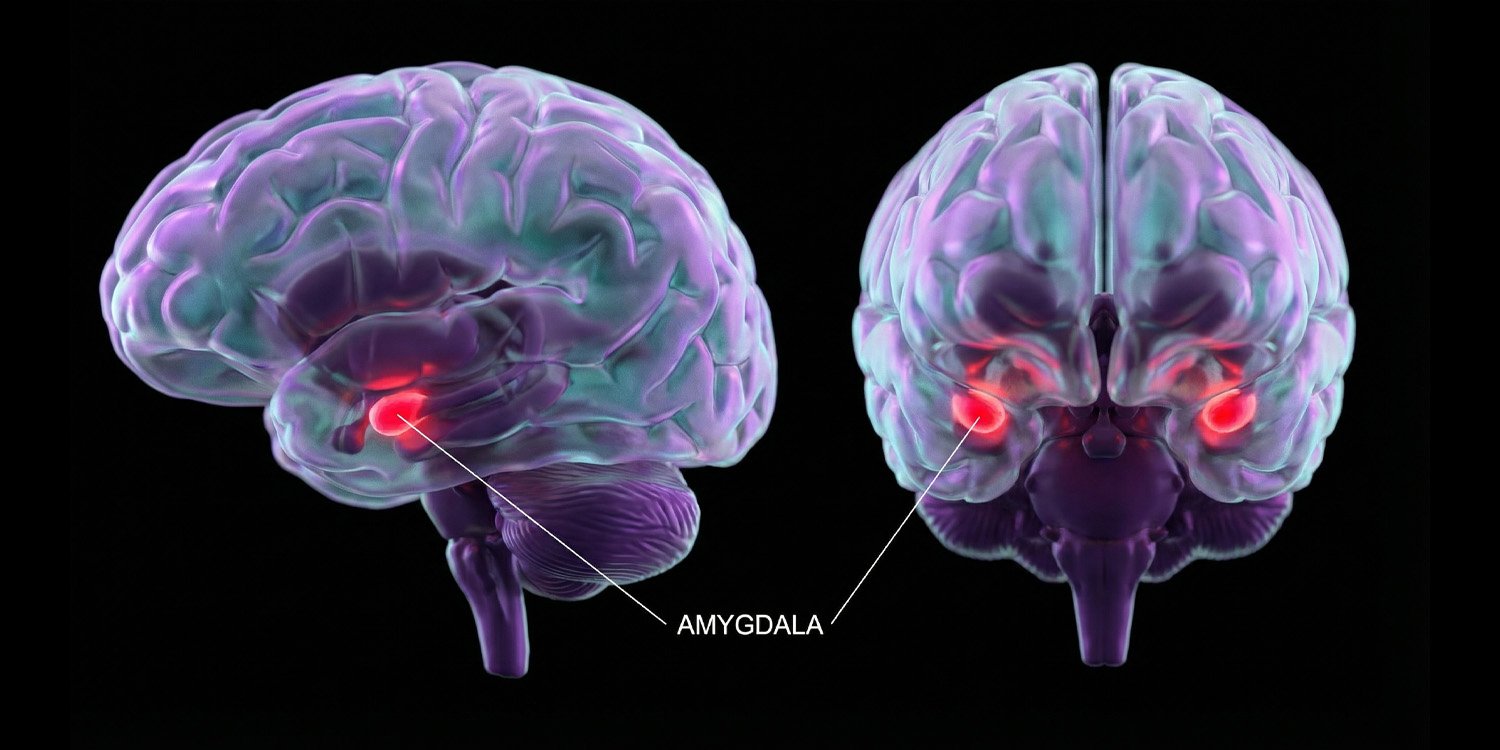
Young people who struggle to manage their smartphone habits have altered brain connectivity patterns related to emotional processing and self-control. A new study maps how these neural differences map to the difficulty of regulating negative emotions. The study was published in the journal BMC Psychology.
Problematic smartphone use refers to technological habits that negatively impact traditional daily life. Although not officially classified as a clinical addiction, this behavior shares similar psychological characteristics with addictive disorders. These include withdrawal symptoms, tolerance build-up, and over-reliance on digital devices to calm bad moods.
The amygdala is an almond-shaped structure deep in the brain that plays a major role in the generation and processing of emotions. In healthy people, the amygdala works in conjunction with other brain networks to recognize threats and regulate emotional responses. Previous neuroimaging studies have shown that people with anxiety, depression, and post-traumatic stress disorder often exhibit abnormal brain activity in this very area.
Yu-Lu Wang, a researcher at Qiqihar Medical University and Zhenjiang Mental Health Center in China, led the study along with several colleagues. The research team wanted to map the precise functional connectivity network originating from the amygdala of problematic smartphone users. They aimed to examine how these local brain network patterns relate to everyday emotional conflicts.
Researchers recruited 72 healthy college students between the ages of 18 and 25. Thirty-seven students were classified as problematic smartphone users based on a standard psychological assessment of addiction to smartphone apps. The remaining 35 students showed no signs of digital dependence and served as a healthy control group.
All participants completed a secondary questionnaire designed to assess their ability to manage negative emotions. This assessment tracks several aspects of emotional conflict, including an inability to control impulses and lack of emotional clarity when upset. Participants then underwent resting-state functional magnetic resonance imaging. This non-invasive scanning technology tracks spontaneous fluctuations in blood oxygen levels throughout the brain while a person is awake and at rest.
By analyzing this resting-state data, researchers can observe which areas of the brain activate in sync. Neuroscientists consider different regions to be functionally connected when they exhibit synchronized blood flow over time. The researchers specifically looked at how the left and right sides of the amygdala communicate with other parts of the brain. To ensure accuracy, the raw scan data was preprocessed to remove motion artifacts and physiological noise.
The scans revealed clear differences in how the amygdala was connected to other regions in the problematic smartphone use group. For the right amygdala, problem users showed stronger functional connections with the right temporal pole. This particular brain region is deeply involved in social cognition and emotional memory processing. The stronger connectivity here may reflect the higher sensitivity these individuals exhibit to social stimuli such as social media notifications.
At the same time, the right amygdala had weaker connections with the right thalamus, left precuneus, and left cerebellum. The precuneus serves as a central node in what neuroscientists call the default mode network. This extensive neural network is highly active when a person is resting, daydreaming, or contemplating their internal states. Researchers note that this node’s weak connectivity may reflect a reduced capacity for self-regulation and self-reflection.
Analysis of the left amygdala also revealed neural differences. Problematic users have been demonstrated to have enhanced functional connections to brain regions involved in cognitive control, attention allocation, and sensory integration. Specifically, the scans showed increased connectivity between the left amygdala and right inferior frontal gyrus, an area deeply involved in response inhibition.
Similar to the right side, the left amygdala also showed weak communication with the cerebellum. Although historically primarily associated with physical coordination, the cerebellum is increasingly recognized for its role in non-motor functions. This includes supporting higher level cognitive operations and deep emotional regulation strategies.
The team then compared these functional brain scan results to participants’ survey scores. They found that decreased communication between the amygdala and cerebellum reliably correlated with greater smartphone dependence. Conversely, increased connectivity between the left amygdala and specific brain regions responsible for attention has been reported to result in greater difficulty in managing emotional responses.
Correlations between the superior parietal lobule and emotion regulation scales were not statistically significant even after controlling for multiple variables, but the broader pattern of connectivity was consistent with the overall study hypothesis. The research team proposes that these altered brain patterns reflect apparent imbalances in the nervous system. The observed neural profile suggests hyperactivation of emotional centers paired with weakening of cognitive control systems.
This internal state of the brain can make it difficult for affected individuals to process negative emotions organically. When people have difficulty mentally processing stress and sadness, they may quickly reach for their smartphones for psychological distraction. Over time, relying on this instant digital relief can strengthen behavioral dependence and trap individuals in unhelpful emotional cycles.
Observational studies have some fundamental limitations. Its cross-sectional design means scientists captured a specific moment in time, limiting their ability to determine true cause-and-effect relationships. It remains objectively unclear whether extreme smartphone use actually changes amygdala connectivity over time. Alternatively, pre-existing structural brain patterns may make some people naturally susceptible to technology overuse.
This finding is also based on a relatively small sample size that focused entirely on individuals in early adulthood. These findings may not fully apply to older adults, as the human brain physically matures by the mid-20s, especially the prefrontal cortex, which controls impulse control. Future longitudinal studies that follow individuals over several years are needed to clarify the developmental timeline of these brain networks.
The study, “The relationship between dysconnectivity of amygdala function and emotion regulation difficulties in problematic smartphone users,” was authored by Yu-Lu Wang, Heng-Yu Bi, Kai-Mo Ding, Jun Zhu, Bei Zhao, Dan-Wei Zhang, Xian-Lu Chang, Guo-Hai Li, Yue Pan, Li Zhu, Qiang Hu, Cheng-Chong Li, and Zi-Liang Wang.
