


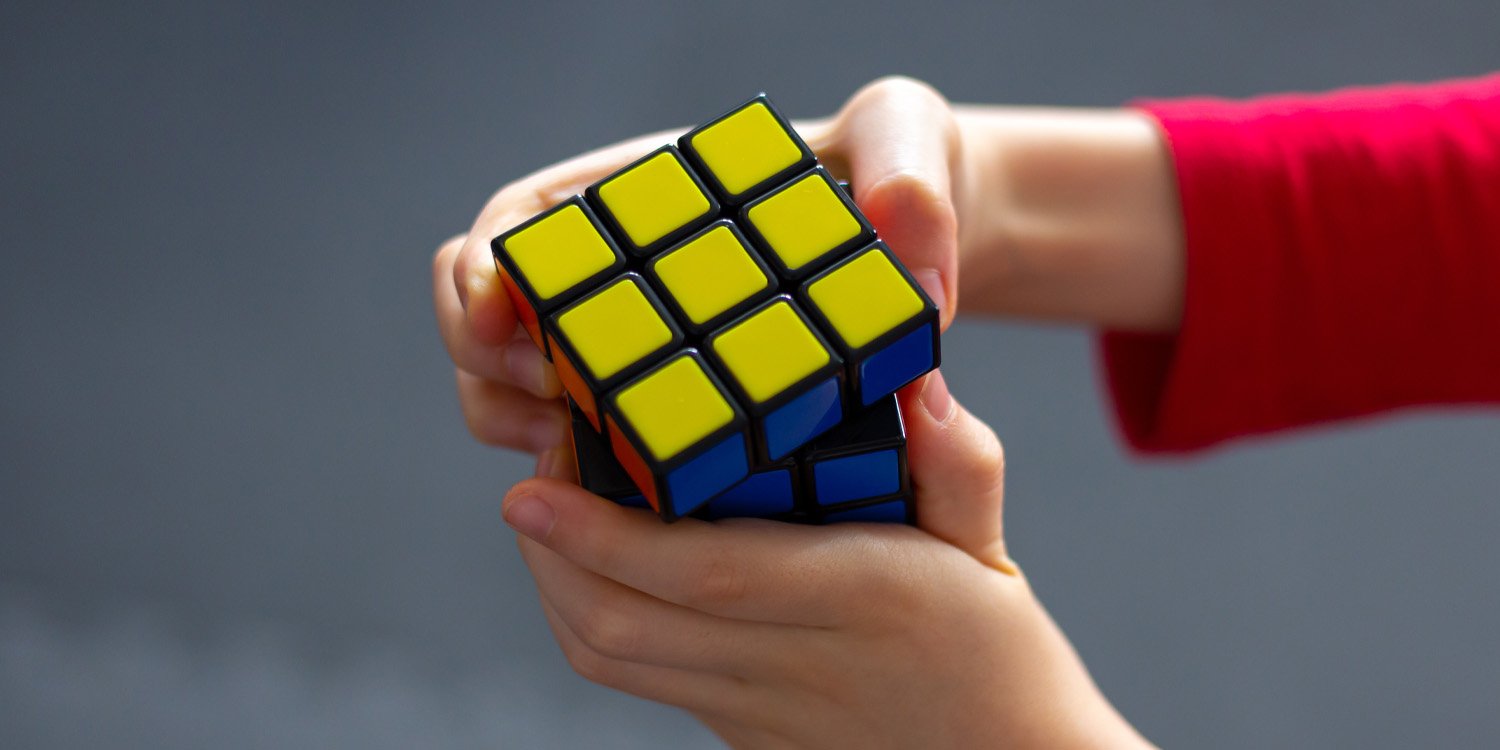
Recent research published in experimental brain research This provides evidence that elite Rubik’s Cube solvers mentally plan their actions using exactly the same brain patterns as they do physically. This study suggests that highly trained professionals solve the entire puzzle in their heads before even touching it. These findings help explain how the human brain adapts to handle complex tasks that require focused thinking and quick physical movements at the same time.
Humans generally have difficulty performing difficult mental arithmetic while performing precise physical movements. For example, people who are texting on their smartphones tend to walk much slower. This is because it is difficult for the brain to use its full capacity for both thinking and acting at the same time.
Solving a Rubik’s Cube is an incredibly difficult task. It requires analyzing color patterns, memorizing those patterns, and predicting what the puzzle will look like in the future. But professional speedcubers can complete this puzzle in seconds.
“We humans can use our brains to perform difficult actions. We can control sophisticated movements and also make complex calculations and associations in our brains,” said study author Anderson Souza Oliveira, associate professor of biomechanics at Aalborg University.
“But when you need to think, and Moving at the same time usually doesn’t do both things very well. You’ve probably seen people texting on their smartphones while walking, but usually if that person is walking slower than normal or close to their normal speed, the speed at which they are texting will slow down. This happens because our brains can’t devote all their power to both moving and thinking at the same time. ”
“Solving a Rubik’s Cube is a very difficult job because you have to analyze the color pattern, memorize that pattern, and predict what that pattern will look like in one or several moves. When a Rubik’s Cube player gets stuck and doesn’t move his pieces, he is seriously thinking about what to do. A Rubik’s Cube player can complete the puzzle in less than a minute, so his brain has to work differently to be able to evaluate.” and Move the pieces simultaneously and very quickly. ”
This extreme speed suggests that the expert’s brain is adapting to evaluating information and physically moving puzzle pieces at the same time. Understanding the brain activity behind this expertise may reveal the broad principles of how humans learn new skills.
To study this process, researchers recruited 13 healthy young male adults with experience in speedcubers. These participants had an average age of 23 years and were able to solve the Rubik’s Cube in an average of 17 seconds.
Scientists placed a special cap with a sensor on the participants’ heads to record their brain waves. This recording technique is called electroencephalography. This allows scientists to measure electrical activity in different areas of the brain as people perform tasks. The device detects different types of brain waves, from slow delta waves to fast beta waves, depending on how the brain works.
The researchers recorded this electrical activity while participants completed four independent computer tasks. They also recorded brain waves while the participants were solving a real Rubik’s cube. Four independent tasks are designed to test the specific mental skills required to solve the puzzle.
The first task tested their planning ability by rearranging the coloring on the screen to match the target image. In the second task, participants had to judge the angle and position of different lines on the screen. This particular assessment measured the ability to visually identify and mentally manipulate objects.
The third task was a memory matching game that tested spatial working memory. Participants had to flip hidden tiles on the screen to find matching color patterns. The fourth task required participants to perform a specific series of repetitive movements on a physical Rubik’s cube for 60 seconds to measure their fine motor skills.
After completing the individual tasks, participants completed the main event. They were given 15 seconds to look at the scrambled Rubik’s cube and formulate a strategy. Immediately after this planning stage, they physically solved the puzzle as quickly as possible.
Examining the data, the scientists found that brain regions that control memory, action planning, spatial manipulation, and fine motor skills are highly synchronized. Brain waves from these different areas worked together seamlessly to facilitate rapid decision-making. Electrical activity across all frequency bands was very similar during both the 15-s planning and physical execution phases.
“Solving a Rubik’s Cube requires a high degree of involvement of brain regions that control memory, action planning, visual-spatial manipulation of objects, and fine motor skills,” Oliveira told Cypost. “Our study showed that waves from brain regions that control such abilities become more synchronized, facilitating decision-making processes.”
“The main surprise was that when the players memorized the cube in their heads or physically solved the puzzle, their brain regions worked very similarly. These players are so adapted to solving cubes that they don’t seem to need a ‘physical’ cube anymore. They can solve it in their heads, and they just repeat the movement of the physical object.”
The researchers also found a specific link between isolated cognitive tasks and real-world puzzle solving. For example, slow delta brain waves in the back of the brain were strongly correlated with the physical execution of puzzles. This region of the back is known as the occipital lobe and primarily deals with visual processing. This connection highlights the critical need for visual and physical integration during tasks.
Similarly, performance on the line angle task was correlated with slower EEG waves in both the anterior and posterior regions of the brain. This association indicates a strong dependence on visual and spatial abilities.
Performance on the ring classification planning task was correlated with delta and theta brain waves in the temporal lobe on the side of the brain. This particular link shows that general planning ability is deeply involved when understanding the Rubik’s Cube. The scientists noted that the planning stage of a puzzle is strongly linked to an individual’s fine motor skill proficiency.
Although this study clearly investigated expert perceptions, there are several points to keep in mind. This study included only experienced speed cubers. Without a control group of novices, researchers cannot say for sure which specific brain adaptations occur only after someone reaches a professional level. The study also had a small sample size, with only 13 participants, all of whom were young men.
“An important limitation of this study is that it did not measure performance and brain activity in people who regularly practiced the Rubik’s Cube,” Oliveira said. “Comparing civilians and athletes may reveal which brain areas are better adapted to solving cubes once they reach the professional level.”
Looking ahead, scientists are highlighting the importance of studying how the brain changes over time as people learn to solve these puzzles. Tracking how beginners become experts may provide better insight into how the brain acquires complex visual and physical skills.
“Our study opens an important venue for investigating how the brain adapts to complex cognitive-motor tasks,” Oliveira said. “In the long term, our study will help define relevant cognitive tasks to improve cognitive performance in children with underdeveloped brains and neurological disorders. This is of great importance, as poor cognitive performance directly affects future prospects for learning, social interaction and professional development.”
The study, “Cortical Activity of Elite Rubik’s Cube Athletes During Cube Solving,” was authored by Ali Asghar Zarei, Casper Ravn Frederiksen, Mathias Bundgaard Jensen, and Anderson Souza Oliveira.
