

Close Menu

    Subscribe to Updates

    Get the latest creative news from FooBar about art, design and business.

    What's Hot

    The Pain Points Holding Back Digital Health Adoption

    November 24, 2026

    The Core Challenges in 2026 Population Health Trends Facing Decision-Makers

    November 23, 2026

    Addressing Gaps in Current Dietary Guidelines for Metabolic Health

    November 22, 2026
    Facebook X (Twitter) Instagram
    Facebook X (Twitter) Instagram
    Health Magazine
    • Home
    • Environmental Health
    • Health Technology
    • Medical Research
    • Mental Health
    • Nutrition Science
    • Pharma
    • Public Health
    • Discover
      • Daily Health Tips
      • Financial Health & Stability
      • Holistic Health & Wellness
      • Mental Health
      • Nutrition & Dietary Trends
      • Professional & Personal Growth
    • Our Mission
    Health Magazine
    Home » News » Closing your eyes to hear better may be a big mistake.
    Nutrition Science

    Closing your eyes to hear better may be a big mistake.

    healthadminBy healthadminMarch 20, 2026No Comments3 Mins Read
    Closing your eyes to hear better may be a big mistake.
    Share
    Facebook Twitter Reddit Telegram Pinterest Email


    Many people instinctively close their eyes when trying to concentrate on a faint sound. A common belief is that removing visual distractions allows the brain to focus more fully on hearing, increasing sensitivity. However, this approach does not always work, especially in environments full of background noise.

    Research published in serviceAIP Publishing, on behalf of the Acoustical Society of America, set out to test whether truly closing your eyes in noise improves your hearing. Researchers from Shanghai Jiao Tong University investigated how visual input affects sound detection ability.

    Experimental experiment on hearing in noise

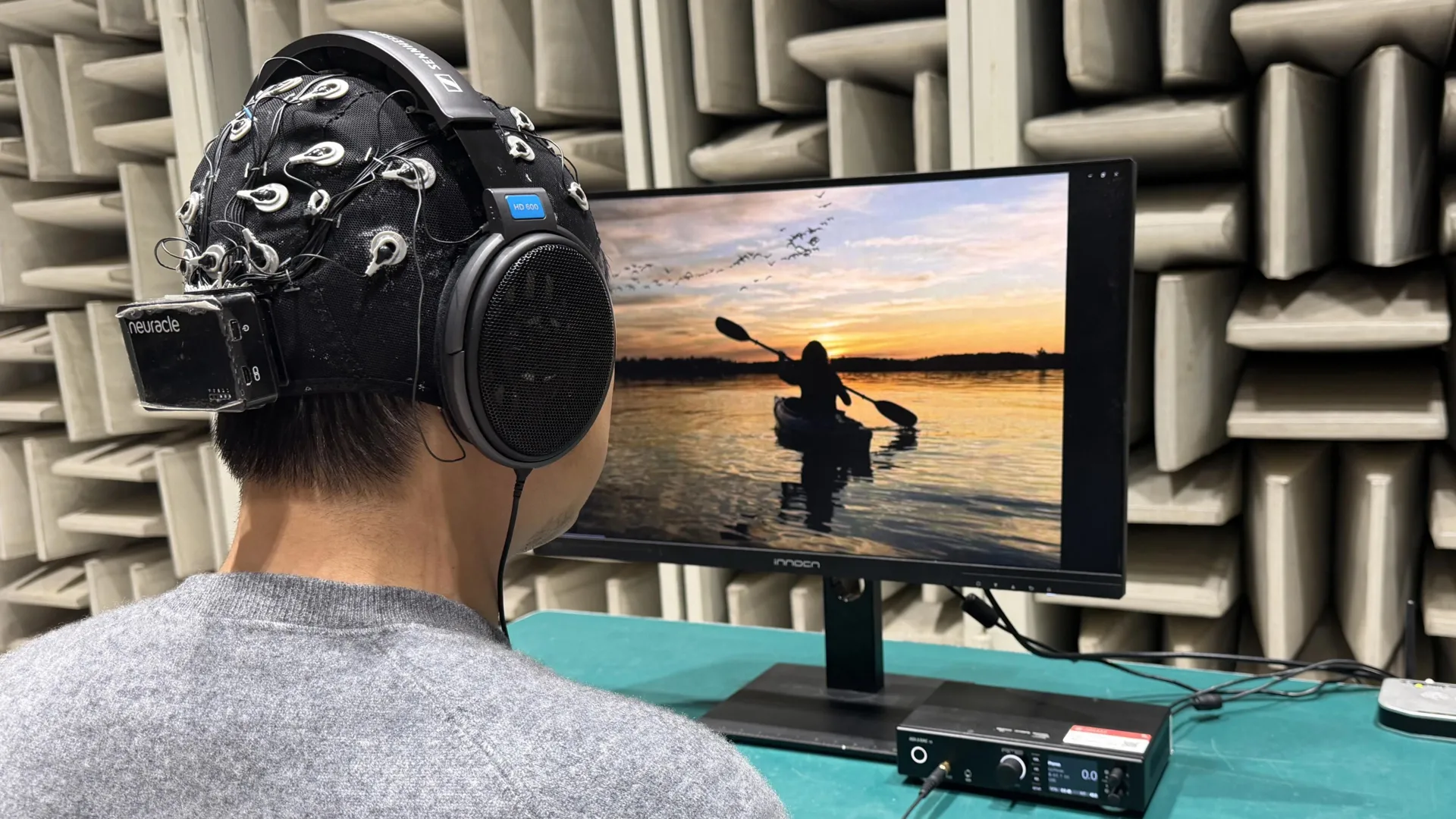
    Study participants listened to a variety of sounds through headphones, with ambient noise playing at the same time. Their job was to adjust the volume until each note was barely audible above the noise.

    The experiment included several visual conditions. First, participants completed the task with their eyes closed. They then repeated this with their eyes open while looking at a blank screen, then a still image associated with the sound, and finally a video that matched what they were hearing.

    Closed eyes vs. visual cues

    The results contradicted widely held assumptions. “Contrary to popular belief, we found that closing your eyes actually impairs your ability to detect these sounds,” said author Yu Huang. “On the other hand, viewing dynamic images in response to sound significantly improves hearing sensitivity.”

    While closing the eyes was less helpful and made it harder to hear faint sounds in a noisy environment, adequate visual input provided clear benefits.

    Brain activity and overfiltering

    To understand why this happens, researchers used electroencephalography (EEG) to track brain activity during the test. They found that when you close your eyes, your brain enters a state known as a neurocritical state, increasing the intensity of its filtering of incoming information.

    This enhanced filtering does more than just reduce background noise. You can also suppress the desired sound that participants are trying to hear.

    “In noisy soundscapes, the brain has to actively separate the signal from the background,” Huang says. “We found that in this situation, the internal focus promoted by eye closure actually works negatively, leading to excessive filtering, while visual engagement helps anchor the auditory system to the outside world.”

    When it works even if you close your eyes

    The researchers noted that this effect was specific to noisy environments. In quiet situations, closing your eyes may improve your ability to detect subtle sounds.

    However, daily life often includes loud background noise, so keeping your eyes open may be a more effective strategy in many situations.

    Future research on vision and hearing

    The research team plans to continue studying how vision and hearing interact. One important question is whether the benefit comes from just visual input or from seeing what matches the sound.

    “Specifically, we want to test mismatched combinations. For example, what happens if you hear a drum but see a bird?” Huang said. “Does improved vision result from simply opening the eyes and processing more visual information, or does the brain require a perfect match between visual and auditory information? Understanding this distinction helps distinguish between the general effects of attention and the specific benefits of multisensory integration.”


    Source link

    Visited 26 times, 1 visit(s) today
    Share. Facebook Twitter Pinterest LinkedIn Telegram Reddit Email
    Previous ArticleNew study finds link between receptivity to ‘corporate bullshit’ and poor leadership skills
    Next Article The first U.S. coal-fired power plant in a decade is on shaky ground.
    healthadmin

    Related Posts

    Addressing Gaps in Current Dietary Guidelines for Metabolic Health

    November 22, 2026

    Overcoming Confusion in 2025-2030 Dietary Guidelines for Metabolic Health

    November 20, 2026

    Navigating Inconsistencies in the 2025–2030 Dietary Guidelines for Americans

    November 17, 2026

    Overcoming Gaps in 2025-2030 Dietary Guidelines for Metabolic Syndrome Prevention

    November 10, 2026

    Navigating Divergences in 2025–2030 Dietary Guidelines vs AHA Statements for CVD Prevention

    October 27, 2026

    Navigating the 2025-2030 DGA: Evidence-Based Updates for Cardiometabolic Health

    October 17, 2026
    Add A Comment

    Comments are closed.

    Categories

    • Daily Health Tips
    • Discover
    • Environmental Health
    • Exercise & Fitness
    • Featured
    • Featured Videos
    • Financial Health & Stability
    • Fitness
    • Fitness Updates
    • Health
    • Health Technology
    • Healthy Aging
    • Healthy Living
    • Holistic Healing
    • Holistic Health & Wellness
    • Medical Research
    • Medical Research & Insights
    • Mental Health
    • Mental Wellness
    • Natural Remedies
    • New Workouts
    • Nutrition
    • Nutrition & Dietary Trends
    • Nutrition & Superfoods
    • Nutrition Science
    • Pharma
    • Preventive Healthcare
    • Professional & Personal Growth
    • Public Health
    • Public Health & Awareness
    • Selected
    • Sleep & Recovery
    • Top Programs
    • Weight Management
    • Workouts
    Popular Posts
    • 1773313737_bacteria_-_Sebastian_Kaulitzki_46826fb7971649bfaca04a9b4cef3309-620x480.jpgHow Sino Biological ProPure™ redefines ultra-low… March 12, 2026
    • pexels-david-bartus-442116The food industry needs to act now to cut greenhouse… January 2, 2022
    • 1773729862_TagImage-3347-458389964760995353448-620x480.jpgDespite safety concerns, parents underestimate the… March 17, 2026
    • 1774403998_image_28620e4b6b0047f7ab9154b41d739db1-620x480.jpgGait pattern helps distinguish between Lewy body… March 24, 2026
    • 1773209206_futuristic_techno_design_on_background_of_supercomputer_data_center_-_Image_-_Timofeev_Vladimir_M1_4.jpegMulti-agent AI systems outperform single models… March 11, 2026
    • Leukemia-620x480.jpgBiomimetic platform powers CAR T therapy for… March 9, 2026

    Demo
    Stay In Touch
    • Facebook
    • Twitter
    • Pinterest
    • Instagram
    • YouTube
    • Vimeo
    Don't Miss

    The Pain Points Holding Back Digital Health Adoption

    By healthadminNovember 24, 2026

    Explore how AI in telemedicine 2026, wearable tech, and AI diagnostics are overcoming data fragmentation, regulatory hurdles, and interoperability gaps in digital health.

    The Core Challenges in 2026 Population Health Trends Facing Decision-Makers

    November 23, 2026

    Addressing Gaps in Current Dietary Guidelines for Metabolic Health

    November 22, 2026

    Navigating 2026 Pharma Pain Points: Rising Costs and Regulatory Hurdles

    November 21, 2026

    Subscribe to Updates

    Get the latest creative news from SmartMag about art & design.

    HealthxMagazine
    HealthxMagazine

    At HealthX Magazine, we are dedicated to empowering entrepreneurs, doctors, chiropractors, healthcare professionals, personal trainers, executives, thought leaders, and anyone striving for optimal health.

    Our Picks

    Navigating 2026 Pharma Pain Points: Rising Costs and Regulatory Hurdles

    November 21, 2026

    Overcoming Confusion in 2025-2030 Dietary Guidelines for Metabolic Health

    November 20, 2026

    Overcoming Barriers in Traditional Clinical Research: Breakthroughs for 2026

    November 19, 2026
    New Comments
      Facebook X (Twitter) Instagram Pinterest
      • Home
      • Privacy Policy
      • Our Mission
      © 2026 ThemeSphere. Designed by ThemeSphere.

      Type above and press Enter to search. Press Esc to cancel.