


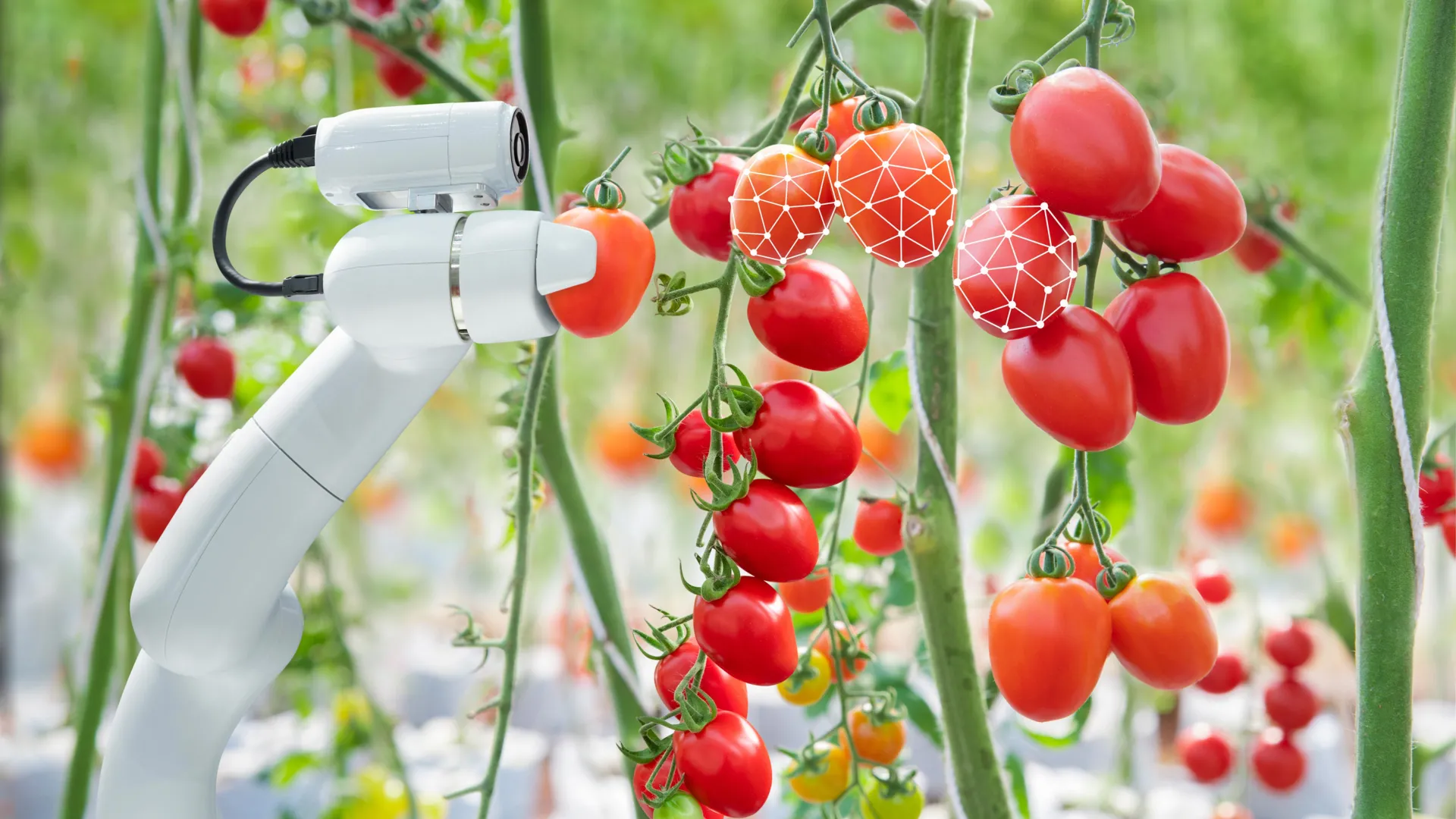
Agricultural labor shortages have led to increased automation in agriculture, especially when it comes to harvesting. But not all crops are easy for machines to handle. For example, tomatoes grow in clusters, so the robot must carefully select ripe fruit and leave unripe fruit alone. This requires precise control and smart decision making.
To address this challenge, Associate Professor Takuya Fujinaga of the Osaka Metropolitan University Graduate School of Engineering developed a system that trains a robot to evaluate the ease of harvesting each tomato before harvesting it.
His approach combines image recognition and statistical analysis to determine the best angle to pick each fruit. The robot analyzes visual details such as the tomato itself, the stem, and whether it’s hidden in leaves or other parts of the plant. These inputs guide the robot to choose the most effective way to approach and harvest the fruit.
From detection to “ease of harvest” decisions
This method departs from traditional systems that focus solely on fruit detection and identification. Instead, Fujinaga introduced what he calls the “ease of harvest estimation.” “This goes beyond just asking, ‘Can a robot harvest tomatoes?’ Asking, ‘How likely is it that the selection will be successful?’ is more meaningful for real-world agriculture,” he explained.
In testing, the system achieved an 81% success rate, exceeding expectations. About a quarter of the successful harvests were from tomatoes that were side-harvested after an initial front-facing attempt failed. This shows that the robot can adjust its approach even if the first attempt is not successful.
The study highlights that many variables influence robotic harvesting, including how tomatoes are clustered, stem shape and position, surrounding foliage, and visual obstructions. “Through this research, we established ‘ease of harvesting’ as an index that can be quantitatively evaluated, and we are one step closer to realizing agricultural robots that can make informed decisions and act intelligently,” said Fujinaga.
The future of human-robot collaboration in agriculture
Looking to the future, Fujinaga envisions a robot that can independently determine when crops are ready to be harvested. “This is expected to usher in a new form of agriculture where robots and humans work together,” he explained. “The robot automatically picks the easy-to-pick tomatoes, while humans handle the more difficult fruits.”
The survey results are smart farming technology.
