


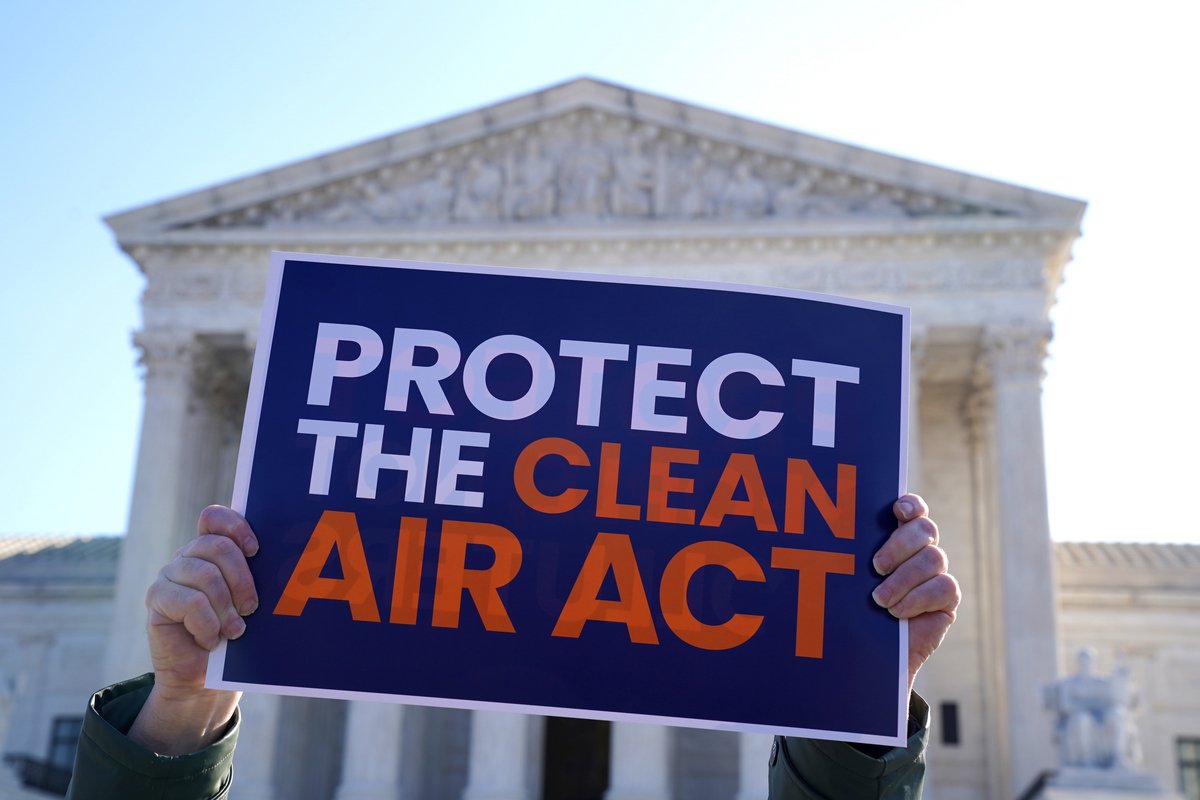
Three presidents have used the Clean Air Act to curb global warming pollution. If President Donald Trump has his way, they will be the last.
But the 1963 Act has always been incomplete and an insufficient tool to address climate change. Just ask the lawyer behind the landmark 2007 Supreme Court case that made the EPA’s regulation of greenhouse gases legal.
“No one thought the Clean Air Act would be the best template for dealing with climate change,” said Richard Lazarus, a professor at Harvard Law School and author of “The Rule of Five,” a book about the Massachusetts v. EPA case. “Obviously there was a mandate, but the hope was that it would help encourage the enactment of new laws.”
Instead, Trump dismantled U.S. climate change policy. Last month, the EPA withdrew its so-called endangered finding that climate pollution harms public health and welfare. This certification is a prerequisite for pollutant regulation under the Clean Air Act. If repeal survives legal challenges, the federal government would lose a major tool to limit climate pollution.
That’s a big change. For the past 19 years, EPA has used the Clean Air Act to curb emissions from three broad sectors: motor vehicles, power plants, and oil and gas.
The track record with these rules is mixed.
Supporters credit the Obama administration’s tailpipe regulations with helping to establish electric vehicles and reduce emissions in the United States. However, attempts to limit climate pollution from power plants have failed, and three power sector regulations have been repealed by subsequent administrations, courts, or both. And while some Biden administration-era oil and gas methane curbs remain in effect, state plans to limit methane from existing fossil fuel infrastructure have been put on hold until 2027 to give the Environmental Protection Agency (EPA) time to ease them.
Some veteran observers say that for sectors other than autos, the Clean Air Act cannot deliver the deep cuts climate science demands. Some blame presidential political whiplash for weakening climate policy. One of the architects of Massachusetts v. EPA also criticized the Obama-Biden EPA for being too slow to use the authority the Supreme Court gave it to regulate a range of highly polluting industries.
“It’s very disappointing,” said David Bookbinder, the Sierra Club’s chief climate adviser and one of the few attorneys to represent the state and environmental petitioners in Massachusetts.
“There are so many parts of the economy that can be regulated,” he said. “Some of the biggest source categories like cement, steel, refineries. Huge source categories that neither Obama nor Biden wanted to touch, probably for fear of political repercussions.”
always plan B
The Clean Air Act became the primary instrument of federal climate policy by default, not by design.
When the Supreme Court ruled on April 2, 2007, that greenhouse gases qualify as pollutants, many of the lawyers who delivered the victory did not believe that was the end goal.
“While we believed the Clean Air Act could address this problem, we agreed there had to be a better way to regulate greenhouse gases,” said James Milkie, head of the Massachusetts Attorney General’s Office’s Environmental Protection Division and who argued oral arguments for the appellants before the Supreme Court.
The law was first enacted in 1963 and underwent major amendments in the 1970s and 1990. The climate pollutants passed the tests that Congress set for the EPA to identify additional pollutants that pose a risk.
But while the law allows the government to regulate pollutants not listed in the statute, it “does not directly establish a regulatory program with those types of pollutants in mind,” Lazarus said.
Immediately after the court’s decision, the arc of history appeared to be bending toward climate change legislation. A longtime opponent showed a new attitude. The court’s decision required the EPA to consider whether emissions from new cars endangered the public, but automakers did not want to be the only sector targeted by the EPA.
“When the court ruled in our favor, all of us on all sides of this case assumed it would lead to Congressional action in the form of some kind of cap-and-trade legislation or similar measures,” Milkey said.
Immediately after the ruling, the Automobile Manufacturers Alliance released a statement calling for “a national, federal, economy-wide approach to addressing greenhouse gases.” John Dingell (D-Mich.), then-chairman of the House Energy and Commerce Committee, called for something similar after years of shielding the auto sector from stricter fuel economy standards and objecting to the Clean Air Act’s targeting of climate pollution.
The Bush administration never released findings on the greenhouse gas crisis. But two years into that reign, President Barack Obama entered the White House, Dingell was replaced by the more progressive Rep. Henry Waxman (D-Calif.) as chairman of the Energy and Commerce Committee, and Senate Democrats increased their majority to 60.
Under the Obama administration, the 2009 endangerment findings prepared Congress for action. Lazarus said that by offering the Obama administration a “Plan B” for regulating climate pollution, the Supreme Court also created an incentive for industry and reluctant lawmakers to negotiate legislation.
“Grand Bargain”
The same qualities that made the Clean Air Act a less-than-ideal climate regulation tool, at least for sectors like electricity, also made it inflexible for industry.
“It just doesn’t add up,” Lazarus says.
The decades-old law was designed with local and regional pollution in mind. Most of its programs were aimed at controlling contamination on-site at individual facilities. However, greenhouse gases have the same impact on the atmosphere no matter where in the world they are emitted, making them ideal candidates for more flexible emissions-limiting policies and taxes on emissions.
So when EPA proposed its endangerment findings in April 2009, it was hoped that it would serve as a cudgel to bring reluctant lawmakers and stakeholders to the table to pass cap-and-trade legislation. Waxman and then-Rep. Ed Markey (D-Mass.) introduced a bill the following month that would cap emissions. Senate Environment and Public Works Committee Chairwoman Barbara Boxer (D-Calif.) and Sen. John Kerry (Massachusetts) introduced similar drafts.
Joe Goffman, who would go on to shape climate change policy at the EPA under former Presidents Barack Obama and Joe Biden, had finished his stint on Capitol Hill in early 2009 as Mr. Boxer’s senior adviser on the committee. He said the message from the Obama administration at the time was that dedicated climate change legislation was preferable to Clean Air Act regulations.
“The idea was that Congress had more freedom than the EPA to formulate decarbonization policies,” he said, noting that the bill could also target post-Great Recession economic stimulus.
The House bill passed the chamber in June 2009, but the Senate bill was never voted on the floor. Congressional leaders chose instead to prioritize President Obama’s signature health care bill, but lost their 60-vote majority in January 2010.
Mr. Goffman became EPA’s senior attorney specializing in climate change in the fall of 2009. The following year, the EPA and Department of Transportation finalized the first tailpipe emissions regulations for greenhouse gases in a “big deal” with the state of California, industry, and labor unions. Experts say the situation is helped by the fact that the federal government just loaned about $80 billion to U.S. automakers to help them weather the economic downturn and rebuild their operations.
David Doniger, a senior attorney at the Natural Resources Defense Council and one of the attorneys who contributed to the Massachusetts v. EPA brief, said President Obama’s vehicle standards would cut the sector’s greenhouse gas emissions in half between 2012 and 2025.
“That in itself, whatever it is, is a huge accomplishment,” Doniger said.
“Shortcut does not exist”
Despite more than a decade of efforts, EPA has been unable to replicate that success at power plants. Doniger said both statutes and policies regarding power plant regulation make consensus difficult.
He said the sector is heterogeneous.
“Investor-owned (utilities) and co-ops don’t see eye to eye,” Doniger said. “Coal mining is trying to protect itself.”
Regulations for coal-fired and gas-fired power generation are also written based on provisions of the Clean Air Act, which depend on state implementation, giving red states more opportunities than the Clean Car Rule.
Both the Obama and Biden administrations were slow to enact power plant rules, ending their administrations long before judicial review of the rules was complete.
The Obama Environmental Protection Agency entered into a settlement agreement with environmental petitioners in 2010 that requires it to finalize climate standards for power plants by May 2012. However, the agency proposed the Clean Power Plan in 2014 and finalized it the following year.
The 2015 rule took a “whole-system” approach to reducing emissions and aimed to shift the broader U.S. electricity mix from coal to gas and renewable energy. The Supreme Court put the rule on hold, ultimately ruling in West Virginia v. EPA in 2022 that the gridwide approach was illegal.
“The Supreme Court’s West Virginia opinion did significant damage to the Clean Air Act’s usefulness as a tool for combating climate change in the power sector,” Goffman said.
Goffman said limiting the EPA to what individual coal-fired and gas-fired power plants can accomplish “seriously distorts the reality of how the power sector works.”
In 2024, when Goffman was EPA Air Force administrator, the agency finalized a rule that would require existing coal-fired power plants and some new gas plants to capture most of their greenhouse gas emissions. EPA is currently in the process of rescinding these standards.
Goffman said these types of technology-based rules are “not without value,” but they don’t leverage “a real existing menu of strategies for decarbonizing the power sector.”
He said anything closer to the Clean Power Plan, which achieves reductions through generational change and demand reduction, would be more efficient and effective.
Goffman said the Clean Air Act has always been most effective in “dialogue” with the law. The agency blocked the Obama administration’s cap-and-trade push and then delivered further cuts at a lower cost in tandem with the 2022 Climate Spending Act, he said.
For example, an EPA analysis of power plant rules during the Biden administration showed that tax incentives and other programs in the Inflation Control Act were more effective at restructuring the power grid than rules alone.
Lazarus said he praised the Clean Power Plan’s policy design but always questioned whether it was sufficiently based on the language of Section 111(d) of the Clean Air Act, which is little used.
“Just because something is a good approach doesn’t necessarily mean it’s legal,” he says.
The next chapter in U.S. climate policy may depend more on voters than on the Supreme Court or the willingness of individual administrations to address greenhouse gases under existing law, Lazarus said.
“There are no shortcuts,” he said. “We have to elect people who are willing to vote for innovative legislation. That’s the only way. And it won’t be easy, but it’s ultimately compelling given the threats we face.”
