


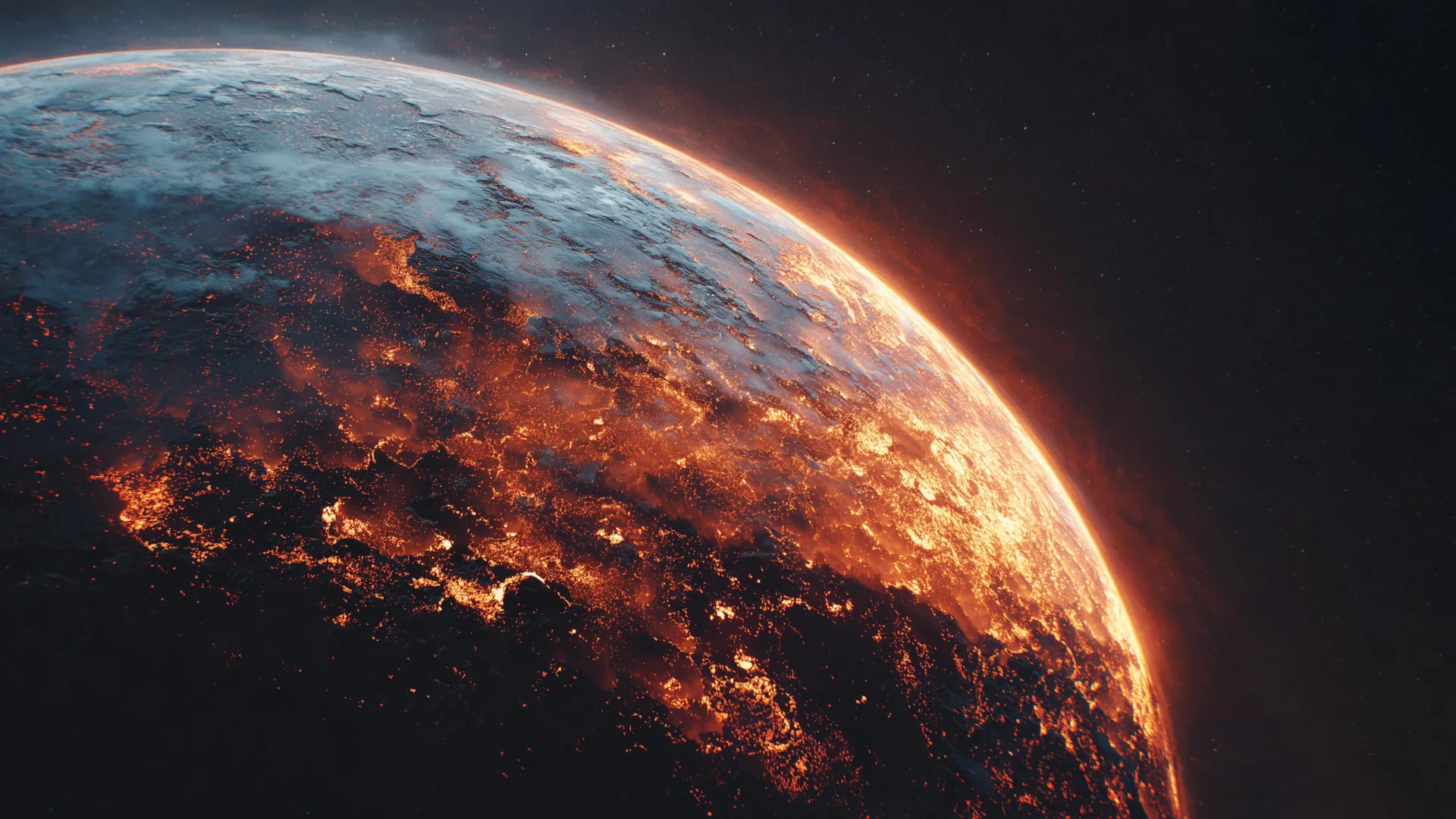
A team of astronomers led by Carnegie has discovered the clearest evidence yet for the presence of atmospheres on rocky planets outside our solar system. Using NASA’s James Webb Space Telescope (JWST), researchers have identified signs of gas around an unusual target: an ancient, extremely hot super-Earth whose surface is likely covered in lava. The survey results are Astrophysics Journal Letter.
The planet, known as TOI-561 b, has about twice the mass of Earth, but is dramatically different in almost every other way. It is extremely close to its star, orbiting at only 1/40th the distance from the Sun to Mercury. Even though the star is slightly smaller and cooler than the Sun, the planet’s narrow orbit allows it to complete a year in just 10.56 hours. One side always faces the star and remains trapped in permanent sunlight.
“Based on what we know about other star systems, astronomers would have predicted that such planets would be too small and too hot to retain their atmospheres long after formation,” explained Carnegie Science Postdoctoral Fellow Nicole Wallach, second author of the paper. “However, our observations suggest that the planet is surrounded by a relatively thick blanket of gas, overturning conventional wisdom about ultrashort-period planets.”
In our solar system, small, intensely heated planets tend to lose their original gas envelopes early in their history. However, TOI-561 b orbits a star that is much older than our Sun and appears to have retained an atmosphere despite its harsh conditions.
Low-density cues indicate unusual composition
The possible existence of an atmosphere may help explain another mystery: the planet’s lower-than-expected density.
“This planet is not what we would call a superpuff planet, or a ‘cotton candy’ planet, but it is less dense than one would expect given its Earth-like composition,” said Carnegie Scientist astronomer Johanna Teske, lead author of the study.
Before analyzing the new data, the team considered whether the planet’s structure alone could explain this. One idea was that TOI-561 b might have a smaller iron core than Earth’s, and a mantle made of lighter rock.
Teske added that this idea is consistent with the origin of the planet. “TOI-561 b is unique among ultrashort-period planets in that it orbits a very old, iron-poor star, twice as old as the Sun, in a region of the Milky Way known as the thick disk. It must have formed in a very different chemical environment than the planets in our solar system.”
This suggests that the planet may resemble worlds that formed when the universe was much younger. Still, configuration alone cannot fully explain the observations.
JWST temperature data reveals hidden atmosphere
The researchers also proposed that the presence of a thick atmosphere could make the planet appear larger and therefore less dense. To investigate this, they used JWST’s near-infrared spectrometer (NIRSpec) to measure the temperature of the planet’s dayside by observing its brightness in near-infrared light. This method tracks how the system’s light changes as the planet moves behind the star. This is the technique also used to study planets with the TRAPPIST-1 system.
If TOI-561 b had no atmosphere, daytime temperatures would reach nearly 4,900 degrees Fahrenheit (2,700 degrees Celsius). Instead, the measurements showed temperatures as low as about 3,200 degrees Fahrenheit (1,800 degrees Celsius). Although it is still very hot, this difference strongly suggests that heat is being redistributed across the planet.
Wind, clouds, and an unstable, rich atmosphere
To explain the cold temperatures, scientists considered several possibilities. The melting ocean surface could transfer some heat, but without an atmosphere the night side would remain solid, potentially limiting heat transfer. A thin layer of evaporated rock may also be present, but by itself cannot provide sufficient cooling.
“We really need a dense atmosphere rich in volatiles to explain all the observations,” said co-author Anjali Piett, a former Carnegie science postdoctoral fellow at the University of Birmingham in the UK. “Strong winds would cool the dayside by transporting heat to the nightside. Gases like water vapor would absorb some wavelengths of near-infrared light emitted from the surface before rising through the atmosphere. (The planet would appear cooler because telescopes would detect less light.) There could also be bright silicate clouds that reflect starlight and cool the atmosphere.”
The evidence points strongly to the atmosphere, but it raises big questions. How can a planet exposed to such intense radiation retain gas? Some material may be escaping into space, but perhaps not as quickly as expected.
“Wet lava ball” with a recycling atmosphere
One explanation is the balance between the planet’s molten interior and atmosphere.
“We think there is an equilibrium between the magma ocean and the atmosphere. At the same time that gas is leaving the Earth and being fed into the atmosphere, the magma ocean is sucking gas back into itself,” says co-author Tim Lichtenberg of the University of Groningen in the Netherlands, and part of the Carnegie-led Atmospheric Empirical Experimental Research (AEThER) project team. “To explain the observations, this planet must be much richer in volatile materials than Earth. It’s just like a wet lava ball.”
Teske emphasized that the discovery raises as many questions as it answers: “What’s really interesting is that this new dataset reveals even more questions than answers.”
JWST observations raise new questions about exoplanets
These results come from JWST’s General Observer Program 3860, which monitored the system for more than 37 hours until the planet completed almost four orbits. Researchers are currently analyzing the complete dataset to map global temperature patterns and better understand atmospheric composition.
This research continues a long legacy of Carnegie science involvement with JWST, stretching back to the early development of the telescope and spanning multiple observing cycles. Since JWST began its scientific operations, Carnegie researchers have led numerous teams studying exoplanets, galaxies, and other cosmic phenomena.
“These JWST breakthroughs directly leverage our long-standing strengths in understanding how exoplanet features are shaped by planetary evolution and dynamics,” said Michael Walter, director of the Earth and Planetary Institute. “More exciting results are on the horizon, and we are ready for a new wave of Carnegie-led JWST science next year.”
