


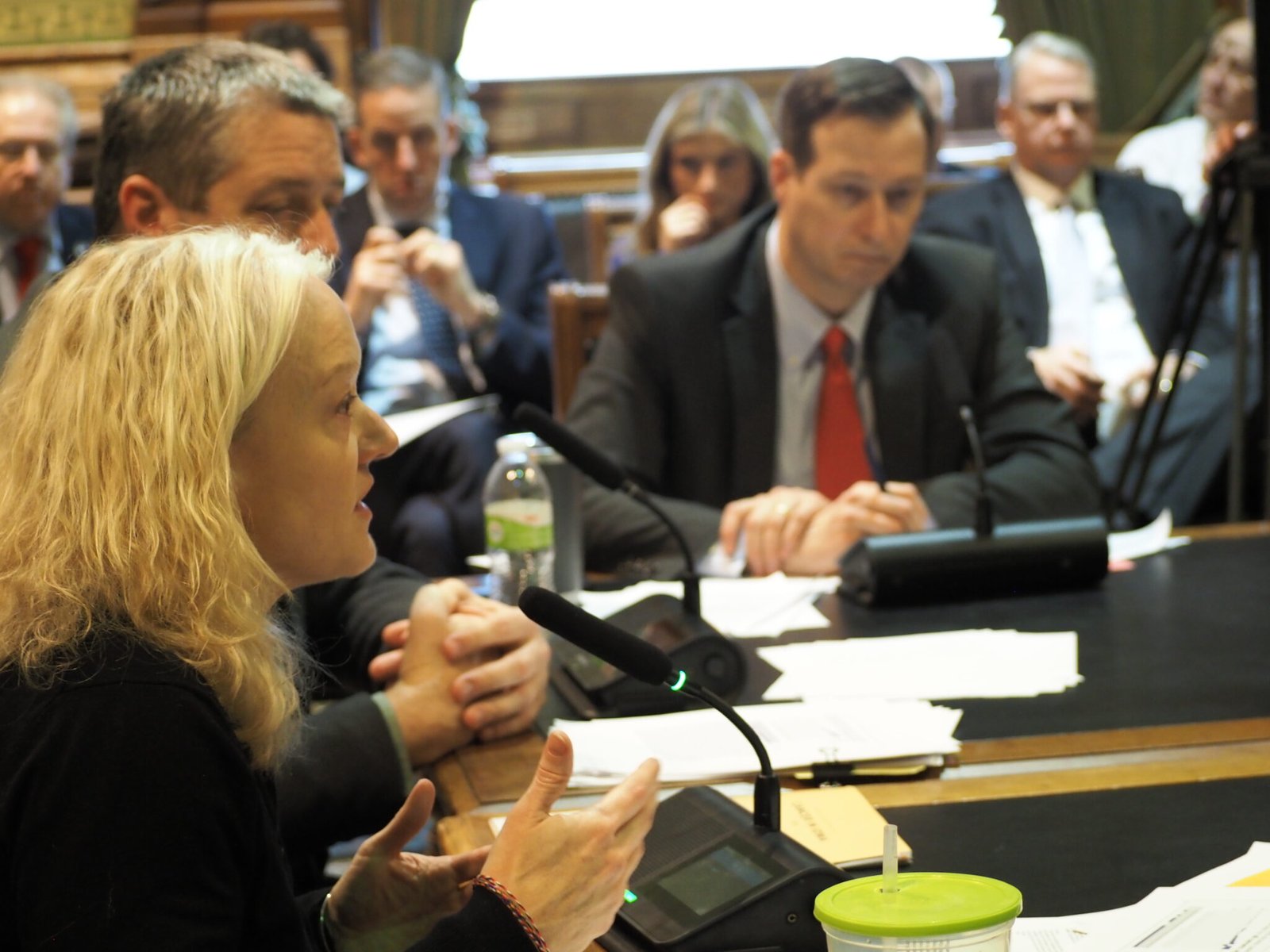
Researchers told Iowa House lawmakers Wednesday that a bill that would raise tobacco taxes and strengthen pesticide monitoring requirements could help lower the state’s high cancer rates and provide more information about its causes.
The House Health and Human Services Committee and the Environmental Protection Committee held a joint meeting Wednesday to hear from speakers from the University of Iowa School of Public Health about the key factors driving up Iowa’s cancer rates.
These UI researchers and staff presented preliminary information collected during a year-long research project conducted through a UI partnership with the Iowa Department of Health and Human Services. Lawmakers last year approved $1 million in funding for the project, which seeks to determine the factors that rank Iowa with the second-highest new cancer rate in the country and one of only two states with rising new cancer rates in 2025.
Preliminary data, first presented at a news conference with Gov. Kim Reynolds in February, reveals that Iowa has higher rates of prostate, breast, lung and melanoma compared to national trends. The first published studies did not examine environmental or genetic factors, but looked at demographic and behavioral factors associated with cancer incidence.
Compared to other states in the Midwest with similar rates of certain risk factors, such as binge eating and drinking, obesity, insurance premiums, and factors such as income and college education, Iowa had similar cancer trends for many cancers, but compared to both national rates and other Midwest states, lung cancer incidence and death rates were significantly higher.
UI staff reiterated to lawmakers many of the points made in the initial data presentation. There appears to be no single factor behind Iowa’s increased cancer rates. Researchers also said that a factor in Iowa’s cancer rates starting to become statistically significantly higher than the national average in 2013 and 2014 may be due to problems in Iowa more than a decade ago.
Jacob Olson, professor of biostatistics at the University of Iowa School of Public Health, said the data collected for these initial results comes from established national and state sources, including the Iowa Cancer Registry, the Centers for Disease Control and Prevention, and the U.S. Census, and provides a baseline for both the known risk factors that contribute to cancer in Iowa, as well as identifying which types of cancer and which regions of the state deviate from expected cancer cases.
“Rather than waste time collecting data, we wanted to start as soon as possible,” Olson said. “We wanted to get results as quickly as possible, and in order to do that we needed to use existing data. So we looked at what was readily available nationally, what was readily available statewide, and how Iowa compares to other states. We looked at what we can look at right away, so this is the high-level data that we have. And as we move forward, we can start looking at more specific information, such as environmental data that we’re working on collecting.”
But as researchers enter the next phase of their analysis, they said they expect it will be more difficult to obtain the data needed to assess environmental and genetic factors that may be contributing to Iowa’s cancer rates.
Democrats and environmentalists point to high nitrate levels in Iowa’s waterways as a potential factor contributing to the state’s cancer rates. When asked by House members about the potential impacts of nitrates, Dr. Mary Charlton, UI epidemiology professor and director of the Iowa Cancer Registry, said nitrate levels and water quality will be evaluated in the next phase of the project, but there are many factors that make impacts difficult to properly assess.
“I don’t know how many of you in this room have only ever drank water from one source in their lives,” Charlton said. “Probably not that much. We don’t have long-term records of where all of you have lived, all the water sources you’re drinking, and the nitrate levels in those water sources. And the nitrates that you may be ingesting now have nothing to do with current cancer rates. It’s going to take decades to figure that out. So that’s the secret to them, but we’re going to do the best we can with the data that’s available.”
Charlton said Iowa cities typically have “pretty good monitoring data on nitrate levels” used in studies. But another factor that can cause serious problems is private wells, she said. Charlton said there are an estimated 300,000 people in Iowa who get their water from unregulated private wells.
“A lot of people don’t check their wells,” Charlton said. “They’re not regulated. There’s no way to know what’s in there unless you test them. So I think that’s a huge area of opportunity for people who are concerned about that.”
Another factor that makes it difficult for researchers to collect meaningful data is how pesticide exposure contributes to cancer rates in Iowa, Charlton said. He pointed to California’s pesticide reporting system as an example of how the state collects data on what pesticides have been applied where and can be compared to cancer data.
“What we don’t know in Iowa is what the exposures are for non-farm and non-occupational people in terms of agricultural exposure,” Charlton said. “We don’t even know if and how they are exposed to pesticides. … We talk a lot about water quality, and we should. We talk less about air quality. It may not be an increased risk, but we don’t know. We don’t even have those kinds of surveillance systems built into our models.”
Charlton said exposure to pesticides may not be a factor in increased cancer rates, but there is no way to tell because this information was not collected in a way that would allow researchers to examine whether proximity to land where pesticides are used correlates with cancer rates in the state.
“There are systems in place already in place in this country, like California, that can be done and I would argue that we should do it in Iowa,” she said. “We use a lot of pesticides. We should know. Again, it might turn out that it’s not that big of an exposure and people who live near farms aren’t as exposed, but it might turn out that they are breathing it in, it might turn out that it’s in the dust in the house, it might turn out that their little kids are licking it off their toys – We don’t know.”
She advocated for a pesticide monitoring system, as well as investing in state agencies such as the Iowa Department of Natural Resources, the state health lab and the UI Occupational and Environmental Health Specialist, which can provide data useful for cancer research.
Rep. Brett Barker (R-Nevada) asked the researchers to comment on a proposed increase in tobacco taxes in the state. In his “Make America Healthy Again” bill, the governor proposed measures that would increase taxes on cigarettes and tobacco products and introduce new taxes on consumable hemp and vaping products. However, this provision was removed from the bill as it passed the House.
Barker introduced House File 2406, another proposal to increase taxes on cigarettes and other nicotine products such as e-cigarettes and pouches, which is not scheduled for a subcommittee meeting.
Barker, the pharmacist, said he believes the measure “raised some eyebrows” when he proposed it, but that his experience as a health care provider led him to consider the measure. He said higher taxes have been shown to reduce tobacco use in some areas, but the study highlights the state’s high rates of lung cancer and death, which is a significant concern.
Charlton said when Iowa increased its state tobacco tax in 2007, smoking rates in Iowa “significantly decreased.” She said this won’t completely eliminate the risk of lung cancer, but it will help improve Iowans’ health outcomes.
“We all know people who have smoked all their lives and never got lung cancer, or who have never smoked and got lung cancer. That’s the complicated part of this issue, and the frustrating part,” Charlton said. “But increasing tobacco taxes is the most impactful public health intervention overall, proven to save lives, reduce cancer, and reduce cancer deaths.”
Researchers said that in addition to increasing tobacco taxes, measures that provide resources to individuals who want to quit smoking and those who want to test their homes for radon and mitigate radon if detected could help reduce lung cancer rates.
Cancer research projects are ongoing. Team members said they expect to complete modeling and mapping analyzes for lung cancer, melanoma, colorectal cancer, and HPV-related cancers by July 1, 2026. They said they plan to produce a report for governors and legislators in the second year of the project with their findings, including environmental and genetic data, and recommendations for evidence-based cancer prevention programs.
Harkin on Wellness Symposium focuses on cancer prevention and treatment
Drake University’s Harkin Institute for Public Policy and Civic Engagement held its annual health symposium focused on cancer prevention and treatment Wednesday.
Symposium speakers emphasized the need for scientific discoveries to inform public health policy. They said patterns and correlates of environmental risks, such as nitrate contamination in drinking water, should be considered when developing public health policy.
In addition to broader environmental changes, cancer prevention may result from increased screening and individual choices.
Gene McGinniss of Origins Health said Iowans can make lifestyle changes to reduce their cancer risk, including choosing cruciferous vegetables, limiting animal products, alcohol and stress.
“My job is to give people hope that there are concrete things they can personally do to reduce their risk of cancer,” McGinniss said.
Another speaker, Aflac Northwest Regional Vice President Joe Garcia, spoke about the importance of increasing cancer screening. Garcia said Aflac has worked to promote cancer screening through a variety of platforms, including online initiatives and partnerships with companies such as Hy-Vee. Garcia said she wants Iowans to know that they can get tested for cancer at church or when they talk to friends.
Dr. Greg Kennedy, chief medical officer of oncology at UnityPoint Health, spoke about the need to partner with local medical facilities to bring cancer care to rural areas of the state.
“Improving health care delivery in these rural areas will help the health of rural hospitals,” Kennedy said.
The symposium concluded with the announcement that Harkin Institute and Iowa Environmental Council research results on cancer and environmental risk factors will be presented on March 25th.
Adam Schreiber, director of health and nutrition policy at the Harkin Institute, said the project, launched at the institute’s 2025 symposium, will examine “unsolved pieces of the puzzle of this cancer that can mean the difference between life and death for Iowa families.”
— Written by Kami Koons
This section has been updated to correct Dr. Greg Kennedy’s title.
You make our work possible.
support
