


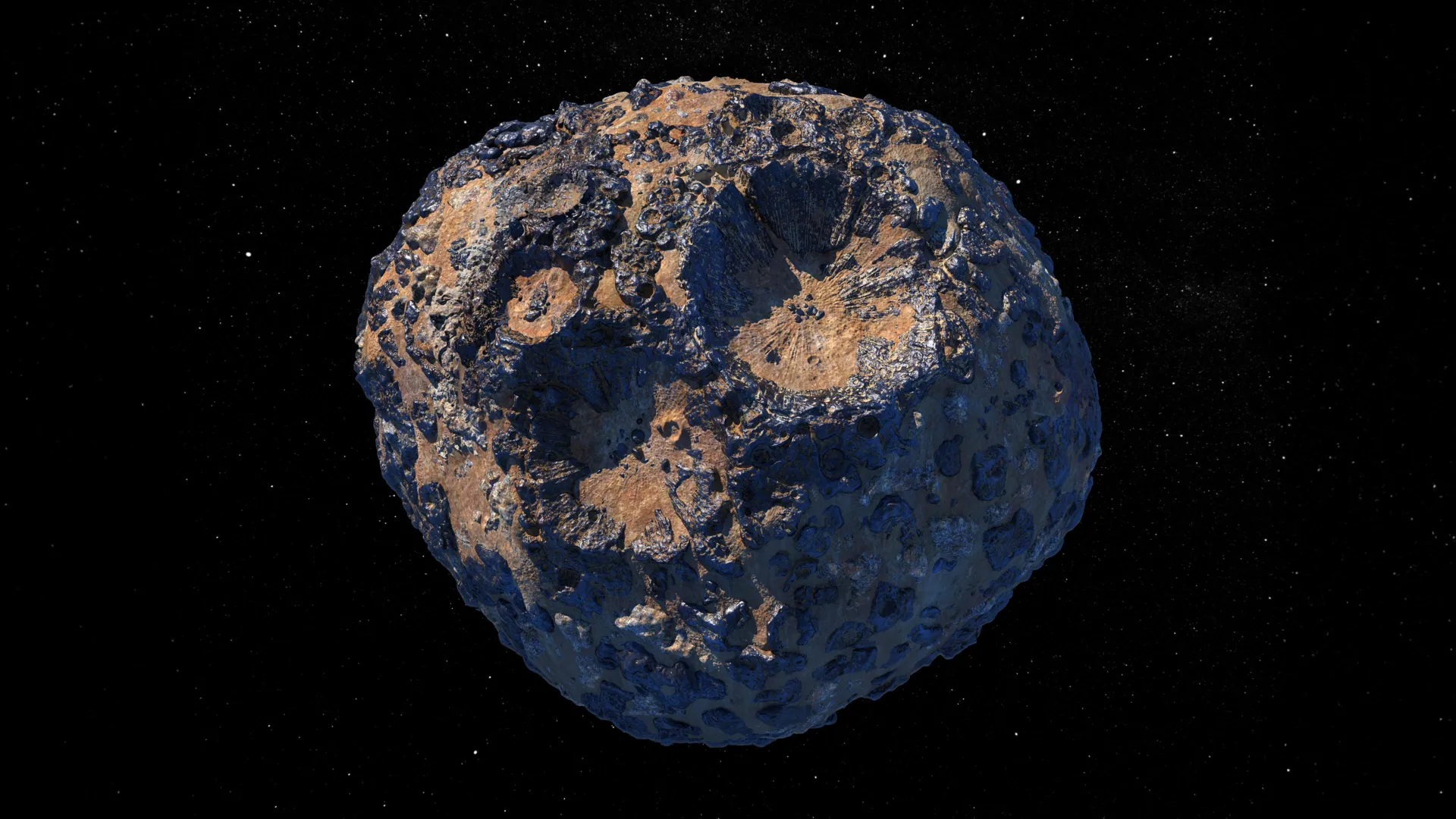
More than two centuries after Asteroid 16 Psyche was first identified, scientists are still trying to understand how Asteroid 16 formed.
Located in the main asteroid belt between Mars and Jupiter, Psyche is the 10th largest asteroid and the largest known object made primarily of metal, with a diameter of about 140 miles. NASA’s Psyche spacecraft is scheduled to arrive in 2029 with the goal of uncovering its origins. Researchers think it could be the remains of an early planet that was torn apart by a massive impact, or perhaps a fragment of a once-layered celestial body that has lost its outer rocky shell.
Other ideas suggest that Psyche may have formed as a metal-rich object to begin with, or that it may have become a mixture of rock and metal after repeated collisions with other asteroids. Each possibility tells a different story about how planets formed in the early solar system.
Simulate a crater to reveal Psyche’s interior
To explore these possibilities, scientists at the University of Arizona’s Lunar and Planetary Institute created a simulation to understand how the large crater near Psyche’s north pole formed. Their findings, published in JGR Planets, provide predictions that will help researchers interpret data collected by NASA’s Psych missions when it arrives. By combining these simulations with real-world observations, scientists hope to eventually figure out what Psyche is made of.
“Large impact basins and craters have been drilled deep into the asteroid, giving us clues about what its interior is made of,” said Namya Baijal, a doctoral candidate at LPL and lead author of the paper. “By simulating the formation of one of the largest craters, we were able to make testable predictions about Psyche’s overall composition upon the spacecraft’s arrival.”
Metal-rich asteroids make up less than 10% of the main belt, but Psyche is the largest of them. Still, researchers will need direct measurements of the spacecraft to understand how the metal is distributed throughout its interior.
Why porosity is important in asteroid collisions
“One of our main findings is that porosity, or the amount of empty space inside the asteroid, plays an important role in how these craters form,” Baijal said. “Porosity is often ignored because it is difficult to include in models, but our simulations show that it can have a significant impact on the impact process and the shape of the crater left behind.”
Asteroids with more internal voids tend to absorb impact energy more effectively, resulting in deeper and steeper craters and less debris scattered on the surface. By comparing the characteristics of simulated craters with those observed by spacecraft, scientists can test whether Psyche’s interior is layered, with distinct regions of metal and rock, or a more chaotic mixture of materials.
Clues to planet formation in the early solar system
The research team compares approaches when investigating the remains of an abandoned pizza shop. Psyche and other main-belt asteroids are thought to be leftover building blocks from planet formation. “Although the cooks are long gone, we can infer how the pizza was made by examining what was left behind, such as the oven, scraps of dough, and toppings,” says Eric Asforg, a professor at LPL and co-author of the study. “We won’t be able to reach the cores of Earth, Mars, or Venus, but we might be able to reach the cores of early asteroids.”
If Psyche turns out to be the exposed core of a former planet that has been stripped of its outer layers, it would provide valuable insight into the intense stages of planetary evolution that are impossible to observe directly.
“We tested two major internal structures of Psyche,” Beichal said. “One is a layered structure with a metallic core and a thin rocky mantle, likely formed when the outer layer is stripped away by a violent impact. The other is a homogeneous mixture of metals and silicates, produced by a more catastrophic impact where everything is mixed together, like the metal-rich meteorites found on Earth.”
Modeling major psychological effects
The researchers built a 3D representation of Psyche using a detailed geometric model based on telescope data, reproducing the formation of a large crater about 30 miles wide and 3 miles deep. In their simulations, the asteroid struck at a speed typical of the asteroid belt, about 3 miles per second. They tested different impactor sizes and compared two internal structure models (a metal core and a mixed rock-metal model) to see which one best matched the observed crater.
“We found that an impactor about three miles in diameter would produce a crater of reasonable dimensions,” Beichal said. “The formation of the crater is consistent with both scenarios of Psyche’s composition.”
Unlike planets, many asteroids are not solid. Instead, they often contain damaged material or empty space from past collisions. By including porosity in their simulations, the researchers showed that porosity has a significant impact on crater formation and post-impact debris distribution.
“By rigorously addressing Psyche’s shape, porosity, and composition, this study represents a real watershed in our ability to realistically simulate impacts with a unique type of asteroid,” said Adine Denton, a postdoctoral fellow and another co-author of the study.
NASA’s spiritual mission and future developments
The Psyche spacecraft is equipped to measure the asteroid’s surface, gravity, magnetic field, and composition. In addition to the crater’s shape, the simulation also predicts other features scientists can look for, such as changes in density caused by shocks compressing the interior and the spread of metal-rich debris across the surface.
“When the spacecraft arrives at Psyche in a few years, the geochemists, geologists and model makers on the team will all be looking at the same object and trying to interpret what we see,” Asfaug said. “This initiative gives us a head start.”
The mission is led by Arizona State University, with Lindy Elkins Tanton of the University of California, Berkeley, serving as principal investigator. NASA’s Jet Propulsion Laboratory, a division of the California Institute of Technology in Pasadena, manages mission operations, systems engineering, and testing. The spacecraft platform was built by Maxar Technologies (now Intuitive Machines) of Palo Alto, California.
Psyche is the 14th mission selected under NASA’s Discovery Program, managed by NASA’s Marshall Space Flight Center in Huntsville, Alabama. NASA’s Launch Services Program in Kennedy was responsible for the launch.
