


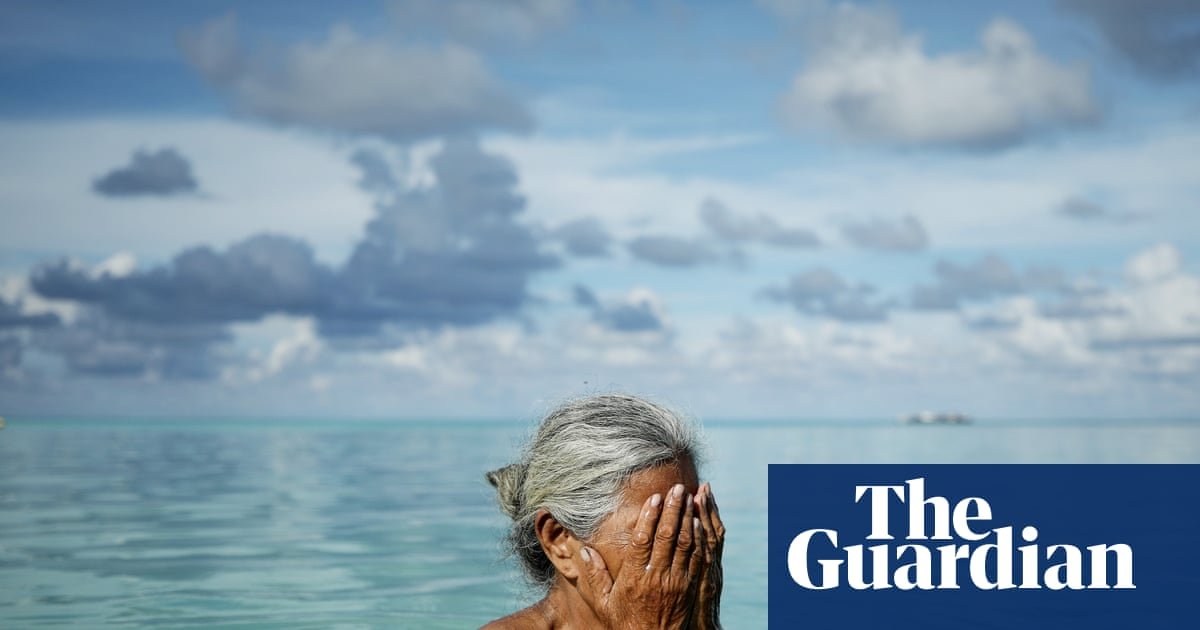
Countries are being “held hostage” by their dependence on fossil fuels, the former UN climate chief has warned, describing the health impacts of climate change as the “mother of all injustices”.
International climate negotiator Christiana Figueres, who helped bring about the Paris Agreement signed in 2016, made the comments as she was announced on Wednesday as co-chair of a Lancet commission investigating how rising sea levels are reshaping health, well-being and inequality.
The Lancet Commission is an international collaboration that analyzes major global health issues and influences policy. The commission will consider legal frameworks to hold countries accountable for the health damage caused by rising sea levels. A report is expected by September 2027.
Although the timing of the announcement in the midst of the US and Israel’s war against Iran is coincidental, Figueres said the fuel crisis is “dramatic evidence” of the global dependence on fossil fuels that is causing geopolitical instability and the health consequences the commission will investigate.
Tepuka Island in Tuvalu is under threat. Photo: Bianca Vitale/Greenpeace
The commission was established after Pacific Island health ministers called for greater global focus on sea level rise as an issue of health and justice, as well as the environment.
Rising sea levels will contaminate drinking water, damage food supplies, and displace entire communities.
Sea level rise is not uniform and is influenced by changes in weather patterns, ocean currents, and gravity as ice sheets melt. The rise is greater in the ocean farthest from the ice sheet and is higher than the global average for the Pacific Ocean. That means island nations including Tuvalu, Kiribati and Fiji could become uninhabitable within decades.
Many low-lying cities are also under threat, including New Orleans in the US, Cardiff and London in the UK, and Amsterdam in the Netherlands.
A study published in the international scientific journal Nature in March found that sea levels had been underestimated due to inaccurate modeling. In some parts of the Global South, including Southeast Asia and the Indo-Pacific, it could be 100 to 150 centimeters higher than previously thought.
Most of Tuvalu is less than 3 meters above sea level. Photo: Bianca Vitale/Greenpeace
“Those of us in the climate change community are very guilty of explaining things in too esoteric terms, as if climate change is something that isn’t happening right now,” Figueras said.
“So looking at these issues from a health perspective, a dignity perspective, a livelihood perspective, a continuity perspective of identity and culture provides a much better context for the challenge of reducing emissions, because you understand that this is actually about the human experience on this planet…
“From a health perspective, all land bordering the ocean is becoming salinized, impacting drinking water, sanitation and food security.
“It’s happening now, it’s a health crisis and it’s the root of all injustice.”
Figueres said the commission will consider the intergenerational trauma and inequalities caused by displacement.
“Can you imagine the pain of having to leave behind the bones of your ancestors and evacuate to protect the future of your children?” she said.
“This is the pain that the Pacific Islands are already experiencing. It is a pain that cannot be expressed in economic terms. The grief is enormous.”
She said young people are “growing up understanding that they are already in a world ravaged by climate change.”
Children at a school on the outskirts of Port Vila, the capital of Vanuatu. The country is lobbying the United Nations to uphold a landmark International Court of Justice ruling on climate damage. Photo: Hilaire Bure/AFP/Getty Images
“How many of them don’t want to have children because they worry about the conditions in which their children will grow up and live.”
The commission will consider how to hold some of the biggest polluters to account for the irreversible damage being caused to countries that contribute the least to climate change. It will assess existing legal instruments, identify gaps in protection, and consider new ways to protect the health and justice of struggling communities.
Double quotes Companies need to understand and reduce emissions to stay in businessChristiana Figueres
A landmark advisory opinion issued by the International Court of Justice (ICJ) in 2025 found that countries have a legal obligation to prevent climate harm and that failure to do so may result in them being required to pay reparations or other forms of compensation.
Although non-binding, Figueras said the findings will likely increase the number of climate change lawsuits and lead to landmark claims.
“The very fact that the ICJ has issued a clear opinion is already an important first step in terms of legal implications,” she said.
Vanuatu will lead a UN General Assembly resolution supporting the ICJ’s position in May, which, if passed, will help shape how the findings are implemented globally.
A sand embankment along the coastline. Photo: Tuvalu Coastal Adaptation Project
But UN experts have warned of attempts by some countries to block the resolution from even being considered, and of growing resistance to explicit references to legal responsibility for fossil fuels and climate change.
Figueres said legally binding agreements alone are not enough to address the health consequences of the climate crisis, recalling how Canada pulled out of the Kyoto accords on the eve of facing billions in fines for failing to meet emissions targets.
“They just sent me a letter and said, ‘Director-General, Canada is now out of the Kyoto Protocol.'” So just because there is a legally binding agreement, there is no guarantee that any country will comply. ”
Nanumea breakwater. Tuvalu is the first country in the Pacific region to access climate finance from the United Nations-backed Green Climate Fund. Photo: Tuvalu Coastal Adaptation Project
She said she believes change is likely to come through a combination of legal pressure, scientific evidence and what she describes as an appeal to the “enlightened self-interest” of governments and businesses.
“That’s why it’s important to clarify the consequences of inaction,” Figueres said, adding: “Companies need to understand that they need to reduce their emissions to stay in business. Governments need to understand that they need to reduce their emissions to stabilize their economies and protect their citizens.”
“I just think that enlightened self-interest based on scientific facts – which is what the commission is proposing – is a much more effective path to reducing emissions than a legally binding agreement that anyone can leave.”
