


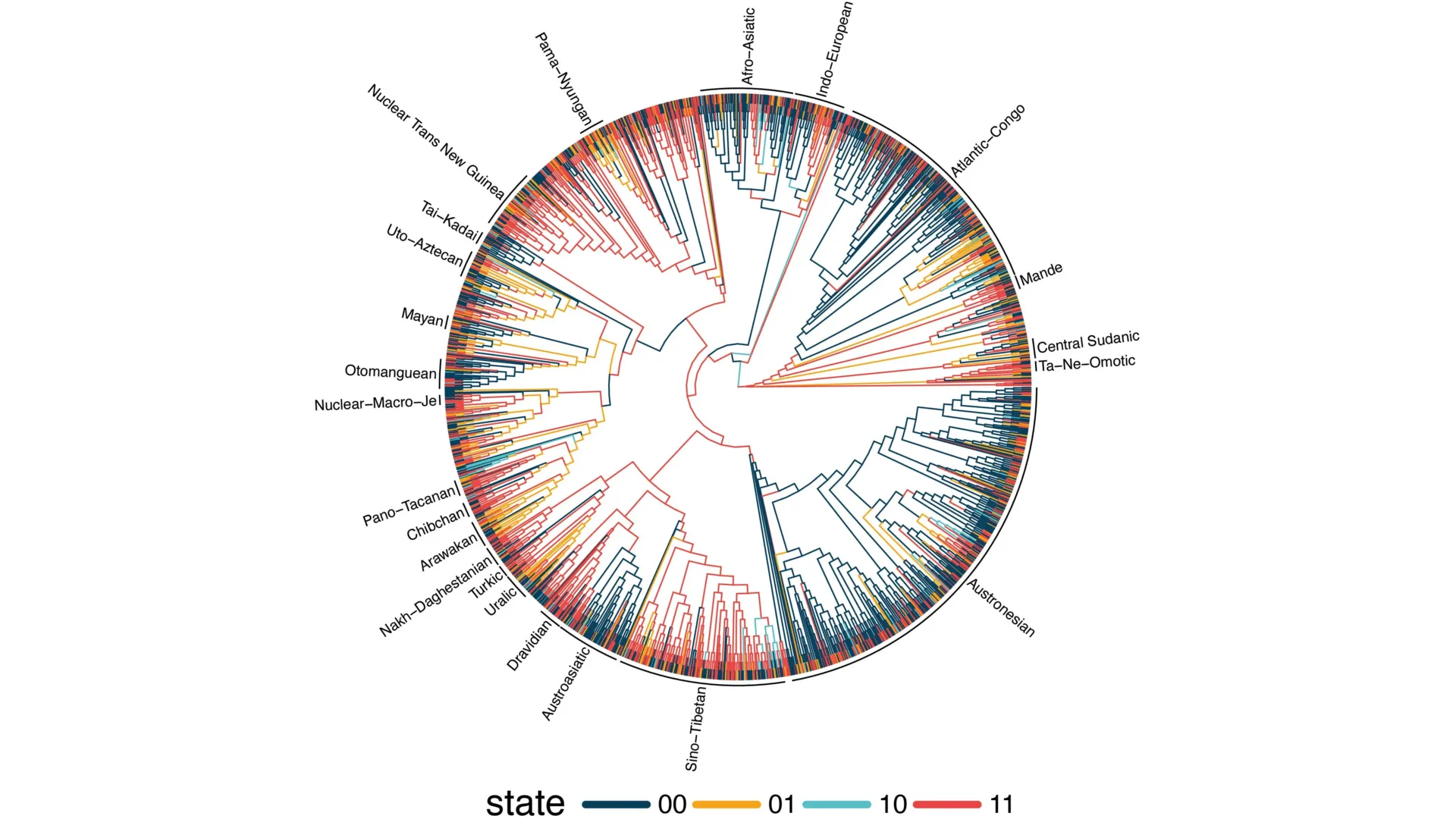
Despite the great diversity of languages spoken around the world, certain grammatical patterns continue to emerge. A new study finds that about a third of long-standing “linguistic universals” are supported by strong statistical evidence when tested using modern evolutionary methods.
An international research team led by Annemarie Verkerk (Saarland University) and Russell D. Gray (Max Planck Institute for Evolutionary Anthropology) analyzed 191 proposed universal words using Grambank, the largest database of grammatical features ever collected. Their dataset covered over 1,700 languages.
In previous studies, linguists tried to avoid similarities between related or nearby languages by selecting samples from distant regions. Although this approach is helpful, it does not completely eliminate hidden connections between languages. It can also weaken statistical results and fail to reveal how language changes over time.
To address this, the researchers used a Bayesian spatial phylogenetic analysis that accounts for both common ancestry and geographic influences. This approach provides a much higher level of statistical rigor than most previous studies.
Languages do not evolve randomly
“It’s interesting that in the face of the huge diversity of languages, languages don’t evolve randomly,” Verkerk says. “We are pleased that the different types of analyzes we conducted converged on very similar results. This suggests that language change must be a central element in explaining universality.”
The findings show strong support for several repeating patterns. These include word order preferences, such as whether the verb comes before or after the object, and hierarchical structure, such as how grammatical relationships are marked within a sentence.
Importantly, these patterns appear repeatedly across unrelated languages in different parts of the world. This repetition suggests that there are deep constraints on the way humans organize language.
Shared pressure shapes language structure
Lead author Russell Gray recalled: “We debated whether to write this as a glass-half-empty paper, i.e., ‘Look at how many of the proposed universals don’t apply,’ or a glass-half-full paper, ‘There is robust statistical support for about a third.'” In the end, we decided to focus on repeatedly evolving patterns and show that shared cognitive and communicative pressures push language toward a limited number of preferred grammatical solutions.
By identifying which universals really stand up to rigorous testing, this study will help focus future research. It points scientists to the underlying cognitive and communicative forces that shape human language.
