


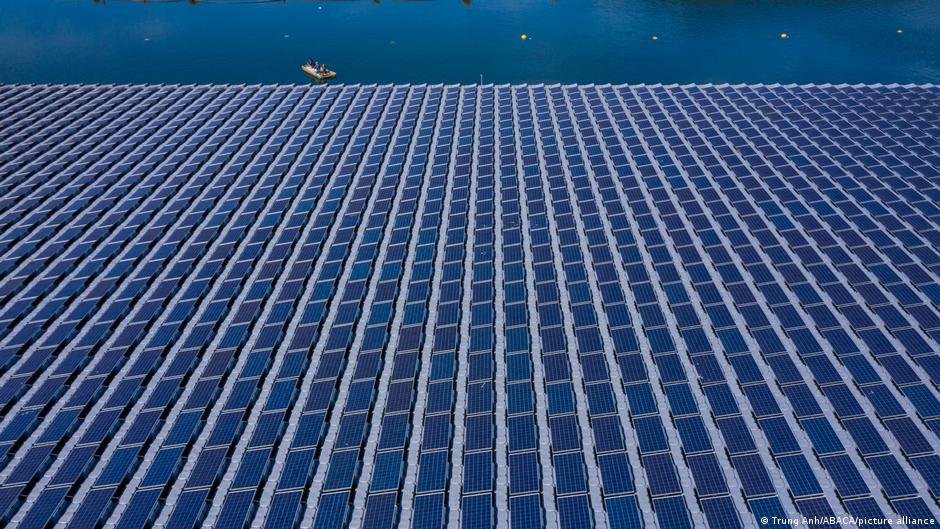
Since the beginning of this century, the expansion of solar power has exceeded expectations more than any other energy source.
Once extremely expensive and only used in remote locations, space travel, or pocket calculators, today’s solar modules are easy to set up and operate, and are generating cheap electricity around the world.
Global solar energy capacity has increased rapidly over the past decade.
– 228 GW in 2015, providing 1% of the world’s electricity
– 759 GW in 2020, or about 3% of global energy demand
– According to estimates, 2,919 GW in 2025 – Currently, solar power supplies about 10% of the world’s energy, ahead of nuclear power by 9%.
Energy sources are still increasing rapidly, and if growth continues at the same pace, global capacity could reach 9,000 GW by 2030, enough to meet more than 20% of global energy needs.
China takes the lead
When it comes to solar power generation capacity, China is by far the world’s number one. According to China’s energy authorities, the country will install 315GW of new panels in 2025, bringing the total capacity to about 1,300GW. Currently, more than 80% of all solar panels are produced in China.
Currently, 11% of China’s electricity comes from solar energy, according to data from Taipei-based LowCarbonPower. Over the past decade, the share of highly polluting coal-fired power generation has fallen from 70% to 56%. This is largely due to the country’s strong expansion of renewable energy, particularly solar and wind power.
EU expands solar power network
With a power generation capacity of 406 GW, the European Union ranks second in the world in terms of solar energy expansion. In the EU, solar energy meets around 13% of the region’s electricity needs. Coal accounted for just 9%, a significant drop from 2015, when it still generated a quarter of the EU’s electricity.
Leading the way in Europe are Greece, Cyprus, Spain and Hungary, each generating more than 20% of their electricity from solar. Even in Germany, where there is less sunlight, the figure is 18%.
In terms of installed solar modules, Germany is the European leader with 119 GW, followed by Spain with 56 GW.
Despite President Trump, US solar power ranks third
Even though renewable energy has been undermined by the Trump administration, the United States still ranks third in the world when it comes to solar energy expansion.
With 267 GW, the United States can supply about 8% of its total electricity demand. In 2015, it was just 1%. Over the past decade, the share of coal-fired power generation has halved from 34% in 2015 to 17% in 2025.
Solar power is also growing in India, Pakistan and Brazil.
India ranks fourth, with 136GW of solar power, which currently generates about 8% of the electricity for a population of 1.45 billion. Japan follows in fifth place with 103 GW of solar capacity, covering 11% of electricity demand.
Fighting the climate crisis in Rio’s favelas
To view this video, please enable JavaScript and consider upgrading to a web browser that supports HTML5 video.
On the other side of the Pacific Ocean, Brazil is also increasing its solar power generation capacity, and is now able to generate approximately 10% of the country’s electricity supply. Combined with hydro, wind and biomass, 88% of the country’s electricity comes from renewable sources.
In 2015, Pakistan and South Africa each produced less than 1% of their electricity from solar panels. Ten years later, it rose to 20% and 10%, respectively.
Electricity generated from solar power becomes significantly cheaper
In just one hour, sunlight hitting the earth provides more energy than humans need in a year. Installing solar panels on less than 1% of the world’s surface could meet the world’s entire energy needs. And solar power is getting cheaper and cheaper.
More efficient modules and mass production have reduced prices by about 90%. This means that solar power is the cheapest form of electricity in many parts of the world.
In sunny regions, large solar parks can generate electricity for about 1 euro cent (1 U.S. cent) per kilowatt-hour. In Germany it’s 4-5 cents.
Electricity from rooftop solar panels is often significantly cheaper than electricity from the general grid, and in many European countries is currently less than half the average electricity price. Storing solar energy in a battery costs an additional 2 to 3 cents per kilowatt-hour.
Current nuclear power prices range from 14 to 49 euro cents (16 to 56 US cents) per kilowatt hour, according to data from Germany’s Fraunhofer Institute for Solar Energy Systems. Coal power generation costs between 15 and 29 cents per kilowatt hour, while natural gas costs between 15 and 33 cents.
Solar power generation will also change transportation and heating
In 2024, power plants with a total capacity of 632 GW will be added to the global power grid. Of this, 72% comes from solar power, followed by 18% from wind power, 4% from gas, 3% from coal, 2% from hydropower, and 1% from nuclear power.
Cheap solar power is also changing the way we heat our homes and move around. Electric cars cost significantly less to run when charged with solar energy from your home’s roof panels. In Germany, you can save more than 80% in total compared to diesel or petrol cars.
Also, using heat pumps to keep buildings warm is generally more advantageous than heating systems that run on oil or gas. In the EU, households can save more than 30% on heating costs. If the electricity to run the heat pump is provided by the owner’s own solar panels, the cost is further reduced.
Sunlight is predicted to become the world’s most important energy source
Many early forecasts significantly underestimated the growth of the solar industry. The International Energy Agency said in its 2020 Annual World Energy Analysis that global solar power expansion will reach approximately 120GW in 2024. In fact, a whopping 597GW was installed that year, almost five times more than predicted.
Energy experts now believe that solar power will eventually become the world’s most important power source. However, it remains to be seen how quickly this change will occur.
Researchers at Finland’s Lappeenranta Lahti University of Technology have uncovered what a cost-effective global energy supply would look like. Based on their model, 76% of the world’s energy would come from sunlight. Wind power will account for a further 20%, with the remainder coming from hydropower, biomass and geothermal energy.
Future infrastructure and digitalization challenges
Industry experts say global electricity demand is likely to more than double by 2050, driven in part by the shift to electric cars and the widespread use of electric heat pumps.
This will require expanding the power grid, including solar power generation, and developing storage batteries for nighttime use. However, the world as a whole will need significantly more storage capacity. Electric vehicle batteries could eventually serve as intermediate storage to supplement the power grid.
Rapid digitization is also important for cost-effective power supply, allowing optimal coordination of power consumption and generation. This would allow electric vehicles to start charging automatically, for example, if the supply of cheap solar power becomes particularly high in the power grid.
This article was originally published in German.
Germany: the world’s first floating vertical solar power plant
To view this video, please enable JavaScript and consider upgrading to a web browser that supports HTML5 video.
