


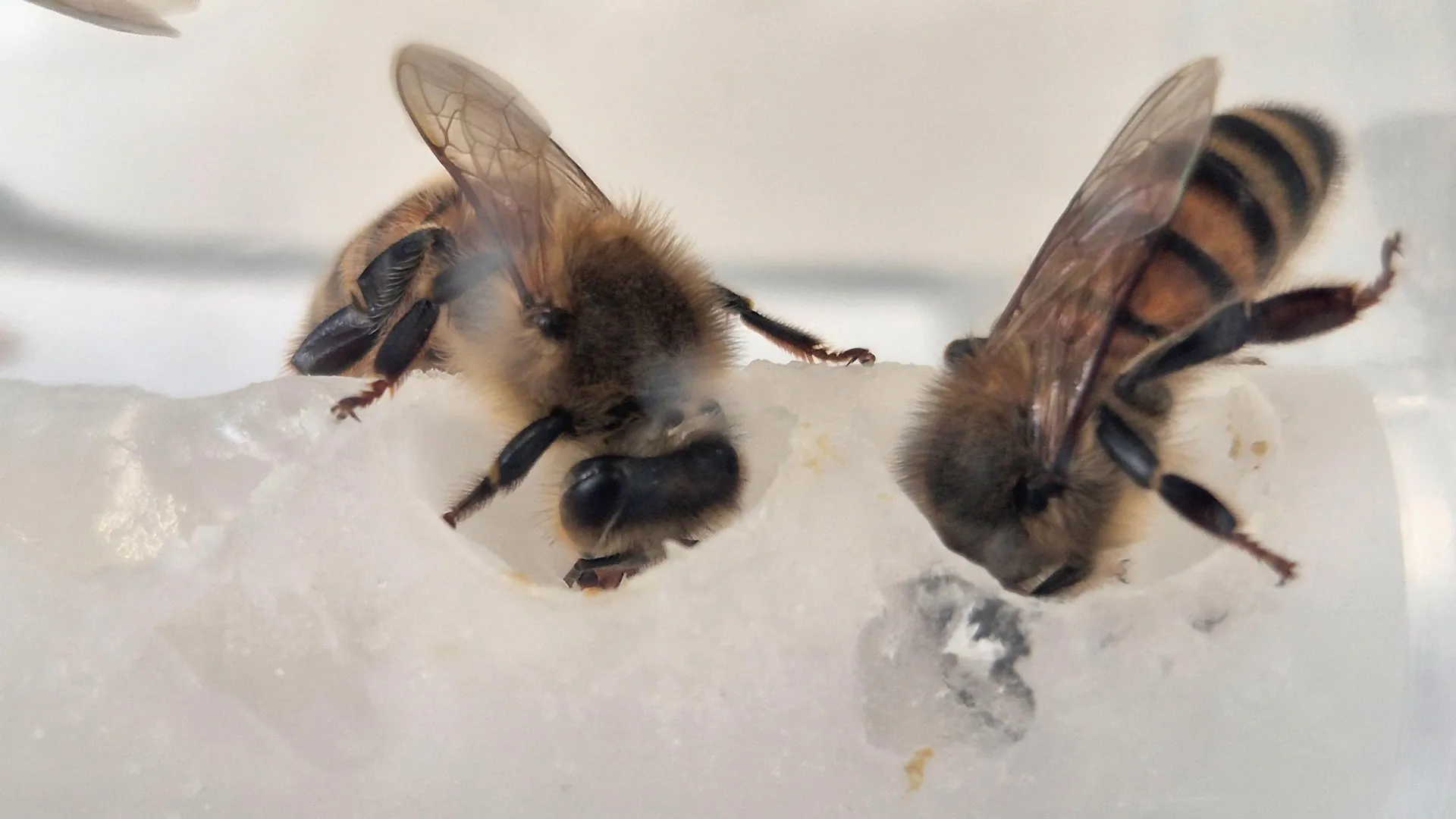
A research team led by the University of Oxford has developed a breakthrough nutritional supplement that could help reverse the alarming decline in bees.
Scientists, in collaboration with the Royal Botanic Gardens, Kew, the University of Greenwich and the Technical University of Denmark, have designed a diet that mimics the key nutrients bees normally get from pollen.
When tested, colonies given this supplement produced up to 15 times more young. The research results were published in a magazine nature.
Bees are hungry for proper nutrients
Bees rely on pollen as their main food source. It contains essential lipids called sterols, which are important for growth and development.
However, climate change and intensive agriculture have reduced the variety of flowers that bees rely on. As a result, bees increasingly lose vital nutrients.
Beekeepers often use artificial pollen substitutes made from protein powder, sugar, and oil. Although these provide calories, they lack the sterols that bees need, leaving the colony undernourished.
Lab-made solution using artificial yeast
To fill this gap, researchers engineered the yeast Yarrowia lipolytica to produce a precise mixture of six essential sterols.
They added the yeast to honey bee diets and tested it over a three-month period in a controlled greenhouse experiment. The closed setup ensured that the bees ate only the experimental food.
Colonies grow faster and stay healthier
The results were dramatic. Colonies fed the enriched diet produced up to 15 times more larvae that reached the pupal stage compared to colonies fed the standard diet.
They also continued to raise the chicks throughout the study period. Sterol-free colonies stopped producing chicks after approximately 90 days.
Even more surprisingly, the nutritional profile of the larvae matched that of naturally feeding bees, suggesting that this supplement closely mimics the nutrition of real pollen.
Scientists say this could be a game changer
Senior author Professor Geraldine Wright, Department of Biology, University of Oxford, said: “Our study shows how synthetic biology can be harnessed to solve real-world ecological challenges. Most of the pollen sterols used by bees are not naturally available in quantities that can be harvested on a commercial scale, and it would otherwise be impossible to create a nutritionally complete feed to replace pollen.”
Lead author Dr Eleanor Moore (then at the University of Oxford, now at Delft University of Technology) added: “For honeybees, the difference between sterol-rich diets and conventional bee diets is, for humans, a balanced and nutritionally complete diet. It’s comparable to the difference between consuming a complete diet and one lacking essential nutrients such as essential fatty acids. Using precision fermentation, we are now able to provide bees with tailored feeds that are nutritionally complete at the molecular level. ”
Decoding honey bee nutrition
To find out what bees actually need, researchers analyzed the tissues of pupae and adults. This required extremely delicate experimental work, including dissecting individual nurse bees.
They identified six important sterols that govern honeybee biology: 24-methylenecholesterol, campesterol, isofucosterol, β-sitosterol, cholesterol, and desmosterol.
Scalable with CRISPR and yeast
The research team used CRISPR-Cas9 gene editing to program Yarrowia lipolytica to efficiently produce these sterols.
This yeast was chosen because it naturally produces lipids, is safe for use in food, and can be scaled up for industrial production. The final supplement is made by growing yeast in a bioreactor and drying it into a powder.
Why this matters for food and agriculture
Bees contribute to the production of more than 70% of the world’s major crops. However, their people are under severe pressure from nutritional deficiencies, climate change, parasites, disease, and pesticides.
Annual colony losses in the United States have hovered in the 40-50% range in recent years and could reach 60-70% by 2025.
This new supplement could boost bee health without increasing competition for limited wildflowers. There is also a possibility that it will evolve into a complete nutritional food.
Helping wild bees too
Co-author Professor Phil Stevenson (RBG Kew Institute of Natural Resources, University of Greenwich) added: “Bees are very important pollinators for the production of crops such as almonds, apples and cherries, so they are present in very large numbers in some agricultural areas and can put pressure on limited wildflowers. Our artificial supplement could therefore benefit wild bee species by reducing competition for limited pollen supplies.”
Breakthrough possibilities for beekeepers
“We rely on honey bees to pollinate every third bite of our food, but bees face many stressors. Good nutrition is one way to increase resilience to these threats, and as bees’ natural forage is reduced, we need to be more resilient to these threats. “This breakthrough discovery of a critical phytonutrient that can be included in feed supplements has tremendous potential to improve colony survival and, in turn, the outcomes of beekeeping operations on which we depend for food production.”
what happens next
Further large-scale field trials are needed to confirm long-term benefits. If successful, the supplement could reach farmers within two years.
The same technology could be applied to support other pollinators and farmed insects, opening new avenues for sustainable agriculture.
