


An international team of scientists has discovered a surprising molecular strategy used by a group of rare land plants. The discovery could one day help researchers redesign important crops such as wheat and rice to convert sunlight into food much more efficiently.
The study was led by scientists from the Boyce Thompson Institute (BTI), Cornell University, and the University of Edinburgh. This addresses a major limitation in agriculture involving Rubisco, an enzyme that captures carbon dioxide from the air during photosynthesis.
Rubisco and the limits of photosynthesis
Rubisco plays a central role in life on Earth, but it has a major flaw. Enzymes work slowly and interact more easily with oxygen rather than carbon dioxide, which wastes energy and reduces efficient plant growth.
“Rubisco is probably the most important enzyme on earth because it is the gateway for almost all the carbon in the food we eat,” said BTI’s Associate Professor Feiwei Li, who co-led the study. “However, it is slow and easily distracted by oxygen, which wastes energy and limits the efficiency of plant growth.”
Over time, some organisms have evolved ways to overcome this inefficiency. For example, many types of algae arrange Rubisco inside small structures within their cells called pyrenoids. These microscopic compartments concentrate carbon dioxide around the enzymes, allowing them to function more efficiently.
Researchers have long wanted to introduce this type of carbon enrichment system to food crops that do not naturally have pyrenoids. However, transferring complex mechanisms from algae to land plants has proven extremely difficult.
Hornwort plants reveal unexpected strategies
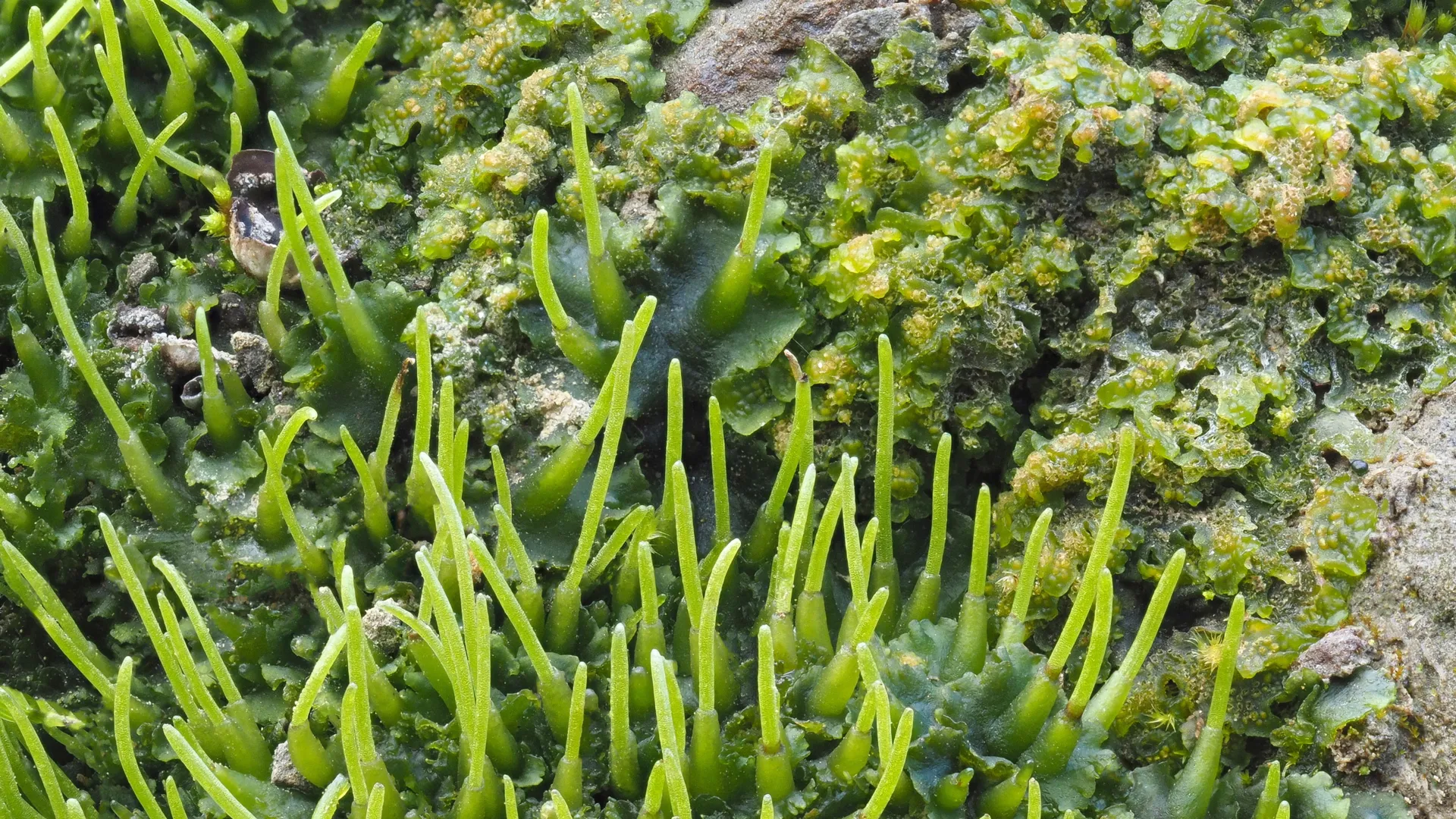
When scientists examined hornworts, they made a groundbreaking discovery. Hornworts are the only land plants known to contain carbon-enriched compartments similar to those found in algae. Because hornworts share a closer evolutionary relationship with crop plants than with algae, the researchers thought their molecular tools might be more transferable.
What they discovered turned out to be very different from what they expected.
“We had assumed that hornworts would use something similar to what algae use, a different protein that collects Rubisco,” said Tanner Robison, a graduate student working with Lee and co-lead author of the paper. “Instead, we discovered that they modified Rubisco itself to do the job.”
RbcS-STAR protein and Rubisco clustering
The key element is a rare protein component that the researchers named RbcS-STAR. Rubisco itself is made up of large and small protein pieces. In hornworts, one version of the small component contains an additional segment called the STAR region.
This additional tail acts like molecular Velcro. This causes the Rubisco proteins to stick together and form cluster structures within the cell.
To determine whether STAR works in other plants, the researchers conducted several experiments. They first introduced the RbcS-STAR component into a closely related hornwort species that does not naturally form pyrenoids. After the change, Rubisco began to spread throughout the cell, forming concentrated structures similar to pyrenoids.
The scientists then tested the same idea in Arabidopsis, a plant widely used in laboratory research. Again, Rubisco gathered in dense compartments inside the chloroplast.
“We had previously tried adding just the STAR tail to the Arabidopsis landrace Rubisco and it caused the same cluster effect,” said Professor Alistair McCormick from the University of Edinburgh, who co-led the study. “This shows that STAR is a true powerhouse. STAR is a modular tool that works across a variety of plant systems.”
A potential path to more efficient crops
The fact that this mechanism operates across a variety of plant species makes this discovery particularly important for agriculture. This suggests that scientists may be able to induce clustering of Rubisco within crop plants simply by adding this generic Velcro component.
However, the researchers stress that more research is still needed. In addition to clustering Rubisco, plants also need to efficiently deliver carbon dioxide to enzymes.
“We’ve built a Rubisco house, but unless we update the HVAC, it won’t be an efficient house,” said Laura Gunn, an assistant professor at Cornell University who co-led the study. The team is currently working to address this challenge.
A step towards more sustainable food production
Still, the discovery represents an important advance in efforts to improve photosynthesis. Increasing photosynthetic efficiency even slightly has the potential to increase crop yields while reducing the environmental impact of agriculture. This goal is becoming increasingly important as scientists seek ways to sustainably produce more food for the world’s growing population.
“This study shows that nature is already experimenting with solutions that we can learn from,” Lee said. “Our job is to understand these solutions well enough to apply them where they are needed most: on the crops that feed the world.”
The study was published in the journal Science with similar contributions from four young scientists: Tanner A. Robison, Yuwei Mao, Zhen Guo Oh, and Warren SL Ang. Corresponding authors are Laura H. Gunn, Alistair J. McCormick, and Fay-Wei Li.
