


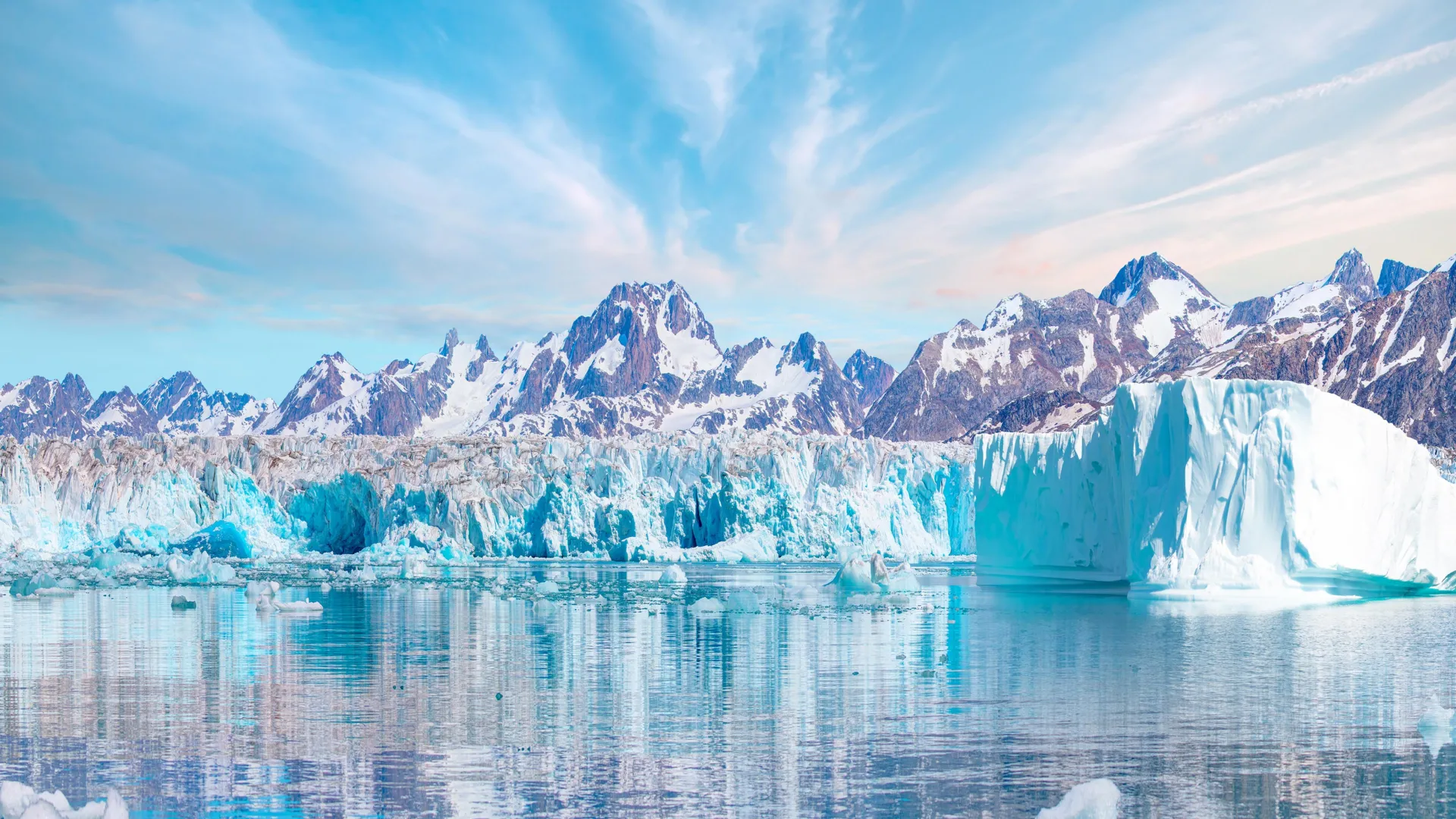
Far beneath the surface of Greenland’s ice sheet, scientists have identified a giant swirling structure resembling a rising plume. These strange geological formations have baffled researchers for more than a decade. Now, scientists at the University of Bergen (UiB) believe they have finally solved the explanation by using a mathematical model similar to the one used to study how Earth’s continents slowly move apart.
A new study proposes that this mysterious plume is generated by thermal convection. This process involves slow circular motion within the ice, caused by temperature differences between deep and shallow layers. Thermal convection is usually associated with very hot material moving within the Earth’s mantle, rather than ice.
“We usually think of ice as a solid substance, so the discovery that parts of the Greenland ice sheet actually undergo heat convection and resemble a pot of pasta is both wild and interesting,” says Professor Andreas Born from the Bjerknes Center for Climate Research and the UiB Department of Earth Sciences.
Born has been studying Northern Hemisphere ice sheets for more than 15 years and is a co-author of the new study.
‘Anomaly of nature’ beneath several kilometers of ice
The idea that convection can occur within ice sheets may seem counterintuitive at first. However, if we consider the properties of ice, we can understand the physics behind it.
“The finding that heat convection can occur within an ice sheet is a little counter to our intuition and expectations. But ice is at least a million times softer than Earth’s mantle, so the physics work out. It’s like a provocative weirdo of nature,” says glaciologist and lead author Robert Roe.
The study has been accepted for publication in the journal cryospherethe editors selected it as a “highlight paper” because of its scientific importance.
Born said the discovery could help scientists refine predictions about the future behavior of Greenland’s ice sheet.
“Our findings could be key to reducing uncertainties in models of future ice sheet mass balance and sea level rise,” he says.
Just because deep ice becomes softer doesn’t automatically mean it melts more easily.
The study suggests that the ice deep in northern Greenland may be about 10 times softer than scientists previously believed. Even so, this does not automatically mean that the ice sheet will melt faster.
“Improving our understanding of the physics of ice is a very important way to have more certainty about the future. But softer ice in itself doesn’t necessarily mean it will melt faster or sea level rise will be higher. More research is needed to fully determine that,” Lo says.
Greenland frequently appears in global headlines due to topics such as mining, geopolitics, and climate change. Lowe emphasizes that the new findings do not predict catastrophic changes in Greenland or elsewhere. Instead, it emphasizes how complex and dynamic ice sheets really are.
“Greenland and its nature are truly special. The ice sheet there is more than 1,000 years old and is the only ice sheet on Earth with a culture and a settled population on its margins,” he says. “The more we learn about the processes hidden inside the ice, the better prepared we will be for the changes that will occur on coastlines around the world.”
About research
Researchers from the University of Bergen (Faculty of Earth Sciences and Bjerknes Center for Climate Research) conducted the study in collaboration with NASA Goddard Space Flight Center, the University of Oxford, and ETH Zurich.
The researchers investigated whether thermal convection could explain the plume-like structures detected deep in the Greenland ice sheet and what it reveals about ice softness and movement.
Their analysis shows that these plume-like features were likely generated by thermal convection, a slow stirring motion inside the ice caused by temperature differences. The results also suggest that the deep ice in northern Greenland may be about 10 times softer than scientists previously assumed.
Because ice softening affects ice sheet flow, this finding could help researchers better predict future sea level rise.
